

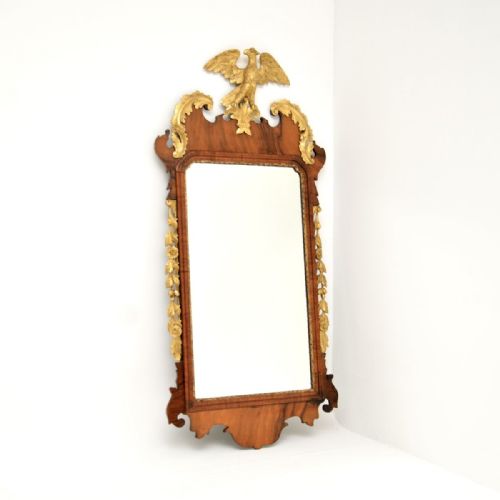

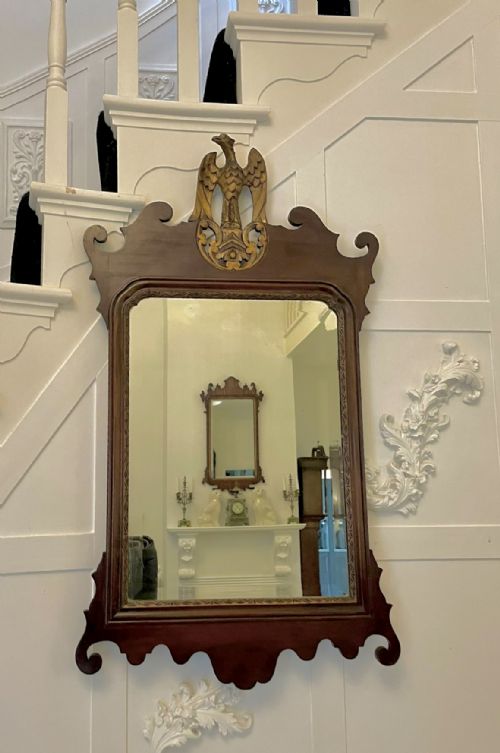


Large Eagle Crest Mirror
These large eagle crest mirrors are bold focal points commanding attention in any room through impressive scale and striking avian ornamentation.
Large Eagle Crest Mirror
A large eagle crest mirror is a substantial wall hanging or overmantel piece defined by a prominent carved bird surmount. You find examples spanning the Regency, Georgian, and Victorian periods, often framed in giltwood or mahogany with circular convex or rectangular mirror glass.
The selection here encompasses various interpretations, from convex wall mirrors featuring gilded eagles to large overmantel mirrors and pier mirrors in revival styles. These objects serve both practical reflective purposes and grand decorative functions within domestic interiors.
Materials and construction methods
Carved wood provides the structural foundation, utilising timber such as mahogany, ebonised wood, and general hardwoods. Artisans applied gesso over the wooden base to create smooth surfaces suitable for fine detail work and subsequent gilding.
Gold leaf and gilding create the brilliant reflective surfaces on the frames and crests, complemented by silvered mirror glass. Craftspeople shaped convex plates and flat plates to fit circular and rectangular frames, sometimes incorporating parcel-gilt highlights on dark wood.
Large Eagle Crest Mirror Retail Price Guide 2026
Typical asking prices for large eagle crest mirror among the pieces listed under this phrase on Sellingantiques today, from the lower quarter to the upper quarter. They describe what is for sale here now, not the wider market.
Listings feature items from the Regency and Georgian periods alongside later 19th century revival styles.
Distinctions in craftsmanship
The finesse of the wood carving separates standard items from exceptional pieces, particularly in the detailed feather work and anatomical proportions of the eagle crest. Crisp relief moulding in the gesso indicates superior artisan skill during the initial preparation stages.
The quality of the gilding and the depth of the original wood grain show through in better preserved examples, reflecting the original materials utilised by makers. Structural integrity of the heavy frames and the clarity of the antique mirror glass also determine the standing of each piece.
William Kent
The Large Eagle Crest Mirror Glossary
- Convex mirror
- A round mirror with a curved glass surface that reflects a wide, distorted field of vision. These pieces often feature spherical balls around the frame perimeter.
- Giltwood
- Timber that has been coated with a thin layer of gold leaf or gold paint. This finish produces a bright metallic appearance characteristic of formal period furnishings.
- Gesso
- A plaster mixture applied to wood frames to provide a smooth base for gilding and carving. It allows craftsmen to achieve sharp decorative details.
- Overmantel mirror
- A large horizontal mirror designed specifically to hang above a fireplace mantelpiece. They anchor the architectural space of a room.
- Parcel-gilt
- Partially gilded woodwork where specific decorative areas are covered in gold leaf while the underlying natural wood remains exposed. This technique highlights carved details against dark timber.
Large Eagle Crest Mirror: Frequently Asked Questions
How do I hang a heavy eagle crest mirror?
These heavy frames require robust wall fixings anchored directly into structural studs or masonry to support the substantial weight safely.
Professional mirror hangers should assess the wall type and utilise appropriate hardware designed for antique giltwood and wood pieces.
Where should I place an overmantel mirror?
Positioning the piece directly above a fireplace mantel creates a traditional focal point that reflects light and opens up the surrounding space.
Ensure the width of the mirror aligns harmoniously with the proportions of the mantelpiece and the wall area above it.
What is a convex mirror used for?
Convex glass provides a panoramic view of an entire room, which historically allowed people to monitor activity from a single vantage point.
These circular mirrors function primarily as decorative art pieces that introduce unusual perspective and brightness to dark corners.
How do I tell a Regency mirror apart?
Regency pieces often incorporate bold classical motifs, ebonized reeded details, and circular convex formats topped with spread eagles.
Examining the construction materials, backboards, and fastener types helps confirm the early nineteenth century origin.