


Large Decorative Asian Vases
Large decorative Asian vases bring commanding scale and rich cultural detail into a room, spanning bronze, porcelain, and cloisonné enamel.
Large Decorative Asian Vases
Large decorative Asian vases encompass substantial vessels originating from China and Japan, taking forms such as baluster vases, palace vases, temple vases, and floor vases. These pieces arrive from various eras, including the Victorian period and the early twentieth century, alongside specific epochs like the Meiji period and the Qing dynasty.
Buyers encounter numerous pairs and individual statement pieces designed for display, sometimes adapted into table lamps or paired with wooden bases. The selection leans heavily towards Japanese Satsuma ware, Imari porcelain, and Chinese bronze or cloisonné enamel work.
Vessels range from modest height increments up to monumental palace proportions exceeding eighty centimetres. Forms include traditional baluster silhouettes, altar vessels, lidded urns, and woven ikebana baskets.
Materials and Techniques
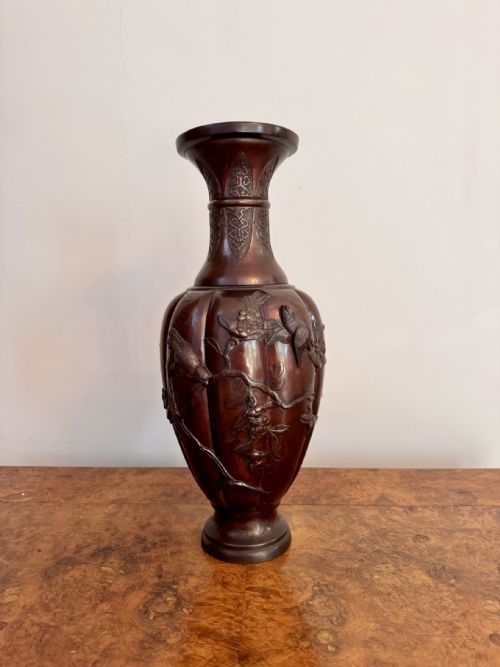
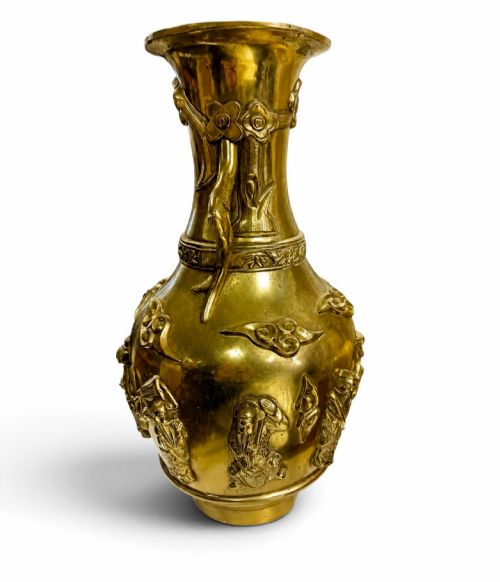
Metal vessels utilise bronze, copper-alloy, and brass, often shaped through casting and finished with champleve or cloisonné enamel where fine wire cells hold coloured vitreous pastes. Artisans also apply gold leaf and gilt highlights to enrich metallic surfaces.
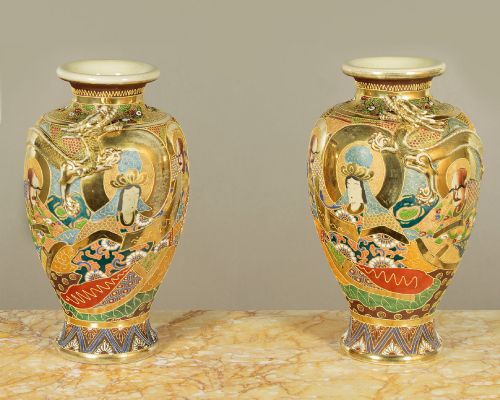
Ceramic pieces combine porcelain and earthenware bodies with hand-painted mineral pigments, employing the Imari palette, rose medallion designs, or intricate Satsuma crackle-glaze enamels. Skilled hands execute high-relief modelling and delicate brushwork depicting figures, birds, and floral motifs.
Several monumental vessels feature fierce dragons and mythical Ho-o birds standing guard over quiet modern drawing rooms.
Distinctions in Quality
The standard of a piece rests upon the crispness of its cast metal details, the precision of cloisonné wirework, and the complexity of the hand-painted palette. Superior examples display dense, disciplined brushwork and harmonious enamel depth rather than hurried, repetitive application.
Proportion and physical presence dictate valuation among large formats, where monumental pairs maintain symmetry and weight distribution appropriate to their scale. Intact base marks, original lids, and well-preserved gilding elevate the standing of a vessel.
The Large Decorative Asian Vases Glossary
- Cloisonne
- A metalwork technique where flat wires form raised barriers on a surface to contain compartments of enamel paste. These compartments are subsequently fired and polished smooth.
- Satsuma
- A type of earthenware originating from Japan, typically characterised by a warm ivory crackle glaze decorated with polychrome enamels and raised gold.
- Imari
- A traditional style of Japanese porcelain featuring a distinctive palette dominated by underglaze blue, iron red, and gold.
- Baluster
- A vertical architectural form shaped like a flask with a rounded body and a narrow neck, frequently used for traditional vase silhouettes.
- Kutani
- A style of Japanese porcelain renowned for bold polychrome designs, often incorporating rich greens, purples, reds, and extensive gold detailing.
Large Decorative Asian Vases: Frequently Asked Questions
How do I identify Satsuma ware?
Satsuma ware typically presents a distinctive cream-coloured earthenware body covered in a fine network of crackled glaze. Artisans decorate these surfaces with dense hand-painted enamels and raised gold highlights, frequently depicting figures or natural scenes.
Most pieces date from the Meiji period onwards, reflecting traditional Japanese motifs designed for both domestic use and export markets.
What distinguishes cloisonne enamel?
Cloisonne relies on thin metal wires soldered onto a bronze or copper base to create compartmentalised designs. Artisans fill these enclosed cells with powdered glass pastes before firing the piece multiple times and grinding the surface flat.
This technique produces vibrant coloured patterns depicting floral elements, dragons, or birds such as the phoenix.
How do I care for antique bronze vases?
Antique bronze and copper-alloy vessels require minimal intervention, needing only gentle dusting with a soft, dry cloth to protect their patination. Avoid applying modern polishes, chemical cleaners, or water directly to the metal or enamel surfaces.
Stable indoor humidity levels help preserve the integrity of both the metallic body and any applied patinas or gilt details.