


Large Church Candlestick Holders
These large church candlestick holders command a room with imposing height, material weight and ritual presence.
Large Church Candlestick Holders
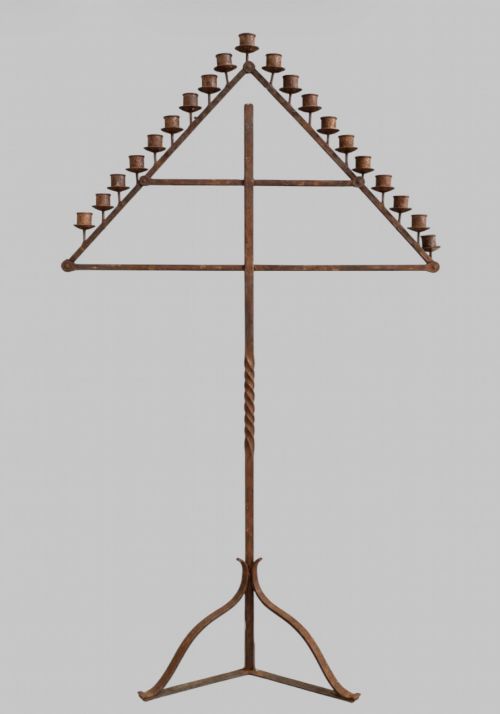
Large church candlestick holders, often referred to as altar candlesticks or floor candelabra, serve as substantial vertical supports for ceremonial candles in ecclesiastical settings. When searching this phrase, a buyer encounters significant architectural pieces designed to stand directly on floors or altars rather than domestic tabletables.
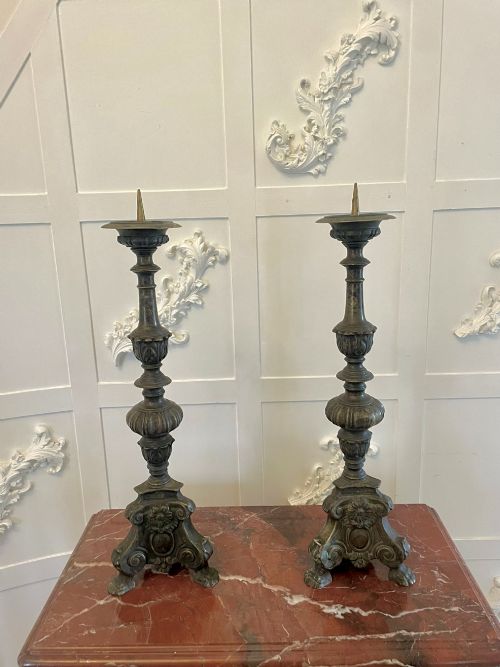
The selections on this page span several centuries, drawing heavily from the nineteenth century alongside eighteenth-century examples and twentieth-century interpretations like the Amsterdam School. Forms range from heavy brass columns to carved wooden pillars, frequently taking the form of pricket sticks where candles impale upon a central metal spike rather than sitting within a socket.
Originating largely from European liturgical contexts, these heavy candle holders reflect distinct regional aesthetics such as Italian Baroque, French chateau styles and British Gothic Revival. Buyers meet pairs and matching sets alongside single monumental columns, each bearing the heavy proportions required to balance tall wax tapers in lofty spaces.
How they were made
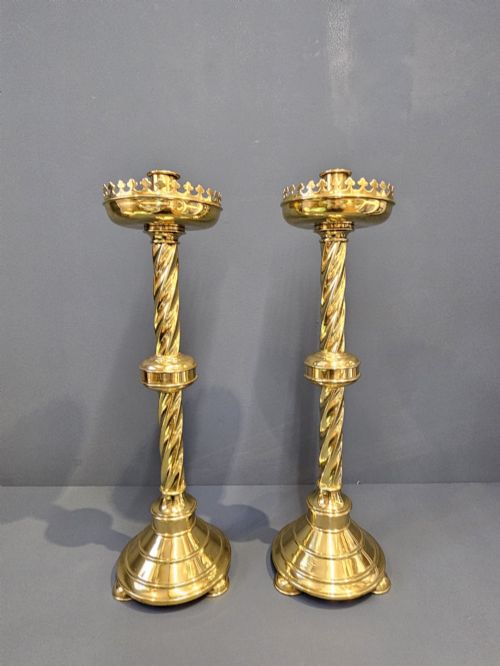
Metal examples rely on cast and turned brass, bronze, and iron, sometimes combined with wrought elements or finished with silvering and gilding. Foundries cast heavy components in sections before threading or pinning them together around a central iron rod for structural stability.
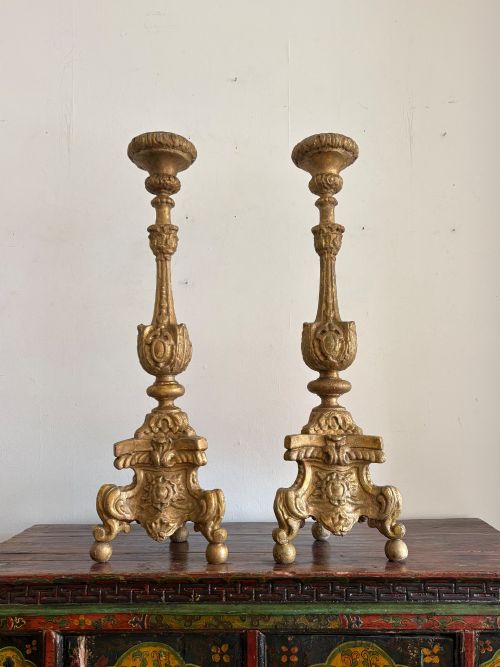
Wooden variants employ carved wood, gesso, and giltwood, often built up with layered polychrome or silver leaf over a softwood or hardwood core. Artisans carved acanthus leaves, fluted columns, and baroque scrolls by hand, applying decorative gesso surfaces to receive gold leaf or paint.
Several pieces include graduated Masonic column designs, proving that even architectural ritual objects enjoy an occasional secret handshake.
What varies in quality
The distinction between ordinary ecclesiastical utility and high-end liturgical art lies in the depth of hand-carving and the precision of metal casting. Finer pieces display crisp botanical relief on wooden surfaces or meticulously chased enrichment across heavy brass collars and bases.
Structural integrity and material authenticity dictate the standing of a piece within its category. Heavy gauge metals, original gilding surfaces that have aged without aggressive intervention, and complete original pricket spikes separate monumental display pieces from later adaptations.
The Large Church Candlestick Holders Glossary
- Pricket
- A sharp metal spike atop a candlestick designed to hold a candle in place by impaling the base of the wax taper. This form appears frequently on ecclesiastical and altar candlesticks.
- Altar Candlestick
- A tall liturgical candle holder designed specifically to stand upon or immediately beside a church altar during services. These pieces often feature elaborate bases and considerable height.
- Giltwood
- Timber that has been coated with a thin layer of gold leaf or powder over a prepared gesso ground. This finish catches candlelight effectively in dim chapel interiors.
- Amsterdam School
- An early twentieth-century architectural and design movement characterised by expressive forms, traditional craftsmanship and rich textures in metal and wood. Pieces from this school display robust, sculptural silhouettes.
- Corinthian Column
- A classical architectural column style featuring elaborate capitals decorated with acanthus leaves. Many nineteenth-century ecclesiastical candlesticks adopt this columnar form for their shafts.
Large Church Candlestick Holders: Frequently Asked Questions
How were large church candlesticks used?
These tall holders were positioned on altars or directly on stone floors to illuminate sacred spaces during ceremonies and mass. Their impressive height ensured that candlelight reached congregation members seated far down long naves.
Today, buyers deploy them as statement architectural elements in residential hallways, beside fireplaces or as dramatic focal points in high-ceilinged reception rooms.
How do I clean brass church candlesticks?
Brass surfaces benefit from gentle dusting with a soft, dry cloth to remove accumulated particles without disturbing the underlying oxidation. Avoid harsh commercial polishes that strip away historical patination and age.
Leaving the natural tarnish intact preserves the character developed over decades of ecclesiastical use.
Can these hold standard modern candles?
Pricket sticks require candles with a small hole drilled into the base to sit securely upon the central metal spike. Pillar styles or sconce adaptations accommodate wider cylindrical wax columns depending on the specific top configuration.
Adapting modern taper candles may require minor modification to fit older spike diameters safely.
How do I date an antique church candlestick?
Dating relies on identifying the underlying material, stylistic markers such as Gothic Revival motifs or Baroque curves, and construction methods like hand-turned threading or casting seams. Comparing the turning profile and base weight helps place the piece within the nineteenth century or earlier periods.
Regional manufacturing traits, such as Italian gesso work or French silver leaf applications, also offer strong chronological clues.