
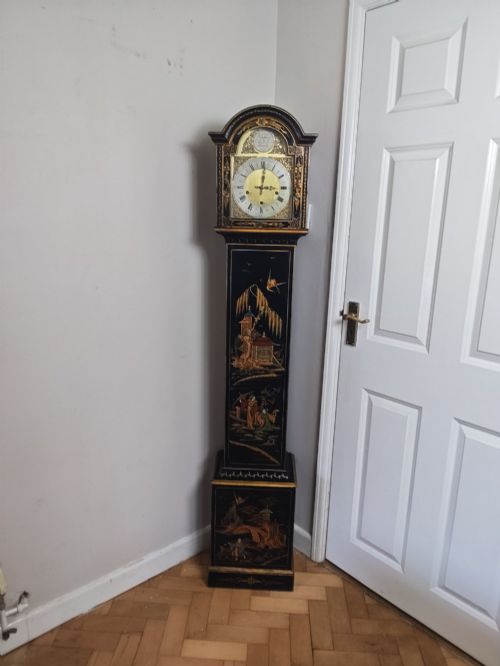
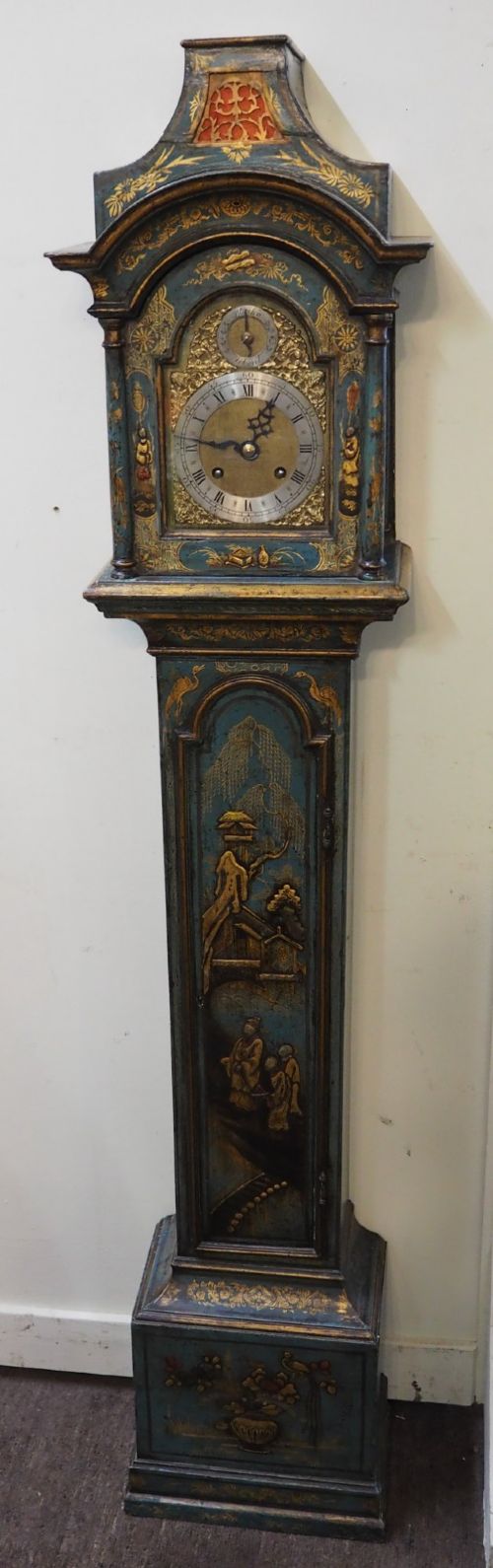


Lacquered Tallcase Clock
These lacquered tallcase clock examples bring centuries of decorated woodwork and striking mechanics into a room.
Lacquered Tallcase Clock
A lacquered tallcase clock combines tall wooden casework with decorated surfaces and weight-driven timekeeping movements. The forms span grandfathers, grandmothers, and longcase clocks.
Most pieces on this page emerge from 18th Century workshops and Georgian periods, alongside Chinoiserie Revival pieces from 1930. Makers signed dials from London, Reading, Edinburgh, Yarmouth, and beyond.
Surfaces feature dark green lacquer, blue lacquer, cream finishes, and gilt decoration. Figures often display Chinoiserie motifs with rocking automaton elements like Father Time.
How they were made
Wood construction forms the structural tallcase body, finished with layers of lacquer and gold leaf. Japanned wood and gilt detailing build up raised pictorial scenes.
Movements incorporate brass dials, glass hoods, and mechanical gear trains. Musical mechanisms and rocking automata appear in advanced dial configurations.
Listings span Georgian, 18th Century, 1750, 1800, 19th Century, and 1930 periods, featuring materials such as lacquer, wood, brass, glass, gilt, and gold leaf.
What varies in quality
The sophistication of the Chinoiserie decoration dictates visual depth, separating flat painted surfaces from detailed raised lacquer work. Originality of the painted finish and the integrity of the tall wooden case govern overall character.
Movement provenance elevates certain examples, particularly signed works by recorded makers like William Kipling, Wise of Reading, Thomas Utting, and Robert Berry. Complex mechanical additions such as automaton figures or musical capabilities set distinct tiers of craftsmanship.
William Kipling London·Wise of Reading·Thomas Utting of Yarmouth·Robert Berry
The Lacquered Tallcase Clock Glossary
- Chinoiserie
- European decorative style imitating Chinese artistic traditions. It employs figurative scenes, pagodas, and landscapes rendered in lacquer and gold leaf.
- Grandmother clock
- A scaled-down version of the traditional longcase clock. These shorter tallcase clocks suit domestic spaces with lower ceilings.
- Automaton
- Moving mechanical figures integrated into the clock dial. Examples include rocking figures like Father Time.
- Japanned wood
- European furniture finished with varnishes and metallic dust to emulate Asian lacquerware. It forms the primary decorative skin on these clock cases.
- Longcase clock
- A weight-driven pendulum clock enclosed in a tall wooden case. They are also known as grandfather or tallcase clocks.
Lacquered Tallcase Clock: Frequently Asked Questions
Where were these clocks made?
Makers operated in various British hubs, ranging from London workshops to regional centres like Reading, Edinburgh, and Yarmouth. Each region contributed distinct cabinetmaking traits and movement designs.
Urban makers often supplied more complex musical or automaton mechanisms. Provincial clockmakers produced robust longcase variants suited to local tastes.
What is Chinoiserie decoration?
Chinoiserie involves European interpretations of East Asian design motifs applied through lacquer and gilt layers. Scenes depict traditional landscapes, figures, and architectural elements.
This aesthetic dominated Georgian lacquered furniture and enjoyed a revival during 1930. The technique creates textured, reflective surfaces across the tallcase body.
How do grandfather and grandmother clocks differ?
Grandmother clocks offer a smaller, more compact scale than standard grandfather or longcase clocks. They retain full weight-driven mechanical movements inside reduced wooden cases.
This shorter stature makes them appropriate for rooms where traditional tallcase clocks overwhelm the floor plan. Both types utilise similar lacquer and dial techniques.