

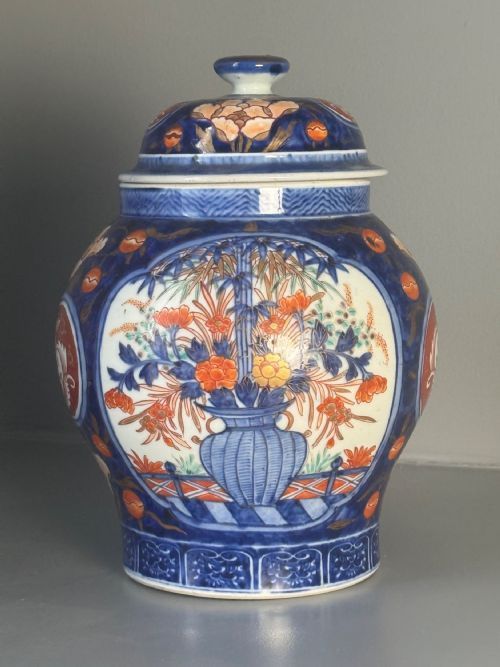


Japanese Porcelain Temple Jar
A Japanese porcelain temple jar brings weight and rich palette to a room, holding centuries of kiln tradition in its covered form.
Japanese Porcelain Temple Jar
A Japanese porcelain temple jar is a substantial vessel designed with a matching lid, often taking the form of a baluster or ginger jar to store prized contents. The pieces seen here appear primarily from the nineteenth century, alongside examples from the eighteenth and early twentieth centuries, reflecting long-standing export and domestic traditions.
Buyers will most frequently encounter nineteenth-century items decorated in the Imari palette, alongside Satsuma and Kutani wares, spanning forms from single large vessels to matched pairs and garnitures. These lidded pots serve as decorative centrepieces, showing the hand of makers working in traditions that crossed from the Edo into the Meiji period.
Materials and construction
Potters shaped these vessels from clay before applying glaze, cobalt blue, and overglaze enamel colours, often finishing the details with gold leaf, gilt, or gilding. Wood stands frequently accompany the larger jars to support their weight and presence.
Kiln work required precise temperature control to fuse the enamel colours and gilding to the porcelain body, yielding durable surfaces that retain their brightness across generations.
Listings span multiple eras, including the eighteenth, nineteenth, and early twentieth centuries, featuring porcelain, earthenware, and wood.
Evaluating standard and execution
Quality rests in the precision of the hand-painted decoration, the crispness of the porcelain moulding, and the alignment of the lid to the body. Pieces bearing identifiable signatures or originating from recognised kilns demonstrate superior brushwork and pigment depth.
The density and richness of the enamel and gilt application dictate visual success, distinguishing standard export pieces from those executed with exceptional ambition and control.
Yamashu·Fukagawa
The Japanese Porcelain Temple Jar Glossary
- Imari palette
- A traditional colour scheme utilising cobalt blue, iron red, and gilt highlights on a white porcelain ground. This combination originated in Japan and proved immensely popular for export wares.
- Meiji period
- The era of Japanese history running from 1868 to 1912, marked by opening trade with the West and high technical achievement in ceramics. Pieces from this time often display ambitious scale and detailed painting.
- Baluster
- A vase shape characterised by a rounded body that tapers toward the base and swells near the lower middle. It forms the standard silhouette for many large lidded jars.
- Garniture
- A set of three or more matching vases and jars designed to be displayed together on a mantelpiece or sideboard. These sets command attention through their uniform decoration and scale.
Japanese Porcelain Temple Jar: Frequently Asked Questions
What is a temple jar used for?
These lidded vessels served primarily for storage and display, holding valuable substances or functioning as ornamental centrepieces in grand interiors.
Over time, their decorative impact surpassed any utilitarian purpose, leading to widespread export and collection in European and British homes.
How do I identify Imari porcelain?
Imari pieces are recognised by their distinct palette of underglaze blue and iron red, frequently enriched with gold leaf and gilt details. The designs typically combine floral and geometric motifs across the entire surface of the porcelain.
Look for the characteristic interplay of cobalt and red pigment beneath and above the clear glaze.
How do I care for antique porcelain?
Keep these vessels out of direct sunlight to protect the overglaze enamels and gold leaf from fading over time. Dust them gently with a soft, dry cloth without using harsh cleaning agents.
Ensure they rest on stable surfaces, as their heavy lids and porcelain bodies can be vulnerable to impact.
How can I date these jars?
Dating relies on stylistic clues, such as the transition from Edo period traditions to Meiji period production methods. Reference marks, the character of the glaze, and the specific palette employed offer further chronological markers.
Comparison with documented pieces from the eighteenth and nineteenth centuries helps narrow the decade of creation.