


Japanese Enamel Wall Platter
These Japanese enamel wall platter examples bring Meiji and Edo period craftsmanship to interiors through large decorative chargers and plates.
Japanese Enamel Wall Platter
A japanese enamel wall platter is typically found as a large charger, decorative plate, or tray designed for display. The pieces on this page span the 17th century to the early 20th century, with a strong concentration from the Meiji period.
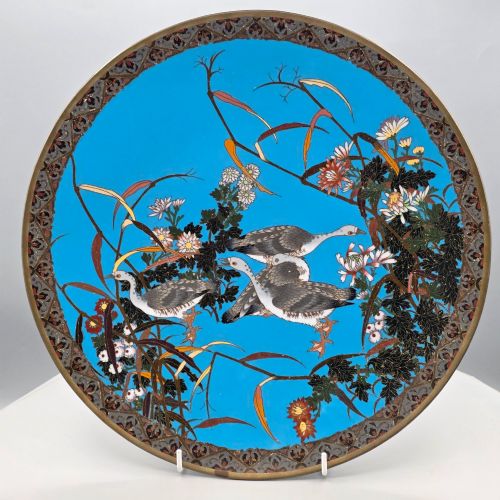
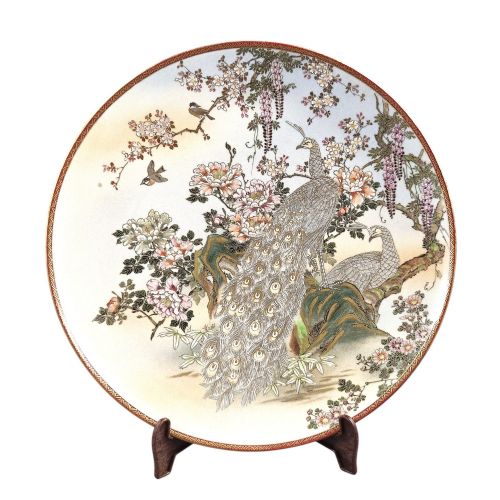
Makers utilised porcelain, copper, and bronze as bases for intricate surface decoration, producing wide dishes measuring up to fifty centimetres. Common motifs include dragons, koi, phoenixes, birds, and landscapes executed with hand-painted detail or cloisonne wirework.
Materials and Technique
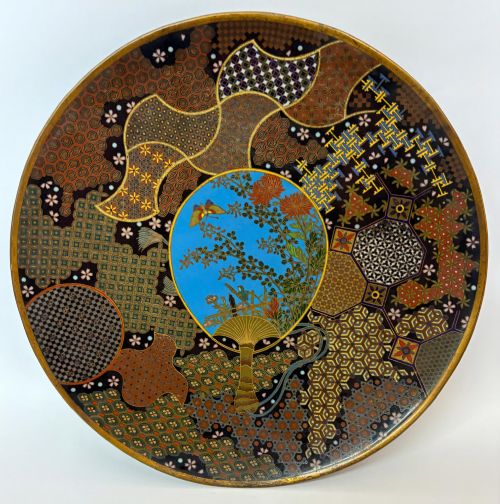
Enamel work on these platters relies on copper, brass, and porcelain bodies combined with coloured vitreous pastes. Artisans applied thin brass wire to form cellular boundaries, known as cloisonne, which were then filled with enamel and fired multiple times.
Certain pieces employ totai shippo techniques, featuring a semi-translucent porcelain body wrapped in cloisonne tree bark designs. Gilding and bronze elements frequently accent the borders and central imagery.
Listings span from the 17th century through the Edo and Meiji periods, utilising copper, porcelain, and brass.
Standard and Execution
Quality rests on the density and precision of the wirework alongside the complexity of the pictorial subject. Masterpieces display finer line work, balanced compositions of flora and fauna, and deeper colour saturation.
The scale of the charger alters the difficulty of the firing process, with larger diameters requiring greater skill to prevent warping or pitting in the enamel surface.
The Japanese Enamel Wall Platter Glossary
- Cloisonne Enamel
- A technique where flat wire is soldered to a metal base to create compartments for coloured glass paste. These cells are fired and polished smooth.
- Charger
- A large decorative plate or platter originally intended for ceremonial dining or wall display. They often exceed thirty centimetres in diameter.
- Totai Shippo
- A method where the core body is porcelain rather than metal, wrapped in wire and enamel. The underlying porcelain can sometimes be partially seen through the design.
- Meiji Period
- The era of Japanese history spanning from 1868 to 1912, noted for the export of advanced metalwork and ceramics to Western markets.
- Edo Period
- The period lasting from 1603 to 1867, preceding the Meiji era and representing earlier traditional craftsmanship.
Japanese Enamel Wall Platter: Frequently Asked Questions
How were japanese enamel wall platter pieces displayed?
These large dishes were traditionally displayed on walls or heavy wooden stands within rooms as focal points of interior decoration.
Their substantial scale and pictorial motifs made them prominent decorative objects in both Japanese homes and Western export markets.
What subjects appear on these platters?
Common subjects include mythological creatures like dragons and ho-o birds, alongside natural scenes featuring koi, geese, owls, and wisteria.
Landscape views involving Mount Fuji and symbolic auspicious patterns also recur across the Meiji and Edo period examples.
How do I identify a Meiji period piece?
Meiji pieces often exhibit complex cloisonne wirework and rich colour palettes produced during the rapid expansion of export manufacturing after 1868.
They frequently depict naturalistic animal scenes and landscapes with high technical precision.
What is the difference between a charger and a tray?
Chargers are wide, circular plates primarily manufactured for visual display on walls or flat surfaces rather than service.
Trays share similar enamel and metal construction methods but typically feature slightly different rim profiles or shallower depths.