


Japanese Cloisonne Wall Dish
When you handle a Japanese cloisonne wall dish, you hold a dense metal plate mapped with fine wire and rich glass enamel.
Japanese Cloisonne Wall Dish
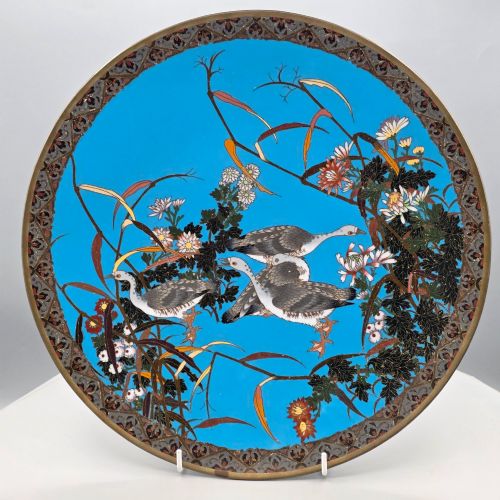
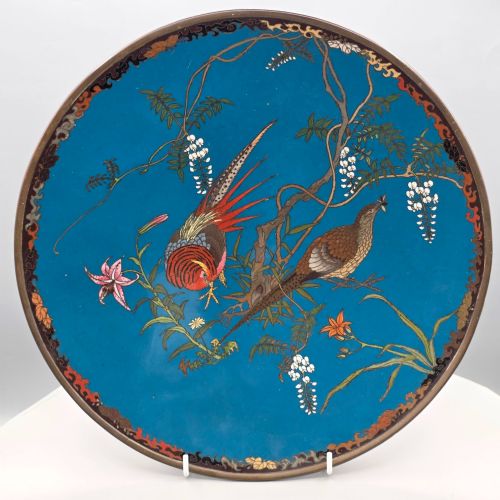
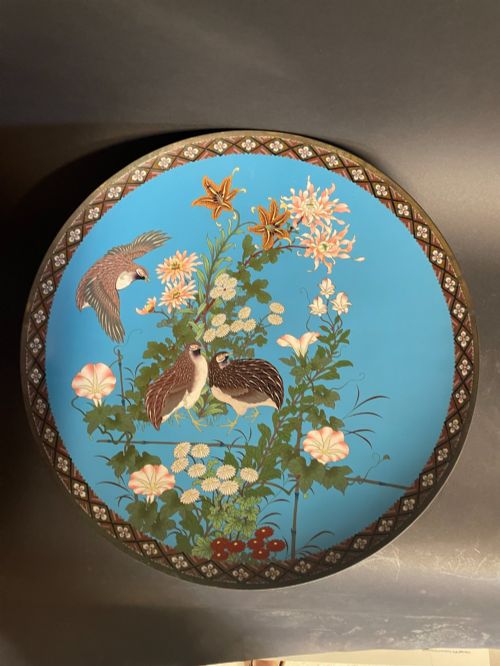
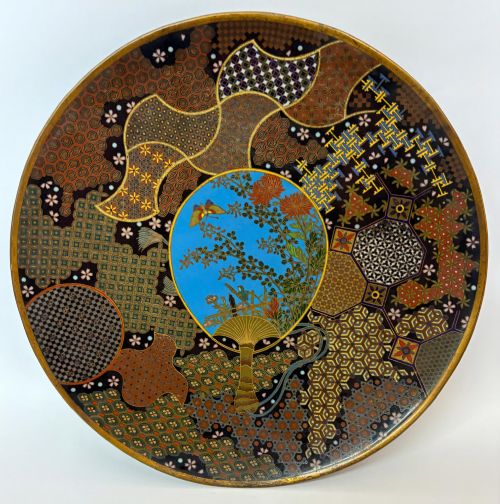
A Japanese cloisonne wall dish typically presents as a wide decorative charger, plate or tray designed for display rather than utility. The pieces seen here span the nineteenth century, including the Edo and Meiji periods, capturing a dynamic range of imagery.
Motive ranges widely across the selection, featuring leaping koi, dragons, ho-o birds, phoenixes, landscapes and figures such as samurai. Most examples take a generous circular form, functioning visually as flat bronze or copper canvases hung upon a wall.
Makers utilised various base bodies, producing traditional metal vessels alongside porcelain cores covered in totai shippo. These diverse formats share a meticulous attention to pictorial detail across every surface.
Materials and Construction
Craftsmen built these plates upon foundations of copper, brass, bronze or porcelain, soldering delicate wire to map out the intricate design cells. This network of brass wire forms the boundaries that hold the coloured enamel pastes.
Enamel fills each partitioned cell before the piece undergoes firing and extensive polishing to achieve a smooth surface. Certain variations incorporate specialised techniques like totai shippo, where enamel and wire adhere directly to a porcelain body.
Among the feathered fowl and mythical beasts, a solitary shrimp shell finds its permanent home rendered in copper wire and coloured glass.
Distinctions in Execution
Quality reveals itself in the fineness of the wirework and the control of the enamel cells, where tighter grids and thinner lines permit vastly more complex pictorial rendering. Superior examples display subtle tonal gradations within the feathers of a bird or the scales of a dragon rather than flat blocks of colour.
The ambition of the subject matter and the overall scale dictate the tier of the piece, with large chargers requiring immense technical stability during multiple firings to prevent warping or cracking of the enamel.
The Japanese Cloisonne Wall Dish Glossary
- Cloisonne Enamel
- A technique where metal wires are soldered to a base to form compartments that are filled with vitreous enamel and fired. This method creates detailed cellular designs across the surface of a plate.
- Charger
- A large ornamental plate traditionally intended for display on a wall or sideboard rather than for dining use. These substantial dishes provide a broad canvas for elaborate pictorial scenes.
- Totai Shippo
- A method of creating cloisonne on a porcelain body rather than a metal one, sometimes revealing textured effects resembling tree bark. The porcelain serves as the structural base for the wire and enamel.
- Meiji Period
- The era in Japanese history spanning from 1868 to 1912, known for a prolific output of exceptionally detailed decorative arts exported worldwide. Enamel work from this time achieved remarkable technical refinement.
- Ho-o Bird
- A mythical Chinese phoenix adopted into Japanese decorative art, symbolising virtue, grace and imperial favour. It appears frequently on high-status chargers with extended plumage.
Japanese Cloisonne Wall Dish: Frequently Asked Questions
How do I hang a heavy charger safely?
Large chargers require robust, coated wire spring hangers that distribute the weight evenly around the rim without exerting pressure on a single point. It is essential to anchor the fixing directly into a wall stud rather than relying solely on plaster.
Ensure the selected hanger matches the exact diameter of the dish and holds the piece securely flat against the vertical surface. Periodic checks of the hardware prevent accidental slips over time.
How do I clean a cloisonne dish?
Dust the surface gently with a soft, dry artist's brush to remove particles settled within the wire crevices. Avoid liquid cleaners, chemical sprays or abrasive cloths, which can harm the polished enamel or corrode the exposed metal wires.
Keeping the piece away from direct sunlight and damp environments preserves the stability of both the metal base and the glass paste.
What indicates an earlier nineteenth-century piece?
Earlier examples often stem from the late Edo period or the transition into the Meiji era, characterised by heavier bronze or copper foundations and deeper, more subdued enamel palettes. The wirework on these older items can sometimes appear slightly thicker and more robust than later productions.
Signed pieces and specific subject matter, such as distinct dragon renderings, help anchor the timeline when compared against standard historical typologies.