


Japanese Cloisonne Enamel Bowl
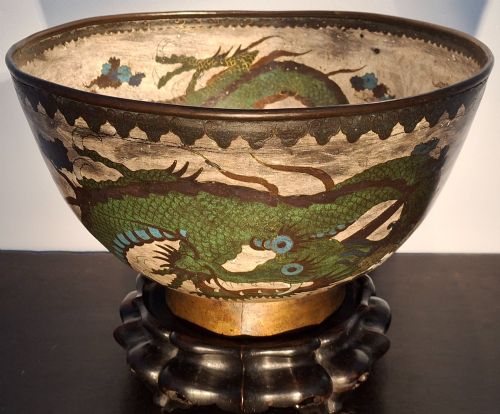
A Japanese cloisonne enamel bowl brings intricate metalwork and vibrant colour into a room, offering skilled craftsmanship from the nineteenth century.
Japanese Cloisonne Enamel Bowl
The designs span from single dragons and shrimp to birds, peonies, and tree bark motifs. Most pieces originate from the latter half of the nineteenth century, specifically around eighteen sixty to eighteen ninety.
Materials and construction
These vessels utilise a base of copper, brass, or earthenware upon which metal wires form detailed compartments. Enamel paste fills these cells before firing and polishing to create the smooth decorative surface.
Specialised techniques such as Totai Shippo integrate wirework with varied surface textures like tree bark effects, while related transparent methods like plique-a-jour appear in later twentieth-century work.
Materials documented in these listings include copper, brass, enamel, and earthenware.
Factors of quality
Quality rests upon the precision of the wirework and the complexity of the motifs rendered across the surface. Elaborate imagery such as dragons or birds demonstrates higher technical ambition than simpler geometric layouts.
The handling of the enamel colours and the smoothness of the final polish distinguish finer examples from standard production pieces.
The Japanese Cloisonne Enamel Bowl Glossary
- Cloisonne enamel
- A technique where metal wires are soldered to a metal base to create cells filled with enamel paste. These compartments hold the coloured glass paste before firing.
- Totai Shippo
- A variation of cloisonne involving wirework applied over an earthenware body rather than solid metal. This method creates textured surfaces resembling natural materials.
- Plique-a-jour
- An enamelling technique similar to cloisonne where the enamel is fired without a backing metal, allowing light to shine through the transparent colours. It resembles miniature stained glass.
- Charger
- A large decorative plate intended for display rather than dining use. These pieces often feature prominent central motifs such as dragons or marine life.
- Edo Period
- A historical epoch in Japan spanning from sixteen hundred and three to eighteen sixty-eight. Pieces from this era reflect distinct traditional craftsmanship before the Meiji period changes.
Japanese Cloisonne Enamel Bowl: Frequently Asked Questions
How do I date a japanese cloisonne enamel bowl?
Dating relies on stylistic clues and material characteristics recorded across the Meiji and Edo periods. Pieces from eighteen sixty often reflect Edo traditions, whereas items from eighteen seventy to eighteen ninety show Meiji developments.
Makers occasionally signed their works, providing further indication of origin and period. Examining the wiring style and enamel palette also assists in placing the piece within its historical decade.
Where were these bowls made?
These pieces originate from Japan during periods of significant artistic output in metalwork and ceramics. Workshops employed skilled artisans who specialised in wire bending and enamel firing.
The resulting vessels combine copper, brass, and earthenware foundations with detailed pictorial designs.
How should I clean my enamel bowl?
Gentle dusting with a soft, dry cloth preserves the polished surface of the enamel and metal wire. Avoid harsh chemical cleaners or abrasive materials that could scratch the glass paste.
Keep the vessel away from direct sunlight and extreme temperature changes to protect the historic materials.