

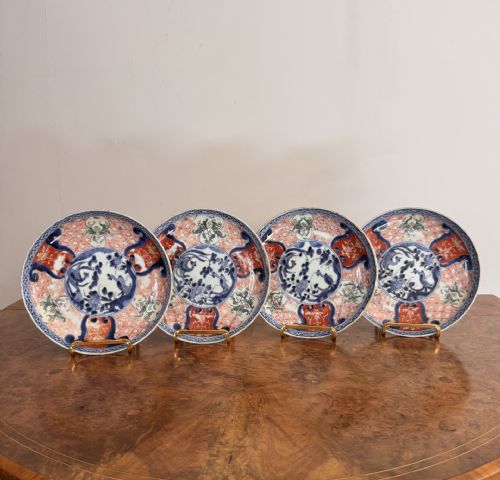
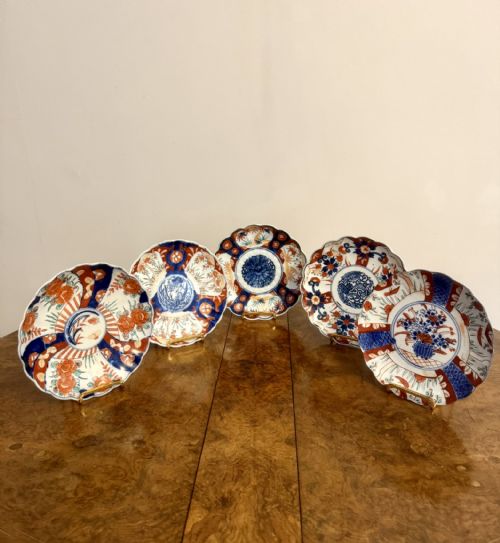


Japanese Ceramic Dishes Set
These japanese ceramic dishes set examples bring distinctive nineteenth century craftsmanship and traditional Japanese Imari or Satsuma styles straight to the table.
Japanese Ceramic Dishes Set
When you search for a japanese ceramic dishes set, you encounter collections of decorative plates, bowls, and saucers originating from the nineteenth century and around nineteen hundred. These pieces frequently arrive in matching sets, complete with original storage boxes, reflecting traditional Japanese artistry.
The selections on this page are heavily represented by Japanese Imari and Satsuma styles, alongside specialised forms like sushi plates and Black Ship decoration. Sets range from small groupings of four dishes up to larger collections of fourteen or eighteen matching plates.
How they were made
These items are constructed from porcelain and earthenware, forming the durable base for intricate surface decoration. Artisans applied rich glaze, enamel, and gold leaf or gilt highlights to achieve the characteristic vibrant visual depth.
Some groupings incorporate wooden storage boxes alongside iron elements, demonstrating a complete approach to the preservation and presentation of the tableware.
Japanese Ceramic Dishes Set Retail Price Guide 2026
Typical asking prices for japanese ceramic dishes set among the pieces listed under this phrase on Sellingantiques today, from the lower quarter to the upper quarter. They describe what is for sale here now, not the wider market.
Several sets come safely tucked inside their original wooden storage boxes, proving that nineteenth century packaging could outlast the empire.
What varies in quality
Quality reveals itself in the precision of the enamel application and the richness of the gold leaf detailing across the porcelain surface. Superior sets maintain uniformity across multiple matching plates, preserving the clarity of traditional motifs.
The presence of original wooden storage boxes and specialised historical themes, such as Black Ship decoration, elevates the historical interest of a set.
The Japanese Ceramic Dishes Set Glossary
- Imari
- A traditional style of Japanese export porcelain characterised by a palette of cobalt blue, iron red, and gilt highlights. These plates and dishes were created for both domestic use and international trade.
- Satsuma
- A type of earthenware featuring a fine, ivory-coloured crackle glaze decorated with enamel and gold leaf. Items in this style often display intricate pictorial scenes.
- Porcelain
- A ceramic material made by heating materials, generally including kaolin, in a kiln to a high temperature. It provides a hard, white, and translucent base for detailed painting.
- Earthenware
- A porous ceramic body fired at lower temperatures than porcelain. It requires glazing to become completely watertight.
- Meiji Period
- The era in Japanese history spanning from eighteen sixty-eight to nineteen twelve, marked by extensive artistic production for export. Pieces from this time show high technical proficiency in decoration.
Japanese Ceramic Dishes Set: Frequently Asked Questions
How were these sets originally used?
These ceramic sets served practical dining functions, such as serving sushi or general tableware use, while also acting as decorative display pieces.
Many of these groupings were specifically created for export markets, combining traditional Japanese motifs with forms suited to Western dining habits.
How do I care for antique ceramic dishes?
These delicate pieces require careful hand washing with mild soap to preserve the sensitive enamel, glaze, and gold leaf details.
Storing the items in their original wooden boxes or padded cabinets protects the porcelain and earthenware surfaces from accidental chipping.
What defines Imari decoration?
Imari decoration is recognised by its distinct palette, typically combining underglaze cobalt blue with iron red, green, and abundant gilt highlights over porcelain.
This style originated in the Edo period and remained popular for export throughout the nineteenth century.
How can I distinguish Satsuma ware?
Satsuma ware is identified by its characteristic warm, ivory-coloured earthenware body covered in a fine network of crackle glaze.
Surface designs on these pieces rely heavily on detailed enamel work and raised gold leaf applications.