





Japanese Art Charger
When you handle a Japanese art charger, you hold centuries of metalwork and ceramic mastery designed to command attention on a wall or sideboard.
Japanese Art Charger
A japanese art charger encompasses large decorative plates, wall plaques, and shallow bowls created across the nineteenth and early twentieth centuries. These substantial display pieces typically showcase intricate motifs ranging from leaping koi carp and dragons to samurai figures and auspicious symbols.
The selections available span multiple distinct eras, including the Edo and Meiji periods alongside later Taisho examples. Buyers frequently encounter cloisonne enamel and Imari porcelain iterations among the current inventory.
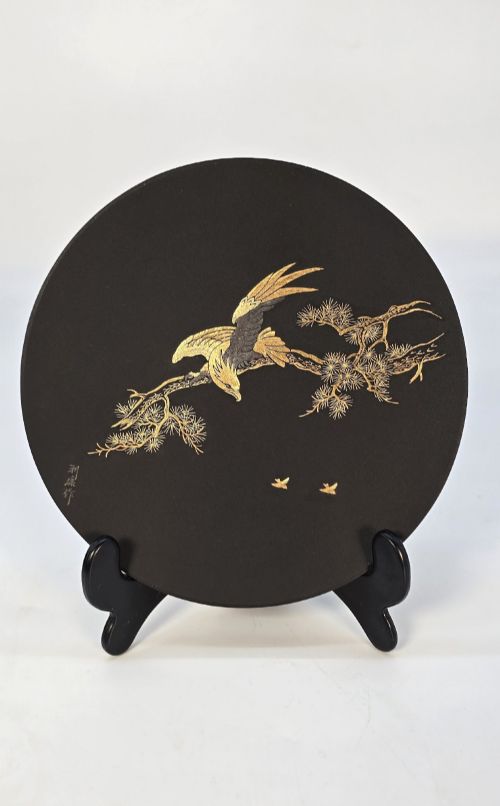
Forms vary from wide copper-bodied display dishes to porcelain plates and patinated iron plaques inlaid with gold and silver. Each piece functions primarily as a visual centrepiece rather than tableware.
Materials and construction methods
Many chargers utilise a copper or iron base combined with cloisonne enamel, where thin metal wires form cellular partitions to hold coloured vitreous pastes. Artisans then fire and polish these surfaces to create smooth, lustrous pictorial scenes featuring birds, foliage, and mythical creatures.
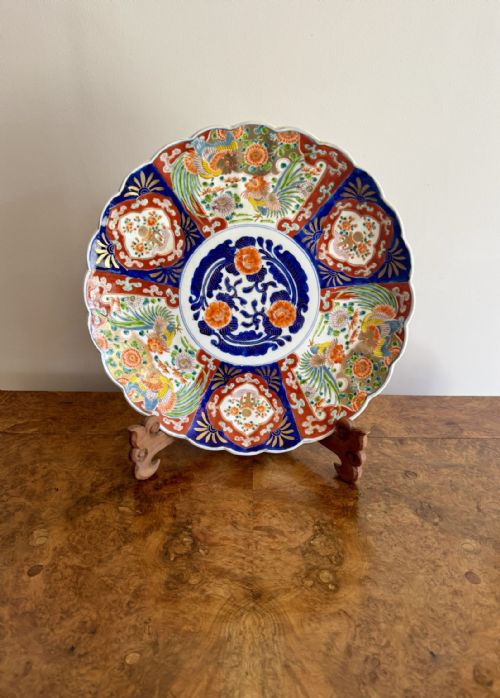
Porcelain examples employ traditional ceramic potting and glazing techniques, seen particularly in Imari wares decorated with underglaze blue and overglaze iron red and gold. Certain specialist pieces integrate wood, gold leaf, and gilt alongside tree bark matrices to achieve tactile variation.
Japanese Art Charger Retail Price Guide 2026
Typical asking prices for japanese art charger among the pieces listed under this phrase on Sellingantiques today, from the lower quarter to the upper quarter. They describe what is for sale here now, not the wider market.
Several dragon and koi chargers feature scales rendered with such precision that they appear ready to swim right off the wall.
Distinguishing quality in decoration
Quality rests upon the precision of the workmanship and the complexity of the narrative imagery displayed across the surface. Finer examples display meticulous wirework in cloisonne or exceptionally crisp brushwork and enamelling on Imari porcelain.
The ambition of the subject matter also separates standard production from superior artistry. Pieces depicting complex iconography such as the Seven Lucky Gods or detailed aquatic fauna demonstrate greater technical demand than simpler geometric patterns.
The Japanese Art Charger Glossary
- Cloisonne
- An enamelling technique where metal wires are soldered to a metal base to create compartments for coloured paste. This method defines many of the metal-bodied display pieces.
- Imari
- A traditional style of Japanese porcelain featuring cobalt blue underglaze and iron red overglaze, frequently accented with gold. These wares were widely produced for export and local display.
- Meiji Period
- The historical era spanning from eighteen sixty-eight to nineteen twelve, noted for a surge in elaborate decorative arts produced for international markets. Much of the extant metalwork originates from this time.
- Patination
- The natural or chemically induced surface ageing on metals such as iron and bronze. This treatment enhances depth and texture on pictorial wall plaques.
- Mon
- A Japanese heraldic badge or crest used to identify families or clans. These mon often appear as decorative motifs on enamel chargers.
- Totai Shippo
- A technique involving cloisonne enamel applied over a porcelain body rather than metal. This unusual method creates a translucent effect across the base material.
Japanese Art Charger: Frequently Asked Questions
How do I hang a heavy charger safely?
Large display pieces require robust, adjustable spring-loaded brass hangers designed to distribute weight evenly around the rim without putting pressure on the centre.
Ensure the wall fixing is anchored securely into masonry or a stud rather than relying solely on plasterboard.
Are these chargers intended for food use?
These items serve strictly as decorative wall plaques and display dishes rather than functional tableware. The metal compositions and historical enamels are unsuited for culinary contact.
Displaying them on stands or mounting them securely protects their delicate surfaces from accidental damage.
How do I clean an enamel charger?
Dust enamel and metal surfaces gently with a soft, dry microfibre cloth to prevent the accumulation of particles. Avoid all liquids, abrasive cloths, and chemical cleaning agents.
Moisture can seep into microscopic fissures or affect exposed metal bases over time.
What is the difference between Imari and cloisonne?
Imari refers to glazed porcelain decorated primarily in blue, red, and gold, whereas cloisonne involves metal vessels worked with wire partitions and glass enamel.
Both categories achieve rich pictorial depth but utilise entirely different material foundations.