

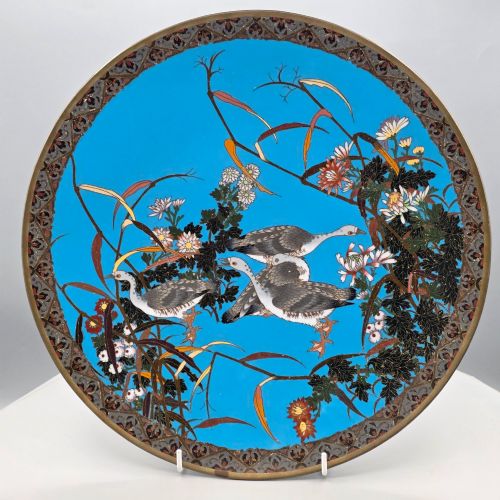




Bronze Enamel Charger
These bronze enamel charger plates are heavy Japanese metalwork decorated with cloisonne wires and coloured glass pastes, prized by collectors for their intricate imagery.
Bronze Enamel Charger
A bronze enamel charger is a large decorative plate or dish created in Japan during the nineteenth century, spanning the Edo and Meiji periods. These pieces serve primarily as wall plates or display chargers rather than tableware, measuring up to forty centimetres across.
The decorative subjects rendered on these chargers include natural motifs such as geese and flowers, chrysanthemums, birds, butterflies, frogs, leaping koi, trees and single dragons. Certain examples incorporate auspicious symbols or utilise Totai Shippo porcelain methods within the design.
Most items encountered on this page originate from the Meiji period, with dates clustering around eighteen ninety, alongside earlier works from the Edo period and the eighteen sixties and seventies. Signed pieces and matched pairs appear alongside large individual chargers.
Materials and construction techniques
The foundation of each piece is formed from bronze, copper, brass or porcelain, shaping the heavy body of the charger. Artisans apply metal wires, including brass wire and silver wire, directly onto the surface to outline the intricate pictorial cells.
Coloured enamel pastes fill these wire compartments before the piece undergoes firing and polishing to create a smooth, luminous finish. Certain variants employ Totai Shippo techniques, incorporating tree bark motifs or ceramic cores beneath the cloisonne layer.
Bronze Enamel Charger Retail Price Guide 2026
Typical asking prices for bronze enamel charger among the pieces listed under this phrase on Sellingantiques today, from the lower quarter to the upper quarter. They describe what is for sale here now, not the wider market.
Materials utilised across the available pieces include bronze, copper, brass, silver wire, and cloisonne enamel.
Distinctions in quality and execution
Quality rests upon the precision of the wirework and the complexity of the enamel palette, where finer compartments yield sharper pictorial details like feathers, scales and petals. The ambition of the subject matter, from simple botanical studies to dynamic dragons and leaping koi, marks the tier of the maker's skill.
The presence of an authentic signature often distinguishes high workshop output from unmarked production. Scale also plays a role, as larger chargers exceeding thirty-five centimetres demand greater technical mastery during the multi-stage firing process to prevent warping.
Kinkozan
The Bronze Enamel Charger Glossary
- Cloisonne Enamel
- A metalwork technique where fine wires form partitioned cells that are filled with coloured glass paste and fired. This method creates detailed pictorial surfaces on plates and chargers.
- Totai Shippo
- A Japanese technique involving enamel applied over a porcelain or pottery base rather than solid metal. It produces a distinct textural effect resembling natural surfaces like tree bark.
- Meiji Period
- The era of Japanese history lasting from eighteen sixty-eight to nineteen twelve, noted for exceptional metalwork and the expansion of decorative arts exported abroad.
- Charger
- A large ornamental plate intended for display on a wall or sideboard rather than for serving food. These pieces form the primary canvas for elaborate wirework designs.
- Edo Period
- The period of Japanese history preceding the Meiji era, spanning from sixteen hundred and three to eighteen sixty-seven. Early chargers sometimes originate from the final decades of this rule.
Bronze Enamel Charger: Frequently Asked Questions
What is a bronze enamel charger used for?
These large decorative plates were created primarily for visual display on walls or sideboards rather than for dining purposes. Their intricate enamelwork and substantial size made them focal points in nineteenth-century interiors.
Collectors today continue to exhibit them as wall art or on dedicated stands to showcase the detailed wirework and pictorial subjects.
How do I date a Japanese cloisonne charger?
Dating relies on stylistic clues, historical periods, and occasional artist signatures recorded on the reverse or base. Pieces from the Edo period and early Meiji years often display distinct wiring characteristics and heavier metal foundations compared to later production.
Examining the palette, the fineness of the brass or silver wires, and the subject matter helps narrow the decade of creation.
Are these chargers made of solid bronze?
The foundation metal varies across pieces, incorporating bronze, copper, brass, or in specific Totai Shippo variants, a porcelain core beneath the wirework. The visible metal is primarily seen in the polished rims and backing surfaces.
Each material provides a sturdy base designed to support the heavy glass enamel layers during the firing process.
What motifs appear on Meiji period chargers?
Common imagery includes natural elements such as chrysanthemums, geese, birds, butterflies, and frogs alongside dynamic subjects like single dragons and leaping koi. Auspicious symbols and botanical studies also feature prominently across the surface.
These designs were meticulously mapped out using fine metal wires before being filled with coloured enamels.