




Jacobean Revival Gateleg Table
These jacobean revival gateleg table pieces offer versatile folding surfaces and sturdy oak timber for everyday dining or quiet corners.
Jacobean Revival Gateleg Table
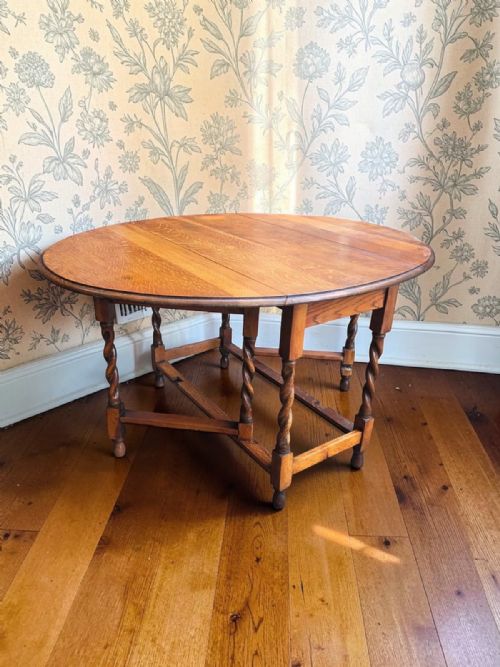
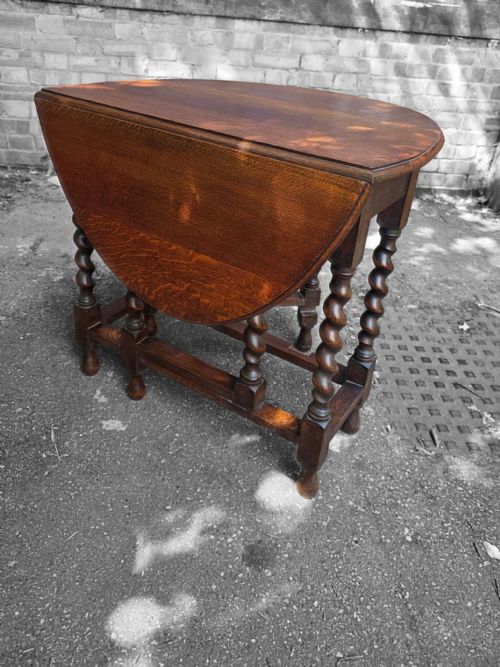
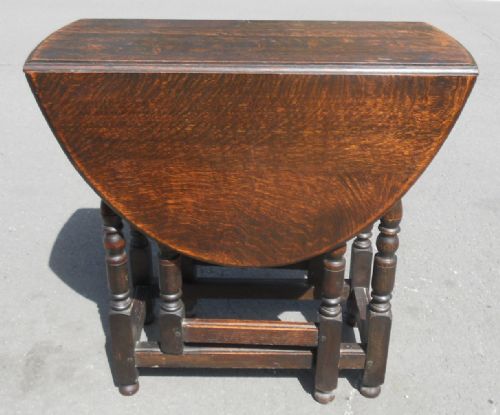
A jacobean revival gateleg table provides a folding leaf design supported by pivoting legs, creating a practical surface that collapses when space is tight. Most examples on this page date from the early twentieth century, spanning periods from nineteen hundred through nineteen thirty.
The form adapts easily across different rooms, appearing in listings as dining tables, drop-leaf tables, side tables, and smaller coffee or occasional pieces. Oak forms the dominant choice across these formats, supplemented by occasional mahogany and metal elements.
How they were made
Makers constructed these tables predominantly from solid oak, utilising timber that yielded heavy framing and durable oval tops. Selected pieces incorporate mahogany, adding a distinct grain and darker tone to the drop-leaf structure.
Turned supports define the carpentry, with barley twist legs appearing frequently alongside metal hinges and pivoting gate mechanisms that hold the folding leaves securely in place.
Listings feature oak predominantly, with occasional mahogany and metal components across dining, coffee, and side table forms.
What varies in quality
Proportion and scale separate standard occasional tables from large dining formats built for heavier domestic use. The precision of the turned barley twist legs and the tightness of the gate joints indicate the standard of workshop execution.
Material selection dictates overall solidity, with dense English oak and carefully joined drop leaves providing greater structural integrity than lighter alternative timbers.
The Jacobean Revival Gateleg Table Glossary
- Gateleg table
- A table with hinged leaves supported by legs that swing outward like a gate. This mechanism allows the surface to expand or fold away flat.
- Barley twist
- A type of decorative wood turning resembling a spiral rope. It appears commonly on the upright legs of early twentieth century revival furniture.
- Drop-leaf
- A tabletop design featuring a fixed centre section with movable side panels. These panels drop down vertically when the supporting gates are folded inward.
- Oval top
- A rounded tabletop shape without sharp corners, frequently found on dining and coffee variations. It softens the visual impact of heavy timber in smaller rooms.
- Occasional table
- A light, movable table intended for specific, temporary use rather than primary seating. The category includes small coffee and side variations.
Jacobean Revival Gateleg Table: Frequently Asked Questions
How do I fold the leaves?
Lift the hinged leaf upward until it rests horizontally. Swing the pivoting gate leg outward from the centre frame underneath until it sits directly beneath the edge of the leaf to support the weight.
To close the table, swing the gate leg back inward against the main underframe and lower the leaf gently. Ensure no items remain on the folding section before operating the mechanism.
Will these fit in small rooms?
The drop-leaf design allows the table to fold down into a narrow footprint when floor space is limited. Smaller coffee and side table variations suit compact areas while retaining the characteristic turned leg profile.
Fully extended dining versions require clearance for the folding leaves and swinging legs on both sides. Measure the available floor space with the leaves up before placing a large example in a tight room.
How do I clean the oak?
Dust the timber regularly with a dry, soft cloth to prevent grit accumulation in the carved grooves of the barley twist legs. Avoid heavy chemical polishes that leave a sticky residue on the wax or lacquer finish.
Feed the dry oak occasionally with a traditional beeswax applied sparingly and buffed thoroughly. Keep the wood away from direct heat sources and damp environments to protect the joints.
Are these tables sturdy enough for daily dining?
Solid oak construction and heavy pivoting gate mechanisms provide a stable foundation for regular meals. The swing legs bear the downward pressure of the extended leaves effectively when positioned correctly.
Care should be taken not to lean heavy weight directly onto the unsupported outer edges of the drop leaves. Check the hinge screws periodically to maintain firm alignment across the top.