




Italian Marble Urns
These Italian marble urns bring classic sculptural form into a room, drawing on centuries of Mediterranean design.
Italian Marble Urns
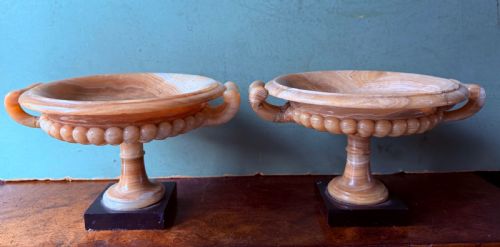
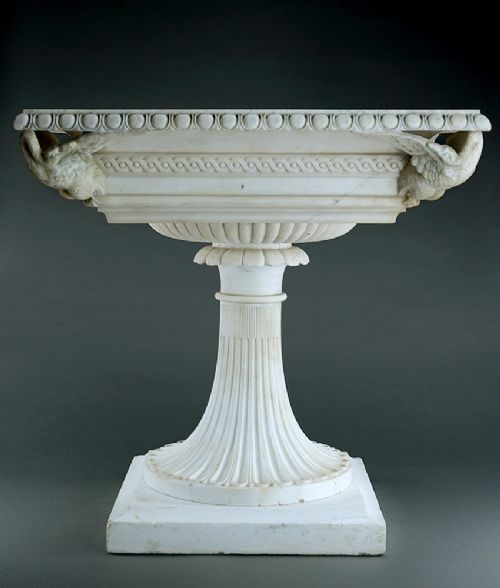
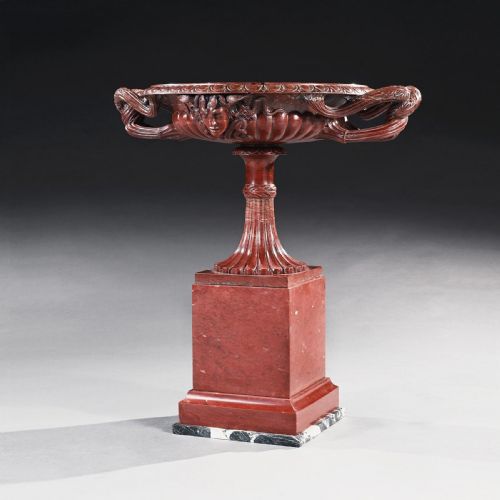
When you search for Italian marble urns, you encounter decorative vessels shaped by classical antiquity and later revivals. The selection ranges from nineteenth-century Grand Tour souvenirs to earlier Renaissance pieces, taking the form of campana urns, tazzas, and labrums.
Most examples found here date from the nineteenth century, reflecting the enthusiasm for classical forms during the Grand Tour period. Alongside traditional urns, the category encompasses related sculptural items such as pedestal bowls, tazzas, and mounted lamps utilising carved stone.
Makers drew directly from Roman and Greek precedents, adapting ancient architectural motifs for European collectors. These pieces function primarily as decorative focal points, often displayed on pedestals, consoles, or mantelpieces within traditional interiors.
How they were made
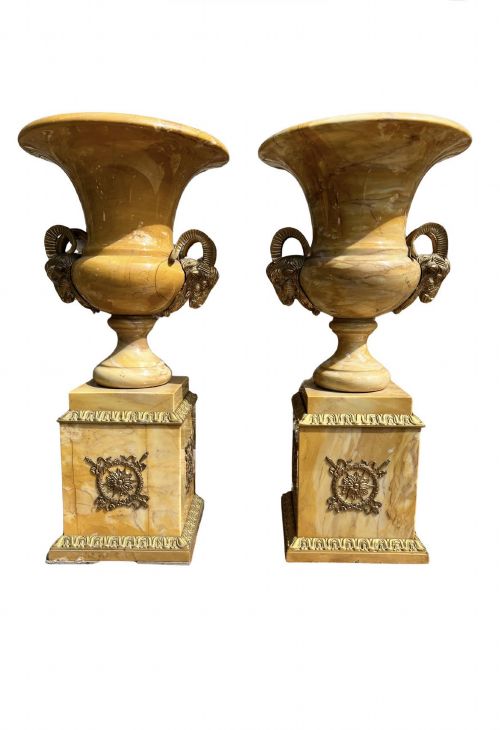
Craftsmen utilised various stones including white marble, Sienna marble, Rosso Antico, and alabaster, frequently mounting them on contrasting black marble or bronze bases. The manipulation of these dense materials required specialised turning on lathes and precise hand-carving for decorative handles and fluting.
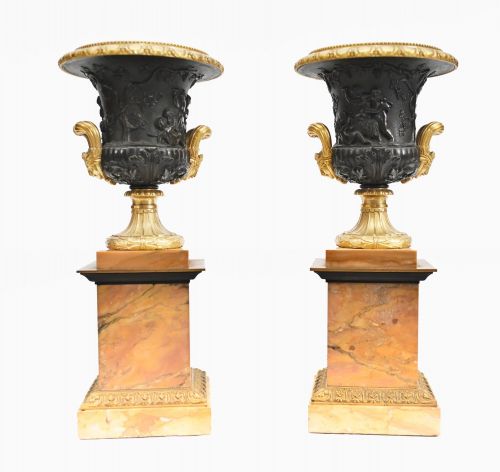
Many nineteenth-century items incorporate cast bronze elements alongside carved stone, combining contrasting textures in the manner of classical antiquities. The surfaces were polished to highlight the natural veining and variegation of the mineral deposits within the stone.
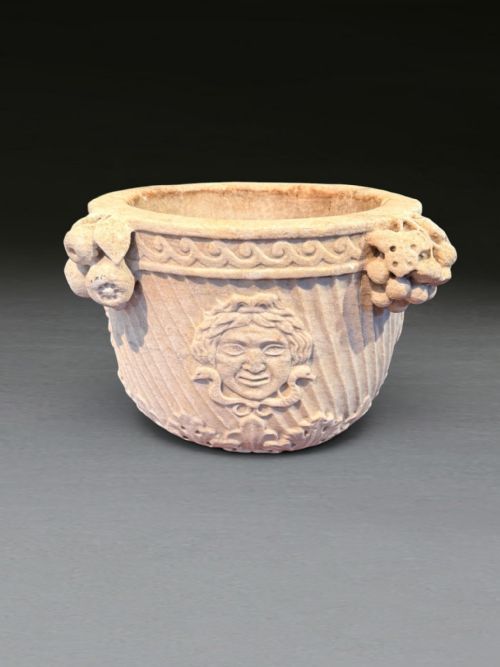
Listings feature sixteenth-century Renaissance carvings alongside nineteenth-century Grand Tour souvenirs in alabaster, Sienna marble, and Rosso Antico.
What varies in quality
The distinction between ordinary souvenirs and superior pieces lies in the crispness of the carving and the selection of the stone. Highly figured marbles with dynamic veining and finely detailed cast bronze mounts elevate a piece above simpler, plain-stone variants.
Proportion and fidelity to classical models dictate the visual success of an urn. Pieces executed with careful attention to historical campana or tazza proportions command greater visual presence than rigid or simplified interpretations.
Benedetto Boschetti
The Italian Marble Urns Glossary
- Campana urn
- A bell-shaped vessel with a flared rim and footed base, derived from ancient Roman pottery and stone models. These forms became exceptionally popular during the nineteenth-century Grand Tour.
- Grand Tour
- A traditional trip of Europe undertaken by upper-class European young men of means in the seventeenth through nineteenth centuries. Travellers frequently acquired souvenir sculptures and urns in Italy.
- Rosso Antico
- A deep red antique marble prized by classical sculptors and later revivalists for its rich colour and smooth finish. It appears frequently in high-status nineteenth-century decorative objects.
- Labrum
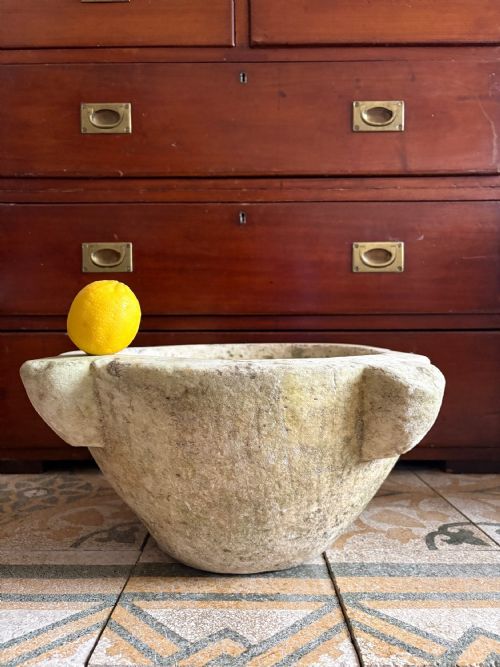
- A large classical stone basin or bowl, often supported by a pedestal and used for decorative or garden display. The term originates from Roman bathhouse architecture.
Italian Marble Urns: Frequently Asked Questions
What are Italian marble urns?
These pieces are decorative stone vessels and tazzas inspired by classical antiquity, produced primarily in Italy as sculptural ornaments for homes.
They emulate ancient Greek and Roman forms, serving as ornamental accents rather than functional containers.
How were they used historically?
During the eighteenth and nineteenth centuries, wealthy travellers collected these objects as souvenirs of their travels through Italy. They were displayed in libraries, halls, and drawing rooms to signal classical learning and refined taste.
Many functioned purely as decorative centerpieces or architectural ornaments on pedestals.
How do I style them at home?
Place them on heavy wooden consoles, marble mantelpieces, or dedicated pedestals where their sculptural silhouette can be appreciated. Their neutral stone tones allow them to anchor both traditional and contemporary interior schemes.
Pairing a pair of matching tazzas creates symmetry on a sideboard or table.
How can I tell the period?
Nineteenth-century Grand Tour pieces often feature specific combinations of coloured marbles like Sienna or Rosso Antico with patinated bronze mounts. Examination of the turning marks on the stone and the wear on the base helps indicate the age.
Earlier examples from the Renaissance or eighteenth century display hand-carved tool marks distinct from later mass-produced souvenirs.