



Inlaid Walnut Tea Caddy
These inlaid walnut tea caddy examples are fine wooden boxes designed to store precious tea leaves securely, prized for their decorative veneers and detailed craftsmanship.
Inlaid Walnut Tea Caddy
An inlaid walnut tea caddy is a wooden storage box created to preserve the aroma and flavour of expensive tea leaves in domestic interiors. Collectors seek these pieces for their rich timber figures and intricate surface decoration.
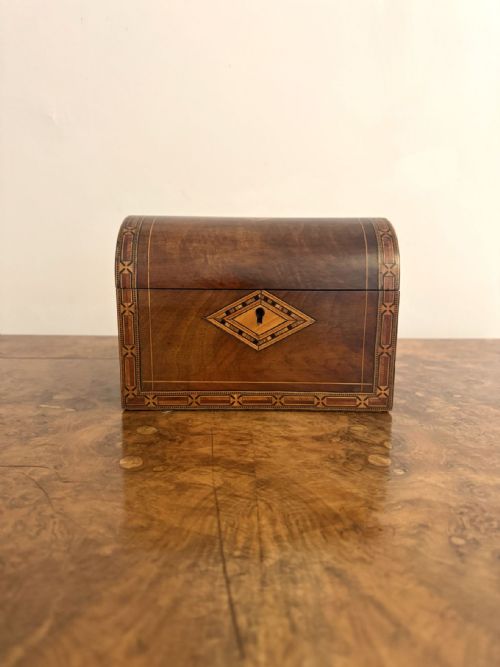
The selections available here span several distinct periods, most notably the Georgian era, the Regency period, and the Victorian age. The forms range from rectangular boxes and sarcophagus shapes to larger freestanding teapoys.
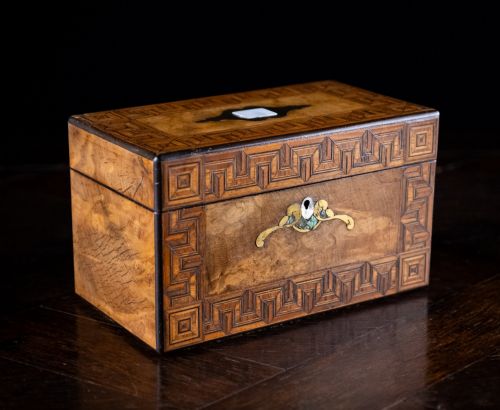
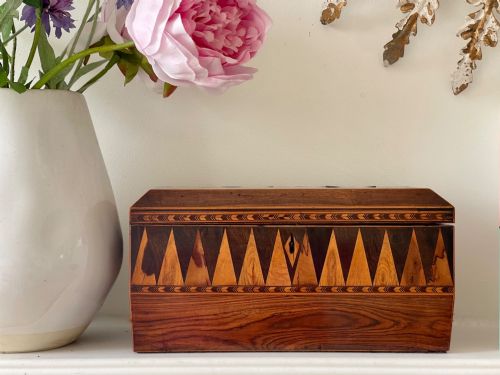
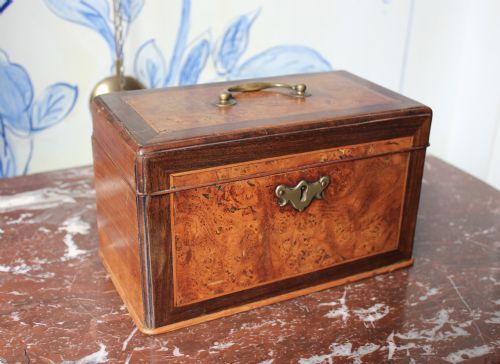
Makers utilised figured timbers such as burr walnut and burl walnut, frequently embellished with contrasting boxwood, mother-of-pearl, and parquetry. Many examples incorporate Tunbridge Ware geometric decoration created by skilled regional specialists.
Judging quality and execution
Quality rests upon the selection of the walnut veneer and the precision of the geometric parquetry or Tunbridge Ware panels. Finer boxes display harmonious grain patterns across every surface without awkward patching or careless timber matching.
Internal arrangements also distinguish better examples, particularly those retaining fitted compartments, mixing bowls, or original paper linings. The crispness of the brass fittings and the exact alignment of the lid closure further indicate superior workshop standards.
The documented forms range from compact rectangular boxes and sarcophagus shapes to elaborate fitted teapoys.
Henry Hollamby
The Inlaid Walnut Tea Caddy Glossary
- Burr walnut
- A prized timber harvested from growths on walnut trees that produces highly swirled and mottled grain patterns. Cabinetmakers selected these sections to create dramatic decorative veneers on fine boxes.
- Tunbridge Ware
- A type of decorative woodwork featuring intricate mosaic patterns assembled from thousands of tiny tinted wood blocks. This specialty thrived in Kent during the nineteenth century.
- Parquetry
- A geometric mosaic of wood pieces applied to a surface to form decorative patterns. It appears frequently on the lids and panels of these boxes.
- Teapoy
- A small stand or large caddy fitted to hold tea canisters and mixing bowls. These pieces often sat beside a fireplace or tea table in polite rooms.
- Escutcheon
- A protective brass plate surrounding a keyhole. This small element prevents the surrounding timber from splitting when the key is turned.
Inlaid Walnut Tea Caddy: Frequently Asked Questions
What are tea caddies?
Tea caddies are small lidded boxes historically manufactured to store loose tea leaves under lock and key when tea was an expensive luxury.
Craftsmen shaped them from decorative timbers like walnut, incorporating internal compartments to separate different leaf varieties.
How do I date a walnut tea caddy?
Dating relies on observing the overall form, construction methods, and decorative styles characteristic of periods such as the Georgian era or the Victorian age.
Changes in hardware, internal fittings, and veneer types provide further clues to the decade of manufacture.
What is Tunbridge inlay?
Tunbridge inlay refers to mosaic woodwork created by gluing together tiny strips of naturally coloured timbers and slicing them to form pictorial or geometric motifs.
This technique decorated the lids and panels of many nineteenth-century boxes.
How were these boxes used?
Households used them to keep valuable tea leaves safe from theft or dampness in the principal rooms of the home.
The mistress of the house typically kept the key to measure out the leaves for each social gathering.
How should I care for walnut?
Walnut surfaces benefit from stable indoor humidity away from direct sunlight and heat sources to prevent the timber and veneers from drying out.
Occasional dusting with a soft, dry cloth preserves the polished finish of the antique wood.