
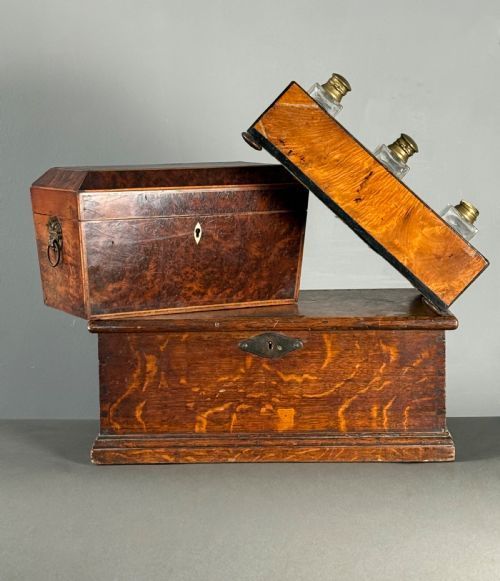
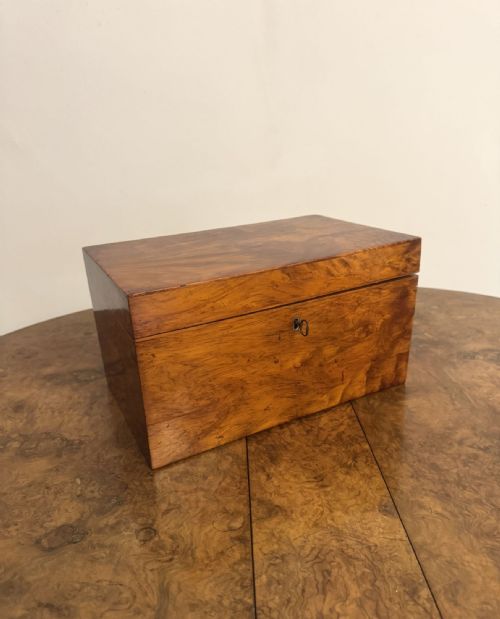


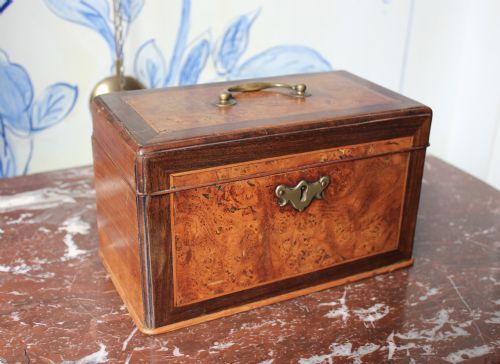

Burr Walnut Tea Box
A burr walnut tea box brings rich grain and practical heritage to a room, offering a compact storage piece with distinct historical presence.
Burr Walnut Tea Box
A burr walnut tea box is a container designed originally to store and preserve dry tea leaves securely. These pieces survive in forms ranging from compact Georgian and 18th-century examples to later Victorian sarcophagus models and tea poys.
The varieties most commonly met on this page span the Georgian and Victorian eras, utilising the distinct figured grain of walnut. They appear as rectangular, dome-topped, semi-circular or sarcophagus shapes, often fitted internally for multiple tea canisters.
How they were made
Cabinetmakers constructed these boxes using a sturdy carcase of oak or secondary wood, then applied thin veneers of burr walnut to the exterior surfaces. Boxwood stringing and brass details frequently provided contrasting borders and secure locking mechanisms.
The distinctive burr pattern arises from growths on the walnut tree, which yielded highly decorative timber slices when cut. Craftsmen matched these figured veneers carefully across the lid and sides to create symmetrical patterns.
Listings feature burr walnut, oak, and boxwood materials across Georgian, Regency, and Victorian periods.
What varies in quality
Quality rests principally on the selection and matching of the burr walnut veneer across the main exterior surfaces. Superior pieces display deep, lively grain patterns that wrap continuously around the corners of the box.
The crispness of inlay work, the preservation of original brass fittings and the integrity of the internal compartments dictate the standing of the piece. Later or simpler examples often show flatter grain patterns and replaced interior elements.
The Burr Walnut Tea Box Glossary
- Burr walnut
- A figured timber taken from the wart or burl of a walnut tree. It produces intricate, swirling patterns highly prized in cabinetmaking.
- Tea caddy
- A box or container made specifically for holding tea. The word derives from catty, a Chinese weight measurement.
- Sarcophagus
- A box shape featuring a sloping, stepped lid resembling a stone coffin. This style became popular during the Regency and Victorian periods.
- Tea poy
- A small stand or table fitted with a tea container on top. They often incorporate internal mixing bowls or canisters.
- Boxwood stringing
- Thin inlay lines of pale boxwood set into the darker walnut veneer. This technique defines edges and geometric panels.
Burr Walnut Tea Box: Frequently Asked Questions
How do I date a tea box?
Dating relies on examining the overall shape, construction methods, and secondary timbers used in the carcase. Georgian pieces often show simpler lines, whilst Victorian versions frequently adopt sarcophagus or dome-top forms.
Internal fittings and lock types also offer clues to the period of manufacture. Earlier boxes tend to use handmade brass hinges and locks distinct from later mass-produced hardware.
Were these boxes used only for tea?
Whilst designed primarily for dry tea leaves when tea was a costly commodity, many boxes transitioned into general storage use. People repurposed them for letters, trinkets, or sewing accessories as social habits changed.
Some larger examples, particularly tea poys, stood on independent pillar bases designed to remain stationary in a drawing room. Their internal compartments made them versatile for small valuables.
How should I care for burr walnut?
Burr walnut requires stable environmental conditions away from direct sunlight and strong heat sources. Excessive dryness can cause the delicate veneers to lift or crack over time.
Applying a traditional beeswax polish occasionally helps maintain the lustre of the timber. Avoid using modern liquid sprays or excessive moisture on antique wood surfaces.