

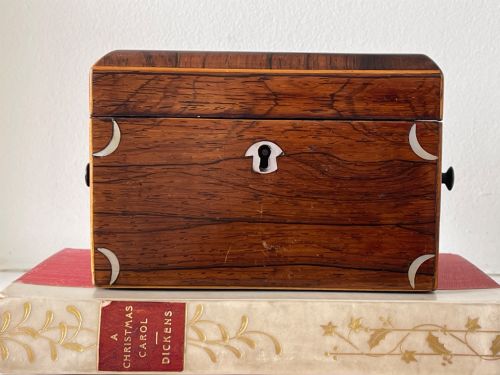

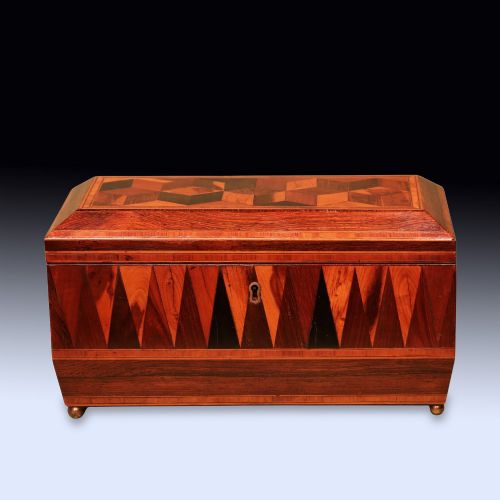


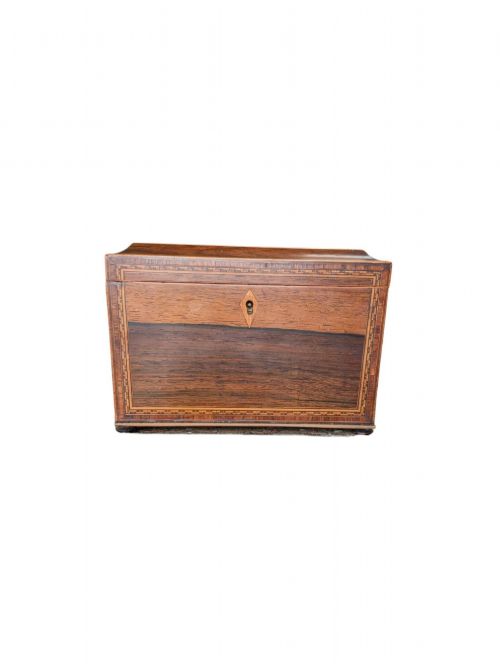


Inlaid Rosewood Tea Box
An inlaid rosewood tea box is a timber chest made to store dry leaves safely, combining dark tropical grain with precision marquetry.
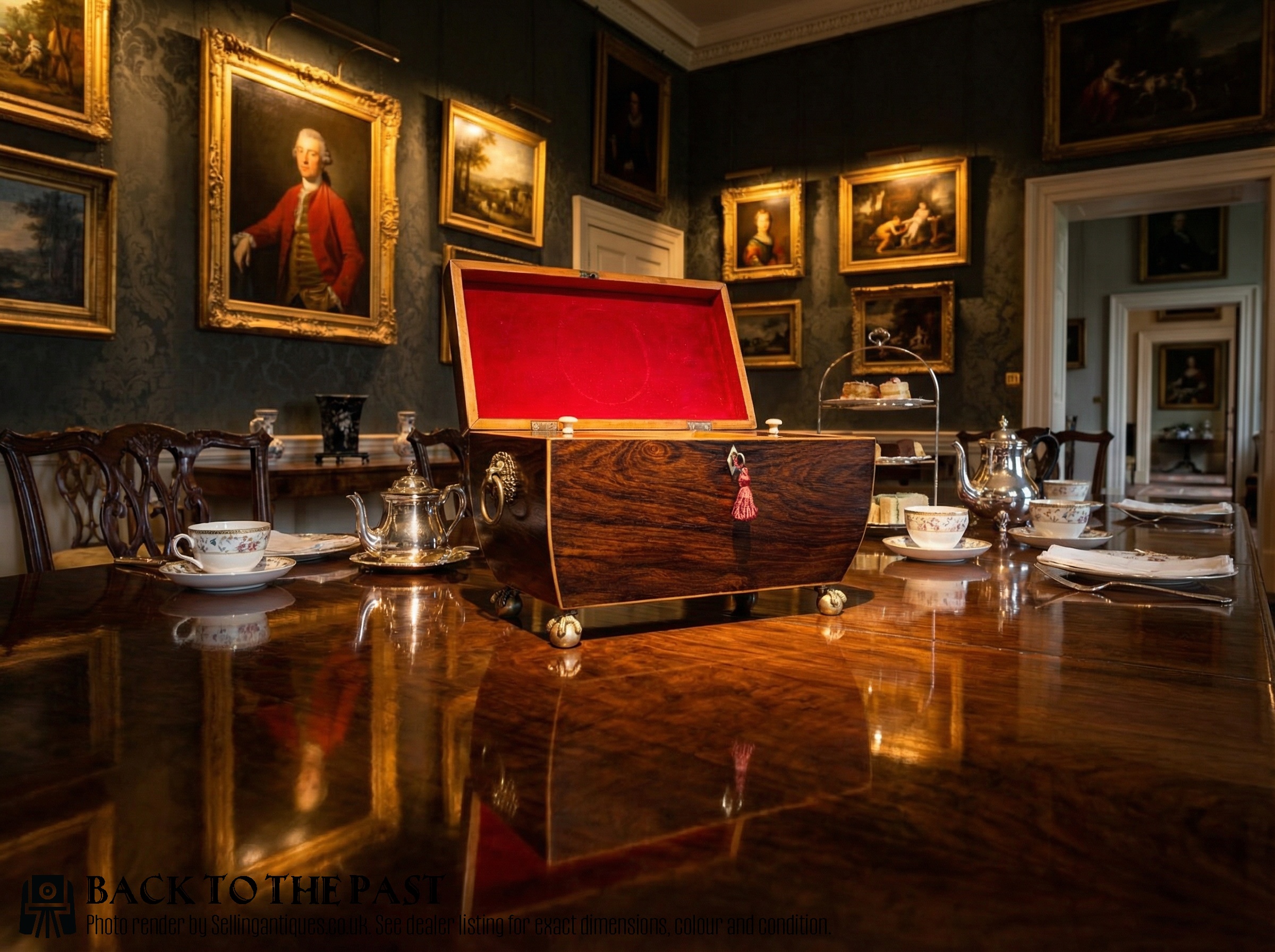
Inlaid Rosewood Tea Box
An inlaid rosewood tea box appears across the nineteenth century in Regency, Georgian and Victorian periods, often taking the heavy sarcophagus shape with fitted internal compartments for loose leaves.
Makers constructed these storage pieces as tea caddies, teapoys on stands, and occasionally sewing boxes, utilising dense tropical timbers decorated with contrasting geometric lines.
The specimens seen here span from the early eighteen-hundreds through to the eighteen-eighties, showing cabinet work from English workshops and specialised regional centres.
Materials and technique
Craftsmen built the carcases from dense rosewood, applying contrasting veneers of boxwood, satinwood and fruitwood to form intricate borders and geometric patterns.
Many examples incorporate inlaid brass stringing and detailed brass escutcheons, alongside tiny mosaic tiles characteristic of Tunbridge Ware production.
Interiors frequently retain remnants of foil lining or feature fitted compartments with bone handles and mother-of-pearl bird and foliate motifs.
Inlaid Rosewood Tea Box Retail Price Guide 2026
Typical asking prices for inlaid rosewood tea box among the pieces listed under this phrase on Sellingantiques today, from the lower quarter to the upper quarter. They describe what is for sale here now, not the wider market.
Some nineteenth-century tea caddies feature hidden compartments so secret that owners occasionally misplaced their favourite leaves for generations.
Quality and craftsmanship
Quality rests in the precision of the parquetry and the alignment of the timber grain across the lid and sides of the box.
Superior examples display crisp brass inlay without gaps, intricate mosaic tesserae, and well-preserved internal lids rather than replaced components.
Henry Hollamby
The Inlaid Rosewood Tea Box Glossary
- Sarcophagus form
- A box shape featuring a domed or stepped lid and a tapering body, popular during the Regency period for larger tea chests.
- Tunbridge Ware
- A type of woodwork originating in Kent involving tiny mosaic tiles assembled from different coloured woods to form pictorial or geometric designs.
- Teapoy
- A small stand or large container supported on a pillar and base, designed to hold tea canisters and mixing bowls.
- Parquetry
- A geometric mosaic of wood pieces used for decorative surfaces on floors and furniture.
- Escutcheon
- A flat plate surrounding a keyhole, usually made of brass to protect the surrounding wood from wear.
Inlaid Rosewood Tea Box: Frequently Asked Questions
What were tea boxes used for?
These boxes stored expensive loose tea leaves securely under lock and key in the parlour.
Tea was a valuable commodity, so the caddy kept dry leaves fresh and protected from household servants.
How do I date a rosewood tea caddy?
Dating relies on the overall architectural shape, such as the heavy sarcophagus form of the Regency era versus later Victorian proportions.
Secondary indicators include the style of brass inlay, internal fittings, and the presence of Tunbridge Ware mosaic work.
What is Tunbridge Ware inlay?
Tunbridge Ware involves gluing together thousands of tiny tinted wood strips to create a mosaic picture or geometric border.
Craftsmen then sliced this bundle crosswise to produce multiple identical decorative panels for box lids.
How do I care for antique rosewood?
Keep wooden boxes away from direct sunlight and sudden temperature shifts to prevent the rosewood veneer from drying and cracking.
Apply microcrystalline wax sparingly to nourish the polished surface without building up residue.