





Inlaid Marquetry Corner Unit
An inlaid marquetry corner unit brings architectural elegance and fine botanical woodwork to neglected angles in a room.
Inlaid Marquetry Corner Unit
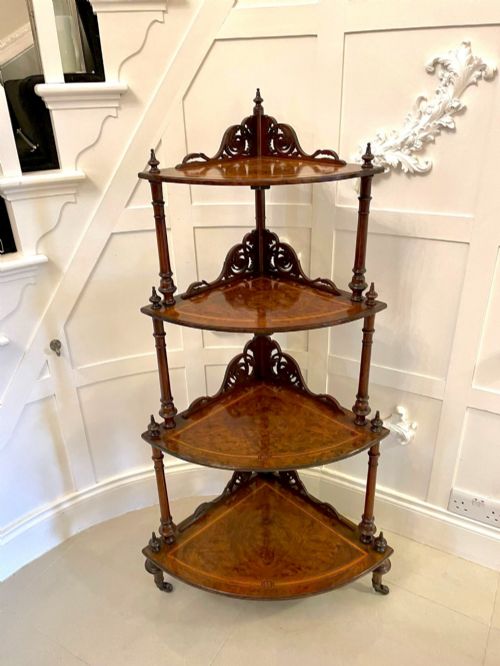
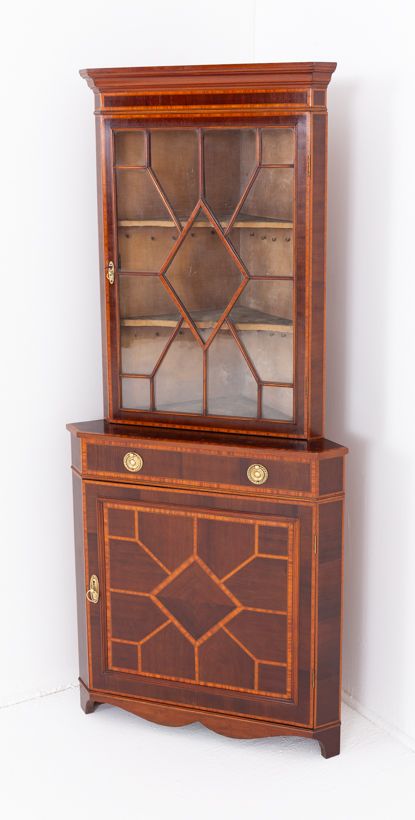
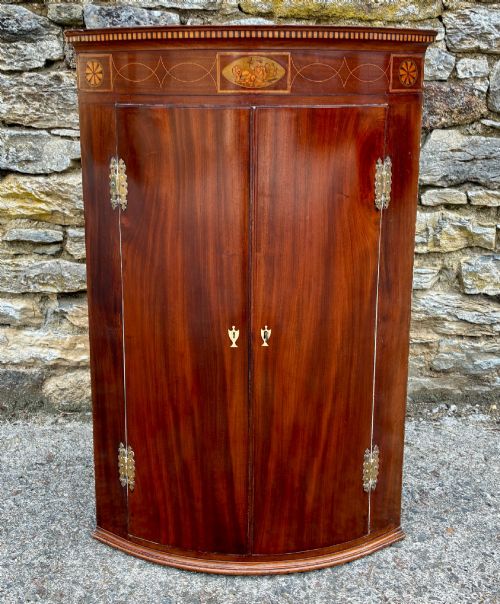
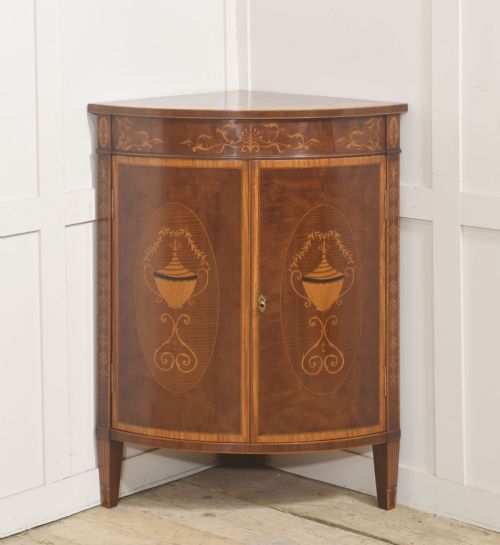
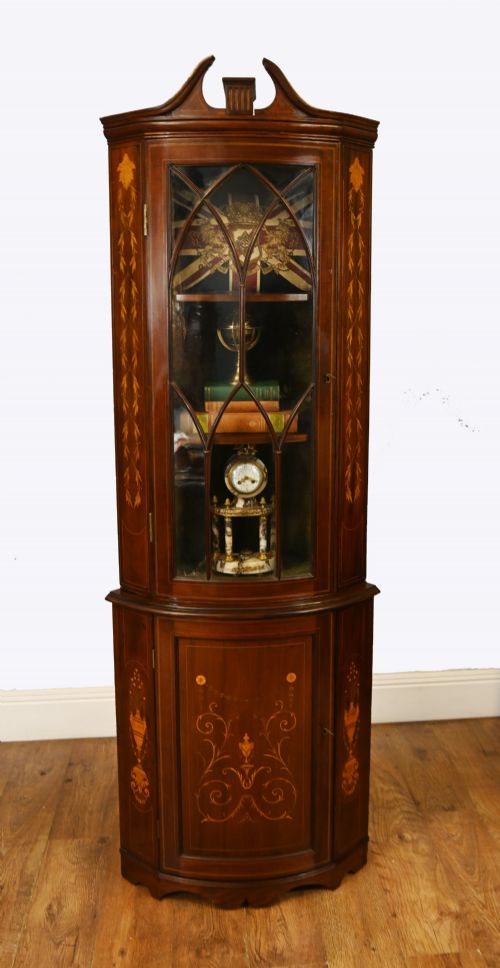
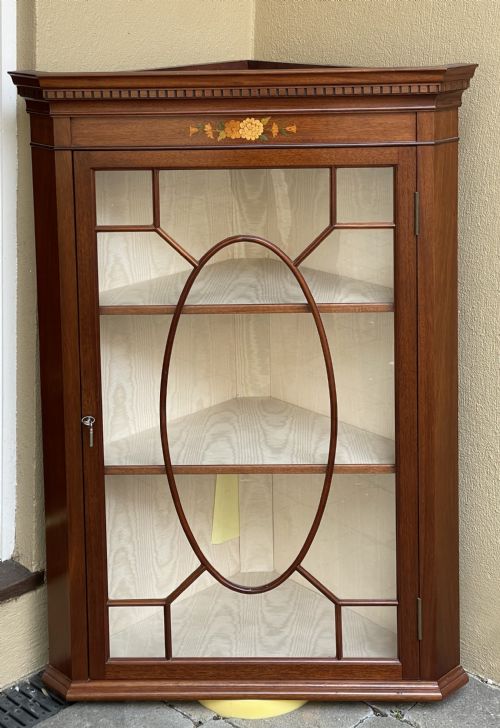
When you search for an inlaid marquetry corner unit, you are looking at fitted timber cabinetry designed specifically to utilise awkward junctions and dead space in period rooms. These pieces take the form of wall-mounted cupboards, glazed display cabinets, and multi-tiered standing whatnots with distinct curved, serpentine, or bow fronts. The selection on this page spans compact Georgian hanging pieces through to substantial Edwardian double-height standing units and Victorian walnut whatnot stands.
The aesthetic vocabulary leans heavily on the Sheraton Revival and Georgian traditions, where symmetry and delicate floral or ribbon motifs dictate the design. Walnut, mahogany, and occasional rosewood provide the dark timber foundation, whilst lighter contrasting woods pick out the intricate surface patterns. Most surviving examples found here originate from the late nineteenth and early twentieth centuries, alongside select Georgian originals and mid-twentieth-century revivals.
Standing corner cupboards dominate the larger formats, often featuring glazed upper doors for porcelain display and solid panelled lower doors enclosing shelf space. Smaller items include tiered shelving units and open corner whatnots designed to hold books or decorative objects without dominating floor area. Each variant utilises the same fundamental geometry, curving outward from a ninety-degree back angle to present a finished decorative facade to the room.
Materials and construction methods
Cabinetmakers built these corner units using solid primary timbers such as mahogany and walnut, often applying fine veneers over stable secondary woods to prevent warping along the wall joints. Structural integrity relied on dovetailed joints for drawers and precise tongue-and-groove housing for the curved interior shelving. Glass panels in display doors were held securely with wooden glazing bars, whilst brass hinges and escutcheons provided durable functional hardware.
The defining characteristic of these pieces is the surface decoration, executed through meticulous marquetry and string inlay using lighter contrasting timbers like satinwood and olive wood. Craftsmen cut thin veneers of various coloured woods by hand, fitting them together like a puzzle to form floral urns, ribbons, and classical scrolls before gluing them to the carcase. This decorative layer was then scraped smooth and polished with shellac or wax to deepen the grain and protect the delicate wood mosaic.
Inlaid Marquetry Corner Unit Retail Price Guide 2026
Typical asking prices for inlaid marquetry corner unit among the pieces listed under this phrase on Sellingantiques today, from the lower quarter to the upper quarter. They describe what is for sale here now, not the wider market.
The documented selection encompasses Georgian hanging cupboards alongside late Victorian and Edwardian multi-tiered standing whatnots.
Distinctions in craftsmanship and design
The distinction between ordinary and exceptional examples rests upon the precision of the marquetry and the architectural ambition of the carcase. Finer pieces display tightly fitted botanical veneers with minimal filler, where individual leaves and petals retain their subtle shading achieved by scorching the wood edges in hot sand. Simpler items rely on repetitive geometric stringing lines rather than pictorial floral scenes.
Structural complexity also separates standard production from top-tier cabinetmaking. Serpentine and bow-fronted standing units require advanced carpentry skills to bend and veneer the timber accurately compared to flat-fronted hanging cupboards. Furthermore, double-height pieces with original glass, functioning locks, and matching upper and lower sections represent a higher tier of original commission.
Edwards And Roberts
The Inlaid Marquetry Corner Unit Glossary
- Marquetry
- Decorative veneer work forming pictorial patterns such as flowers, urns, or scrolls. Craftsmen assemble thin pieces of various coloured woods on a paper backing before gluing the entire mosaic to the furniture carcase.
- Whatnot
- An open set of standing shelves designed for the display of ornaments and knick-knacks. These multi-tiered pieces often feature turned upright supports and corner configurations.
- Bow front
- A convex, outwardly curved furniture facade that softens the geometric rigidity of a room corner. This shape requires specialised joinery to veneer correctly.
- Sheraton Revival
- A late nineteenth-century design movement inspired by the neoclassical furniture of George Sheraton. It is characterised by slender proportions, satinwood inlay, and painted or marquetry motifs.
- Stringing
- Thin lines of contrasting timber inlaid into shallow grooves on a furniture surface. This technique creates delicate borders and frames panels of veneer.
Inlaid Marquetry Corner Unit: Frequently Asked Questions
How do I know if the inlay is antique?
Examine the timber around the inlay for natural shrinkage, slight fading, and the subtle microscopic cracks associated with aged shellac polish. Modern reproductions often use laser-cut synthetic veneers that lack the hand-carved irregularities and warm patina of nineteenth-century work.
Run your fingertips gently across the decorated surface to feel the slight texture of the different wood species. True antique marquetry usually exhibits tiny height variances where the varied grain densities have settled over the decades.
Can corner units fit modern standard rooms?
Most corner units are engineered to fit standard ninety-degree wall junctions, making them surprisingly versatile for contemporary layouts. Because they occupy vertical dead space, they provide storage and display without encroaching on main walking routes.
Take careful measurements of your room's skirting boards and cornices before purchasing, as older walls are rarely perfectly square. Some standing units may require small adjustments at the back edge to sit flush against modern plastered walls.
How should I care for walnut and mahogany veneer?
Protect antique polished wood surfaces from direct sunlight and extreme temperature fluctuations to prevent the underlying veneer from lifting or splitting. Dust regularly with a soft, dry cloth and apply a quality beeswax sparingly once or twice a year to nourish the grain.
Avoid placing damp items or unsealed plant pots directly onto the polished tops, as moisture can penetrate the historic shellac finish. Lift rather than drag these units when repositioning them to protect the delicate corner joints.