




Inlaid Mahogany Nesting Tables
Inlaid mahogany nesting tables offer clever multi-tiered surface space, pairing rich timber tones with delicate decorative banding for flexible room layouts.
Inlaid Mahogany Nesting Tables
Inlaid mahogany nesting tables provide graduated sets of occasional surfaces that slide neatly beneath one another when floor space matters. Buyers searching for these pieces encounter designs spanning the Victorian, Edwardian, and 1930s periods, drawing heavily on Sheraton and Regency styles.
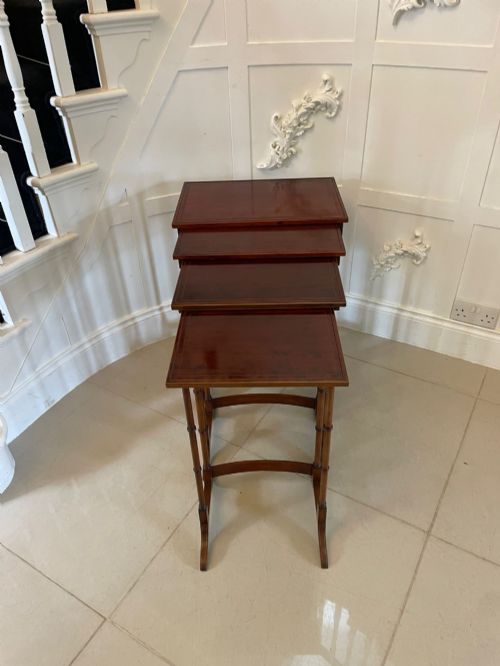
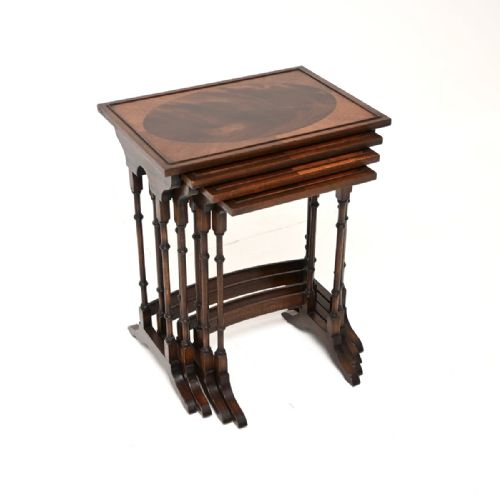
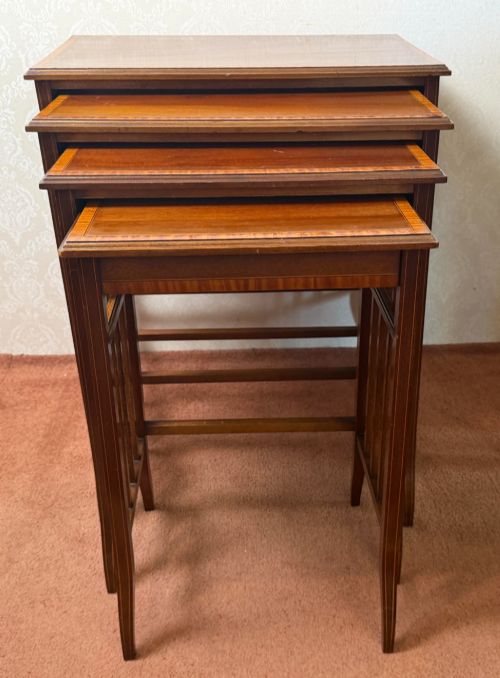
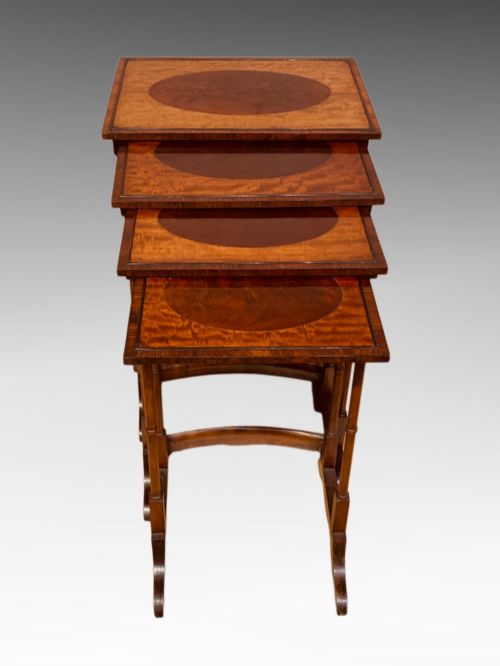
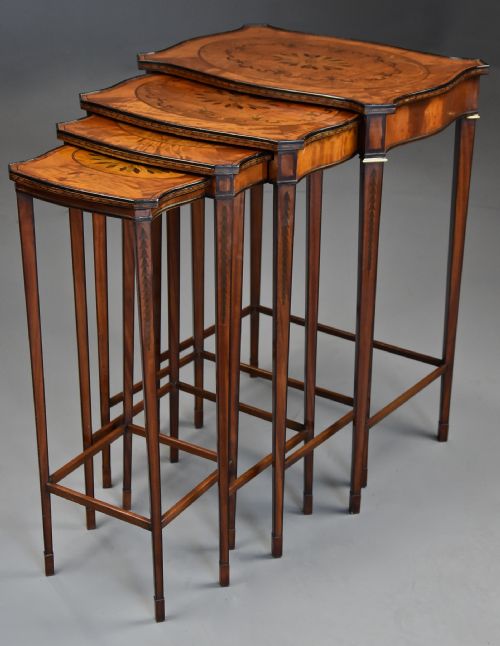
The most common version met on this page is the Edwardian quartetto nest, typically comprising four tables of descending size designed to stack tightly together. These pieces often feature rectangular, serpentine, or kidney-shaped tops supported by slender legs.
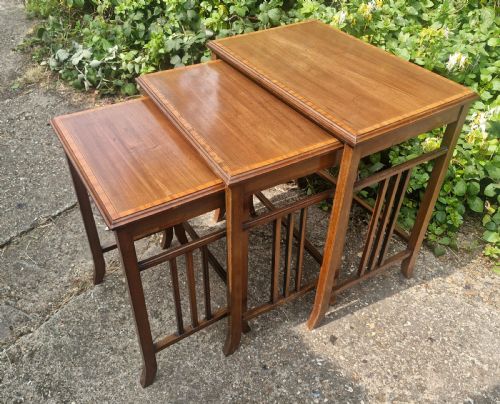
Originating primarily from English workshops, these tables served historically as versatile tea, occasional, or lamp tables that could be deployed across a room as needed. Their enduring appeal lies in combining practical multi-table functionality with refined cabinet-making.
Materials and technique
Cabinet-makers constructed these tables using solid mahogany and mahogany veneers applied to secondary framing, providing a stable yet lightweight foundation for stacking. The timber was frequently selected for its deep grain patterns and polished to a warm, lustrous finish.
Decoration relied heavily on contrasting wood inlays, incorporating satinwood, boxwood, rosewood, and amboyna to create intricate geometric banding, stringing, or floral marquetry motifs. Cross-banding and delicate string lines framed the table tops, highlighting the geometric precision of the maker's hand.
A set with kidney-shaped tops proves that Victorian and Edwardian woodworkers liked to curve things just to show off.
Quality variations
The highest tier of these tables is distinguished by the crispness of the inlay work and the harmonious grain matching across the graduated set of tops. Superior examples maintain structural rigidity when stacked, ensuring each smaller table slides smoothly within its designated channel without binding.
Material selection dictates the upper range, with finer sets utilising richly figured mahogany alongside genuine satinwood or rosewood cross-banding rather than simpler painted or minimal stringing. Proportion and leg taper also separate standard production pieces from exceptionally refined cabinet work.
The Inlaid Mahogany Nesting Tables Glossary
- Quartetto
- A set of four tables designed to graduate in size and nest within one another. This term appears frequently in Edwardian cataloguing for nesting sets.
- Cross-banding
- A strip of veneer applied to the border of a table top with the grain running perpendicular to the central panel. It creates a contrasting visual frame.
- Stringing
- Thin lines of contrasting wood inlay used to outline table edges or legs. This technique adds subtle linear definition to mahogany surfaces.
- Marquetry
- Decorative patterns formed by fitting together small pieces of various veneers into a timber surface. Floral and geometric motifs are typical.
Inlaid Mahogany Nesting Tables: Frequently Asked Questions
What is a quartetto nest?
A quartetto nest is a set of four tables specifically engineered to slide neatly beneath one another into the footprint of the largest single table.
This format gained immense popularity during the Edwardian era for entertaining and saving domestic floor space.
How were these tables used historically?
They served as flexible occasional furniture, deployed around a drawing room for afternoon tea, holding lamps, or writing letters.
When entertaining concluded, the smaller tables simply slid back into the master table to clear the floor.
How do I date an Edwardian piece?
Edwardian nesting tables date from the reign of Edward VII, spanning roughly the first decade of the twentieth century. They often lean heavily on Sheraton Revival aesthetics.
Look for light satinwood inlays, square tapered legs, and construction traits typical of mass-atelier production from that period.
What is satinwood cross banding?
Cross banding involves applying a contrasting border of timber veneer around the edge of a table top.
Using golden satinwood against dark mahogany creates a sharp, bright visual frame characteristic of finer Georgian and Sheraton revival designs.
Are these tables sturdy enough for daily use?
Yes, despite their lightweight appearance and slender legs, they were built to hold small items like tea services or books.
Care should be taken when sliding the smaller tables in and out to avoid scratching the polished interior surfaces.