

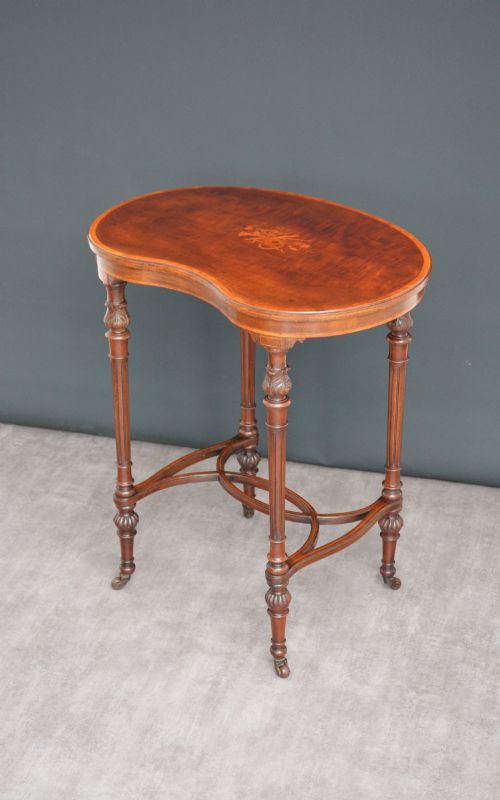
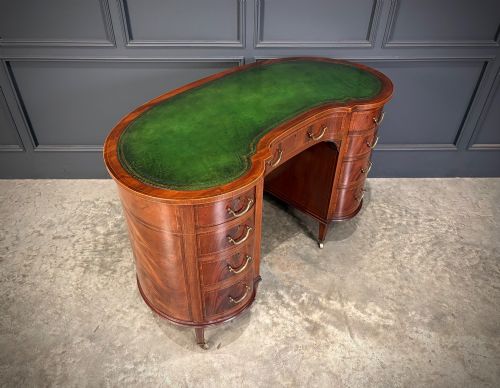
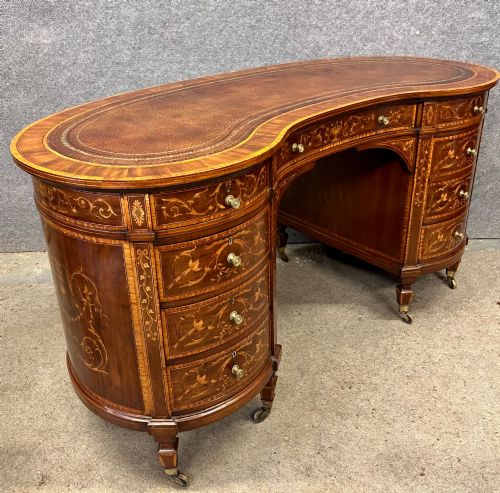
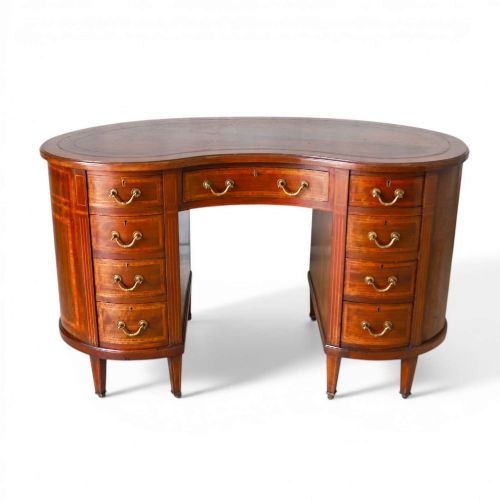



Inlaid Kidney Desk
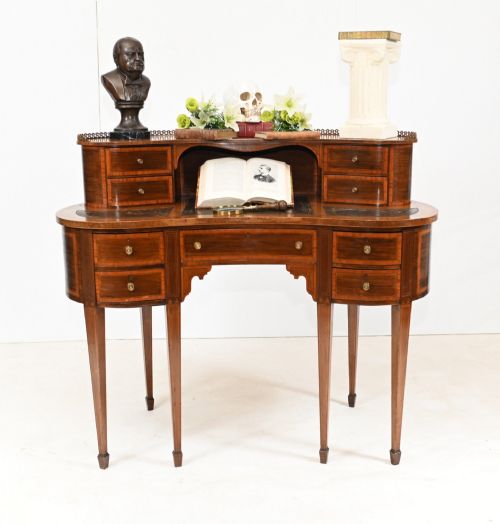
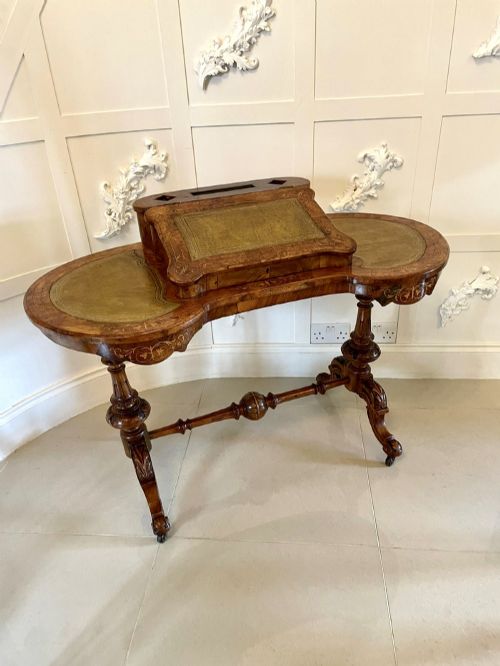
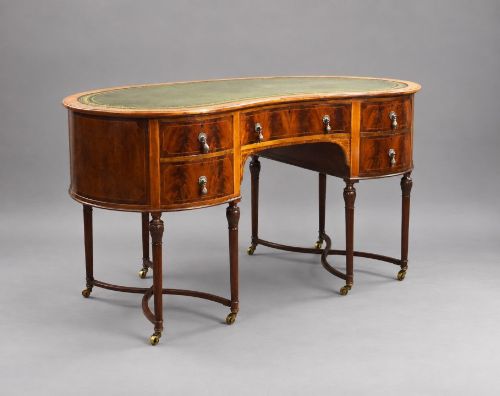
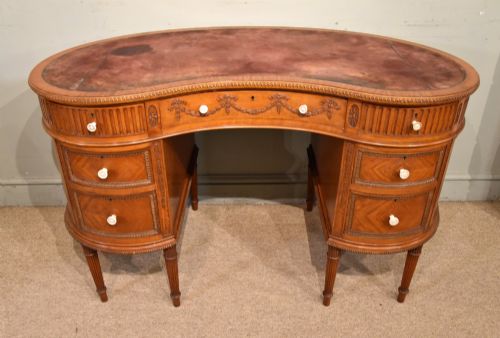
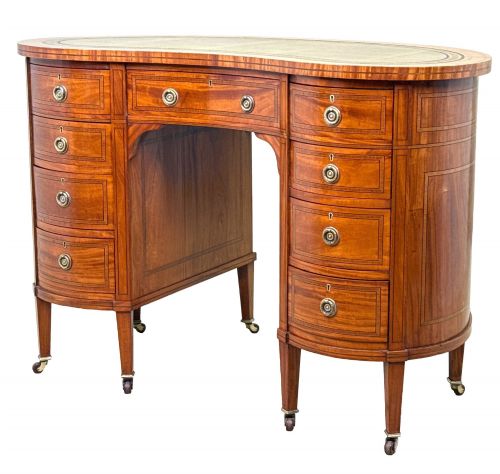
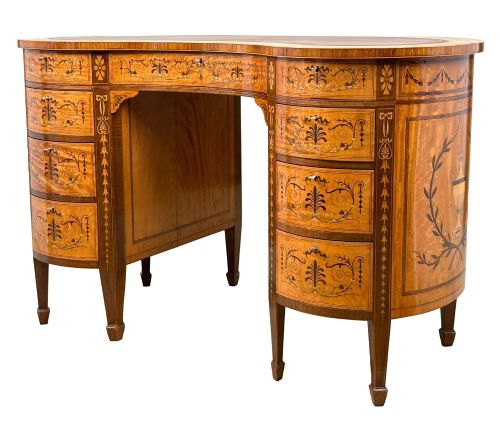
An inlaid kidney desk curves gently around the writer, offering a compact writing surface framed in fine marquetry and satinwood.
Inlaid Kidney Desk
The inlaid kidney desk is a compact writing table distinguished by its curved, bean-shaped top that wraps around the user. These pieces emerge predominantly from the Victorian and Edwardian periods, alongside Sheraton Revival interpretations and French Louis XV style influences.
Most examples found here date from the late nineteenth century through to the Edwardian era, constructed primarily as freestanding lady's writing desks or occasional writing tables. The distinctive concave front allows the user to sit comfortably in the centre while drawers or side compartments remain within easy reach.
Materials and Construction
Cabinet makers utilised solid and veneered timbers such as mahogany, satinwood, burr walnut, and rosewood to form the curved carcasses. Complex satinwood inlay and marquetry create elaborate floral or geometric motifs across the top and drawer fronts.
Many writing surfaces are inset with tooled leather panels, bordered by delicate stringing. Structural detailing often incorporates brass handles, brass gallery rails, and cast or chased ormolu mounts.
Inlaid Kidney Desk Retail Price Guide 2026
Typical asking prices for inlaid kidney desk among the pieces listed under this phrase on Sellingantiques today, from the lower quarter to the upper quarter. They describe what is for sale here now, not the wider market.
Listings feature mahogany, satinwood, burr walnut, and rosewood across Victorian and Edwardian periods.
Evaluating the Pieces
The distinction between standard production and exhibition quality lies in the crispness of the marquetry and the choice of timber veneers. Finely figured flame mahogany or burr walnut with intricate, multi-timber inlay indicates superior workshop execution.
Secondary elements reveal the standard of manufacture, from the neatness of dovetail joints inside the small drawers to the integration of brass mounts and the preservation of the original leather writing surface.
Maple & Co·Edwards & Roberts·Wolfe & Hollander·Gillows·Jas Shoolbred
The Inlaid Kidney Desk Glossary
- Kidney-shaped
- A curving furniture design resembling a kidney bean, featuring a concave front curve that accommodates the seated user.
- Marquetry
- Decorative patterns formed by fitting together thin veneers of different coloured woods, ivory or shell onto a structural base.
- Satinwood
- A durable, lustrous tropical timber with a golden-yellow sheen frequently utilised for fine cabinet work and detailed stringing.
- Ormolu
- Gilded bronze cast and chased into decorative mounts, handles or feet, commonly seen on French revival pieces.
- Sheraton Revival
- A late nineteenth-century design movement recreating the lighter, neoclassical furniture styles associated with George Sheraton.
Inlaid Kidney Desk: Frequently Asked Questions
Where should I place a kidney desk?
Because the finished grain and marquetry usually extend all the way around the back, these pieces function well when placed freestanding in the middle of a room rather than pushed flat against a wall.
Positioning the desk away from direct sunlight protects the delicate wood veneers and keeps the leather writing surface from drying out over time.
How do I care for the leather top?
The inset leather surface responds best to gentle cleaning with a dry or barely damp cloth, avoiding modern chemical solvents that might lift the gold tooling.
Occasional application of a neutral leather balm helps maintain suppleness and prevents the hide from cracking around the wooden borders.
Are these desks comfortable for daily writing?
The curved recess offers an ergonomic wrap-around shape, though the kneehole space is typically shallower and narrower than that of a standard pedestal office desk.
They suit correspondence, laptop work, and occasional writing tasks rather than heavy administrative paperwork.
How do I distinguish Edwardian from Victorian examples?
Victorian models often feature darker timbers like burr walnut and heavier mahogany with deep polish, while Edwardian pieces frequently employ brighter satinwood and lighter Sheraton Revival stringing. Nail construction, drawer linings, and overall aesthetic lightness help clarify the period of manufacture when labels are absent.