
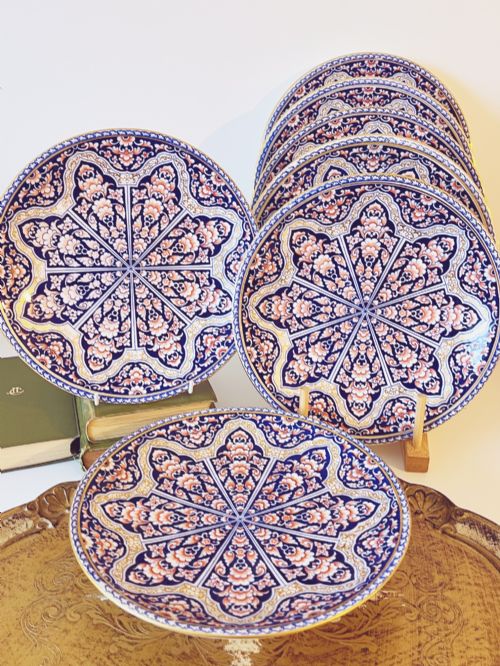
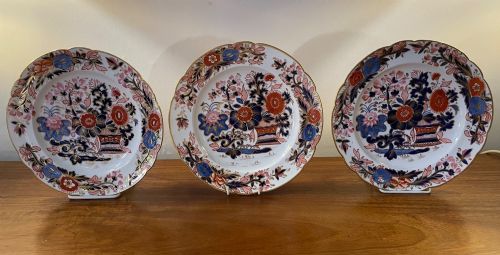


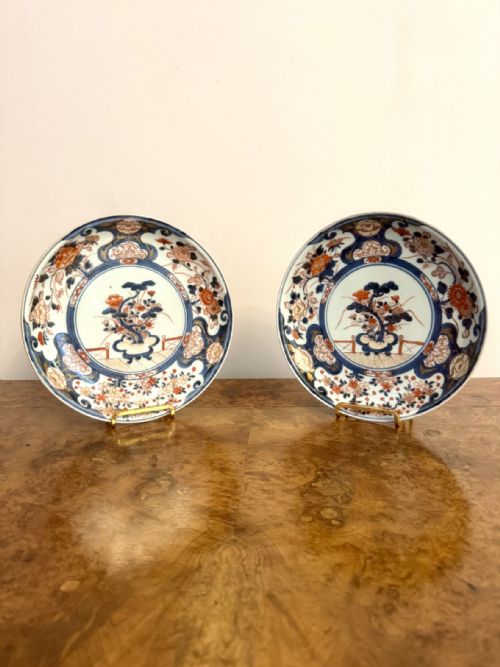
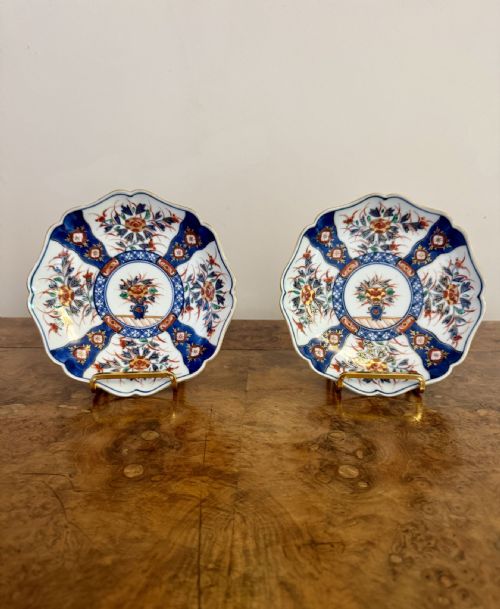


Imari Style Display Plates
These imari style display plates bring together the rich palette and decorative forms that defined late nineteenth-century interiors.
Imari Style Display Plates
When you search for imari style display plates, you encounter an array of ceramic tableware and chargers originating from Japanese workshops as well as English factories. The most common examples on this page date from around nineteen hundred, taking the form of round or scalloped plates shaped primarily for visual display.
The selection spans origins from Japanese Arita production to English houses such as Royal Crown Derby, Mintons, and Worcester. Forms range from single decorative dishes and large chargers to dessert services comprising comports and multiple plates.
Periods represented across the listings stretch from the mid-eighteenth century through the Georgian and Victorian eras up to the early twentieth century. Buyers find both blue and white variations and richly coloured polychrome designs executed in the traditional palette.
How they were made
Potters utilised porcelain, bone china, ceramic, and stoneware as the body for these pieces, applying cobalt underglaze alongside enamel pigments. Gold leaf and gilt details often highlight the painted patterns on both Japanese porcelain and English ceramics.
Hand painting remains a dominant technique across the selection, with artisans applying dense motifs of blue, iron red, and gold directly onto the glazed surface. Firing techniques varied between eastern kilns and English manufactories, resulting in distinct body weights and glaze textures.
Some nineteenth-century dessert services survived intact with an exact tally of seventeen matching plates.
What varies in quality
The distinction between standard production and the finest output rests in the crispness of the hand-painted brushwork and the precision of the cobalt underglaze. Superior pieces exhibit controlled enamel application and well-preserved gilding that remains intact across complex surface patterns.
Form and scale also set individual items apart, with large chargers and matched dessert services commanding attention for their uniform condition across multiple components. Scalloped edges and unusual oval configurations demonstrate greater ambition in ceramic shaping.
Royal Crown Derby·Flight Barr And Barr·John Ridgway·Mintons
The Imari Style Display Plates Glossary
- Imari palette
- A decorative scheme employing cobalt blue, iron red, and supplementary gold leaf. This distinct colour combination originated in Japanese export wares before being adopted by European potteries.
- Charger
- A large decorative plate intended primarily for display on a wall, sideboard, or cabinet rather than for serving food at the table.
- Cobalt underglaze
- A blue pigment applied to the ceramic body before the glaze and firing process. This technique protects the colour beneath a glossy vitrified layer.
- Comport
- A raised dish or bowl designed to hold fruit or sweetmeats as part of a formal dessert service. It frequently appears accompanied by matching plates.
- Bone china
- A type of porcelain incorporating animal bone ash into the paste. English factories utilised this material to achieve a bright white and translucent body.
Imari Style Display Plates: Frequently Asked Questions
How do I hang a heavy charger?
Display chargers require specialist wall mountings that distribute the weight safely across the rim without causing stress fractures to the ceramic body.
Spring-loaded brass hangers padded with protective tubing provide a secure grip for larger porcelain pieces.
Can I use these plates for dining?
Most antique display plates feature delicate overglaze enamels and gilt highlights that wear away under regular use and cutlery contact.
Gentle visual display preserves the surface decoration and protects the historic glaze from scratching.
How do I clean antique porcelain?
Dusting with a dry, soft microfibre cloth removes surface particles without introducing moisture to aged ceramic bodies.
Avoid immersion in water, particularly on pieces with exposed gilt or delicate enamel work.
What is the difference between Japanese and English imari?
Japanese examples typically utilise a dense porcelain body with characteristic cobalt blue and iron red painting executed in Arita workshops.
English interpretations adapt the palette onto bone china or stoneware bodies within factories such as Derby and Worcester.