


Imari Ginger Jar
An imari ginger jar brings rich colour and traditional pattern into a room, joining centuries of ceramic artistry on your shelf.

Imari Ginger Jar
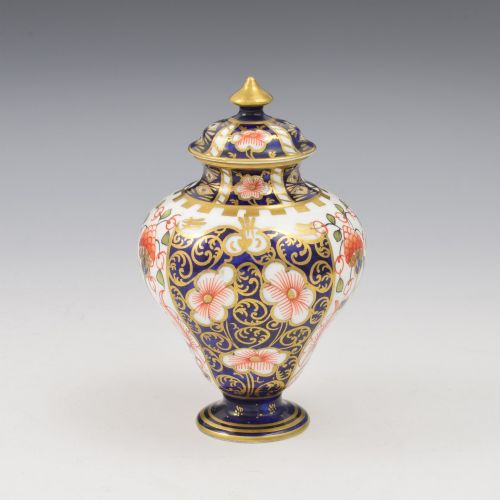
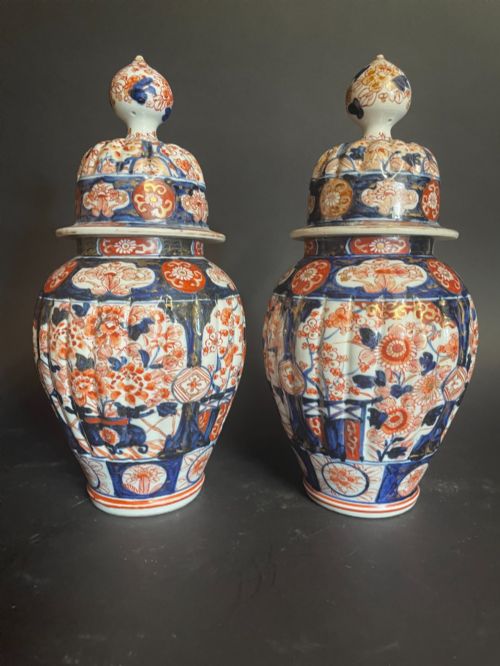
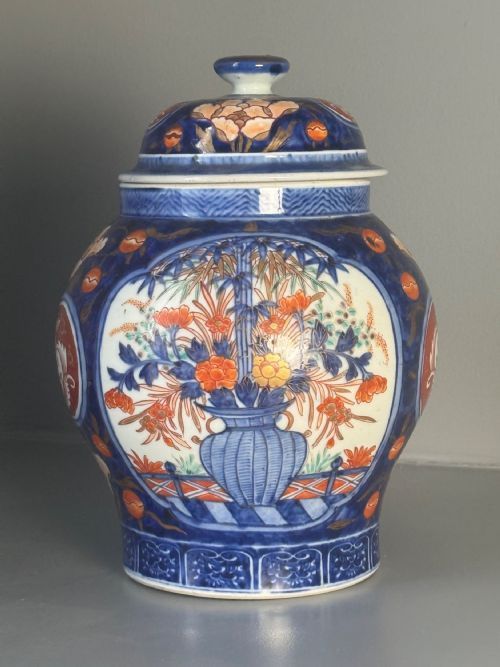
An imari ginger jar is a lidded ceramic vessel designed for storage and display, appearing across this selection in various scales from diminutive examples to large statement pieces. You will most frequently encounter 19th-century Japanese pieces alongside later European adaptations created in the same palette.
The form encompasses covered jars, baluster vases, and octagonal vessels originating from periods spanning the Edo and Meiji eras, as well as Victorian interpretations. These vessels combine functional storage origins with highly decorative characteristics suited for formal display.
How they were made
These vessels utilise hard-paste ceramic and porcelain bodies, shaped by hand or moulded before receiving underglaze and overglaze treatments. The distinctive palette relies on cobalt blue and iron red pigments applied directly to the porcelain body.
Makers integrated gold leaf, gilt, and enamel highlights over the fired glaze to build rich surface detail. Kiln firings set the cobalt under the glaze before secondary firings fused the enamel and gold leaf elements to the exterior.
Some lidded jars survived centuries of domestic shifting while keeping their original matching covers intact.
What varies in quality
Quality rests in the precision of the hand-painted brushwork and the depth of the iron red and cobalt blue pigments. Finer examples display crisp delineation in the motifs and balanced composition across the panels of the jar.
The application of gold gilding and enamel separates standard production from exceptional pieces, with superior vessels retaining rich metallic lustre. The pairing of the original matching cover also elevates the integrity of the piece.
Royal Crown Derby·Samson
The Imari Ginger Jar Glossary
- Imari
- A style of Japanese porcelain decorated in underglaze blue, iron red, and gilt. The term originates from the port city of Imari where wares were shipped from Arita.
- Arita
- The Japanese town renowned as the birthplace of Japanese porcelain production. Kilns here produced the original export wares that defined the aesthetic.
- Baluster
- A jar shape characterised by a rounded body that tapers toward the base and swells above. This form provides a stable silhouette suited for detailed surface decoration.
- Gilding
- The application of gold leaf or gold paint to ceramic surfaces. It provides metallic accents that catch the light against the dark cobalt blue.
Imari Ginger Jar: Frequently Asked Questions
How were imari ginger jars used originally?
These vessels originally served to transport and store spices, ginger, and other valuable commodities along trade routes.
Over time, they transitioned into purely decorative objects placed on mantelpieces and cabinets within affluent homes.
How do I distinguish Japanese pieces from European copies?
Japanese pieces from the Edo and Meiji periods typically exhibit characteristic potting traits and paste variations native to Arita kilns.
European makers such as Samson produced deliberate interpretations during the 19th century, often marked by different weight and glaze characteristics.
How do I safely display an imari ginger jar at home?
Place the jar on a stable, level surface away from high-traffic zones to prevent accidental knocks against the ceramic body.
Keep the vessel out of direct sunlight to protect the stability of the overglaze enamels and gold leaf highlights over time.
How can I tell the period of a lidded jar?
Dating relies on examining the potting technique, the clarity of the cobalt blue, and the wear patterns on the base of the ceramic.
Meiji and Victorian pieces often show distinct decorative density compared to earlier 18th-century production methods.