


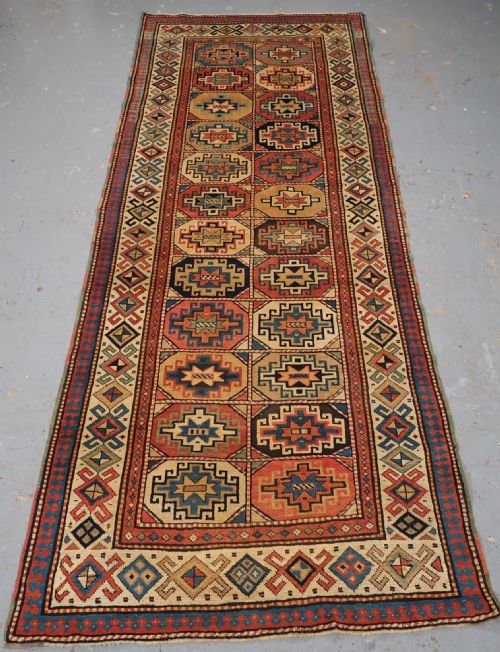


Hooked Medallion Carpet
A hooked medallion carpet delivers striking tribal geometry and rich wool texture straight from nineteenth and early twentieth century weaving traditions.
Hooked Medallion Carpet
Every hooked medallion carpet brings together bold central motifs and nomadic traditions from the Caucasus and Kurdish regions. These floor coverings range from compact area rugs to long runners, shaped by tribal weavers working across the late nineteenth and early twentieth centuries.
The most frequent examples found in this category belong to the Kazak tradition, particularly Moghan and Bordjalou formats, alongside Kurdish and Baluch tribal pieces. They showcase distinctive geometric layouts defined by stepped outlines and latch hook details.
How they were made
Traditional production relies on durable wool and occasional camel hair foundations, spun by hand to withstand generations of daily use. Natural dyestuffs provide the underlying palette, yielding soft colours that weather gracefully over decades.
Weavers knotted these pieces by hand on vertical looms, applying geometric precision to structural patterns like Memlinc guls and multi-medallion layouts. The resulting dense pile secures the bold designs while maintaining a tactile, heavy handle.
Current listings span the decades from 1870 to 1920, utilising wool and camel hair across Caucasian, Kurdish, and Baluch traditions.
What varies in quality
The distinction between average and exceptional pieces rests upon the crispness of the geometric drawing and the subtlety of the wool pile. Finer examples display balanced proportions in their latch hook medallions and harmonious shifts in tone across the field.
Structural integrity and wool quality dictate longevity, with tightly packed knots providing sharper detail and greater resilience. Weaving precision separates standard regional production from masterworks executed with striking clarity.
The Hooked Medallion Carpet Glossary
- Latch hook
- A stepped triangular motif projecting from the edge of a medallion or border. This graphic device is characteristic of Caucasian and tribal weaving.
- Gul
- A repeating octagonal or medallion-like motif used as a primary design element across nomadic carpets. It often identifies the specific tribal group responsible for the weaving.
- Kazak
- A designation for rugs produced in the southern Caucasus region during the nineteenth and early twentieth centuries. They are celebrated for their saturated colours and bold geometric designs.
- Runner
- A long, narrow carpet format traditionally utilised in hallways and corridors. These pieces adapt tribal motifs to a linear perspective.
Hooked Medallion Carpet: Frequently Asked Questions
Where were these carpets made?
These pieces originate primarily from the Caucasus and surrounding tribal regions, including Kurdish and Baluch areas. Local nomadic and village weavers produced them on traditional upright looms.
Production spans the late nineteenth and early twentieth centuries, reflecting distinct regional aesthetics and weaving customs passed down through generations.
How do I care for my carpet?
Regular gentle vacuuming without a beater bar keeps wool fibres free from damaging grit and dust. Professional cleaning by a specialist in antique textiles preserves the natural lanolin.
Positioning the rug out of direct sunlight prevents natural dyes from fading prematurely, ensuring the balanced colours endure for decades of daily enjoyment.
What materials are used?
Construction relies heavily on sturdy handspun wool for both the pile and the foundation threads. Selected examples incorporate camel hair to provide natural tonal variations within the ground.
Natural dyes derived from regional plants and minerals create the soft colour palette seen across these nineteenth-century floor coverings.
How do I identify a Kazak rug?
Kazak pieces typically exhibit bold geometric layouts featuring large medallions, hooked motifs, and primary colours softened by age. The weave is generally heavier and more robust than fine city carpets.
Structural characteristics include wool foundation threads and symmetric knots tied by village weavers in the southern Caucasus.