
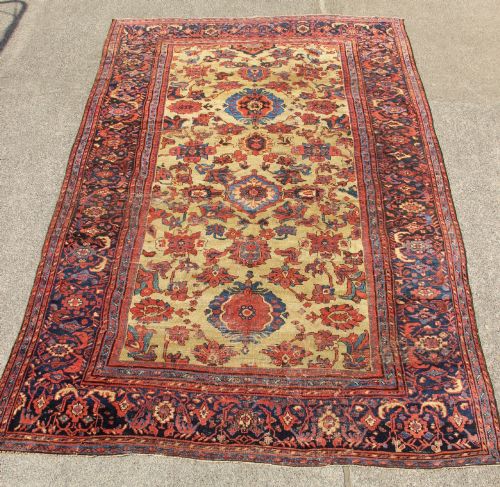
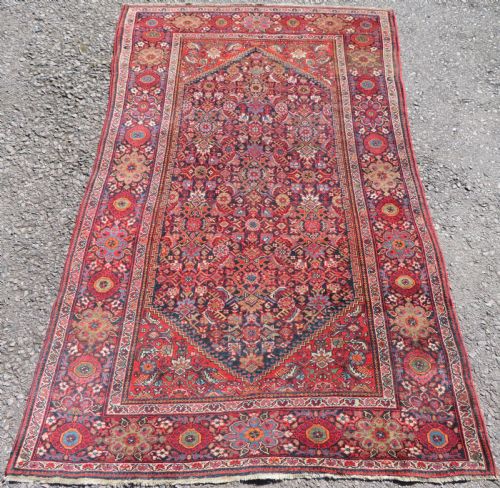


Herati Pattern Persian Rug
A herati pattern persian rug carries a timeless fish and rosette trellis motif across wool pile woven in villages and towns throughout nineteenth and early twentieth century Persia.
Herati Pattern Persian Rug
When you search for a herati pattern persian rug, you encounter traditional room-sized carpets, smaller village rugs, long runners, and delicate kilims woven across Persian regions. These floor coverings are defined by the repeating geometric motif of a central floral rosette enclosed by two curved leaves, often resembling fish.
The selection on this page centres on nineteenth and early twentieth century examples, spanning the periods from eighteen fifty up to nineteen thirty. The origins represented range from specific weaving centres like Fereghan, Malayer, Senneh, Bidjar, and Tabriz to broader tribal groups including Baluch, Afshar, and Qashqai.
Buyers looking at these pieces will find both large gallery carpets exceeding five metres and compact pushtis or area rugs. The format varies from square formats to long narrow kelleh carpets designed for specific hallway and chamber layouts.
How they were made
The foundation of these textiles relies upon sturdy cotton warps and WEFTS that support a dense wool pile hand-knotted by village and tribal artisans. Some flatwoven kilim varieties are constructed entirely without pile through interlocking weft techniques.
Dyes derived from natural materials impart deep tones of indigo blue, madder red, and unusual ground colours such as lemon. Artisans tied the knots by hand using traditional Persian weaving methods passed down through generations in workshops and nomadic tents.
Herati Pattern Persian Rug Retail Price Guide 2026
Typical asking prices for herati pattern persian rug among the pieces listed under this phrase on Sellingantiques today, from the lower quarter to the upper quarter. They describe what is for sale here now, not the wider market.
The listings on this page span the nineteenth and early twentieth centuries, constructed from wool and cotton.
What varies in quality
Knot density and precision of line separate the finer city carpets from coarser tribal village pieces, determining how sharply the repeating trellis geometry stands out. Superior wool quality gives certain examples a softer handling and deeper lustre that improves with age.
The crispness of the drawing in the central repeating motifs and the harmony of the secondary border proportions indicate the skill of the original workshop or weaver. Original edge bindings and intact end finishes preserve the structural integrity of the textile over centuries.
Fereghan·Malayer·Senneh·Bidjar·Tabriz
The Herati Pattern Persian Rug Glossary
- Herati design
- A traditional repeating Persian motif composed of a central flower surrounded by four leaves, frequently flanked by curved lancet leaves often likened to fish swimming around a pond.
- Kelleh
- A long, rectangular format carpet traditionally used in Persian domestic interiors to flank larger centre carpets or fit narrow rooms.
- Kilim
- A flatwoven textile produced without a pile, created by tightly interlocking the coloured weft threads through the warp.
- Pushti
- A small scatter rug or mat, typically used as a cushion or placed on a small section of floor.
- Warp
- The stationary vertical threads stretched onto a loom that form the structural foundation of a woven rug.
Herati Pattern Persian Rug: Frequently Asked Questions
What is a herati pattern?
The herati pattern is a classic repeating Persian motif featuring a central floral head framed by curved leaves that resemble fish. It appears across various carpet types from both settled towns and nomadic tribes.
This geometric arrangement creates an all-over field design that can expand across large gallery carpets or fit compactly onto smaller area rugs.
How do I identify a Fereghan carpet?
Fereghan carpets originate from the Fereghan region of Persia and typically display finely knotted wool pile on cotton foundations. They often feature dense herati designs woven in subtle tones of indigo and madder.
These pieces date predominantly from the nineteenth century and are recognised for their durable construction and refined village aesthetic.
Where were Bidjar rugs made?
Bidjar rugs are produced by Kurdish weavers in and around the town of Bidjar in western Persia. They are renowned for heavy, rigid foundations and tightly packed pile.
This robust construction method earned them a reputation among collectors for exceptional longevity and resilience under heavy foot traffic.
What is a kelleh carpet?
A kelleh is a specific long and narrow Persian carpet format that is shorter than a full gallery runner but longer than a standard area rug. It was traditionally utilised in specific architectural spaces within traditional Persian homes.
These elongated proportions make them suitable for corridors, hallways, or alongside larger furniture groupings.
Are Senneh rugs flatwoven?
Senneh production includes both finely knotted pile rugs and flatwoven kilims created without a pile. Both variants frequently showcase precise geometric medallions and detailed herati or boteh motifs.
Originating from the town of Senneh in western Persia, these textiles are prized for their delicate drawing and intricate craftsmanship.