
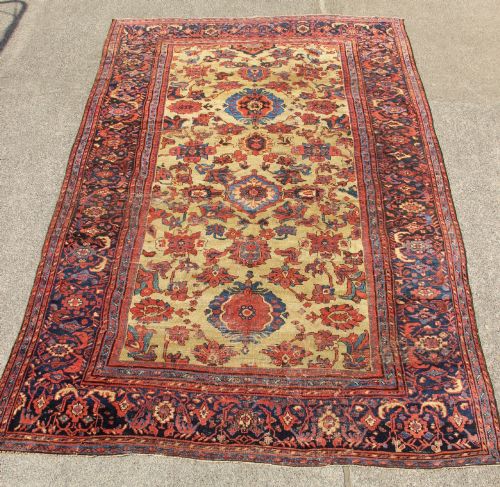
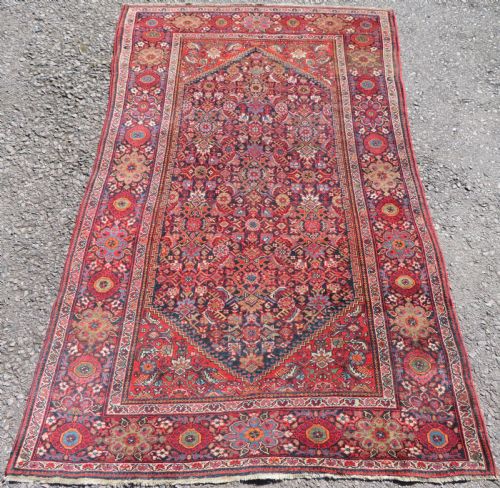


Herati Pattern Carpet
A herati pattern carpet brings centuries of Persian weaving tradition into a room through its repeating floral lattice.

Herati Pattern Carpet
A herati pattern carpet displays a repeating design of a central rosette enclosed by lancet leaves, often called the fish pattern in traditional rug terminology. The pieces available span from the nineteenth century into the early twentieth century, originating from regions such as Fereghan, Malayer, Senneh, and Bidjar. Buyers encounter formats ranging from smaller scatter rugs and runners to large gallery carpets and square carpets.
The regional variations reflect distinct weaving communities across Persia, including tribal village workshops and larger urban centres. Listings frequently record traditional Persian styles such as Ferahan, Afshar, and Qashqai alongside general Persian classifications. These textiles serve as both functional floor coverings and historical examples of classical oriental carpet design.
How they were made
Weavers constructed these carpets using wool pile knotted onto a cotton foundation, providing both structural stability and a soft surface texture. Artisans utilised hand-spun yarns dyed with natural colorants, yielding the deep reds, blues, and occasional unusual ground colours seen in the regional weaving traditions. The knotting density and pile height varied according to whether the piece came from a settled urban workshop or a nomadic tribal loom.
Herati Pattern Carpet Retail Price Guide 2026
Typical asking prices for herati pattern carpet among the pieces listed under this phrase on Sellingantiques today, from the lower quarter to the upper quarter. They describe what is for sale here now, not the wider market.
The listings span from the nineteenth century to the early twentieth century, utilising wool pile on cotton foundations.
What varies in quality
Quality rests in the precision of the drawing and the complexity of the repeating motifs across the field. Finer knots per square centimetre allow for sharper definition within the intricate floral details and the surrounding borders. The choice of wool quality and the depth of the dye saturation further separate standard village productions from master-woven examples.
The Herati Pattern Carpet Glossary
- Herati design
- A repeating ornamental pattern composed of a central flowerhead surrounded by four curved leaves and flanked by two lancet leaves. This motif forms the primary decorative field across many classical Persian carpets.
- Kelleh
- A long, narrow carpet format traditionally used in Persian domestic interiors, typically longer than a standard rug but narrower than a full room-size carpet.
- Kilim
- A flat-woven textile produced without a pile, constructed by tightly interweaving warp and weft strands to create a flat surface.
- Medallion
- A central ornamental design motif placed in the middle of the carpet field, frequently seen in Persian tribal and village rugs.
Herati Pattern Carpet: Frequently Asked Questions
How do I place a herati pattern carpet in a modern room?
These carpets work well as grounding elements in contemporary spaces, adding texture and historical pattern to wooden floors or neutral stone tiles. Their repeating floral motifs bridge the gap between traditional and minimalist interior schemes.
Larger formats anchor main living areas or dining spaces, while runners and smaller rugs suit hallways, studies, or bedside placement. The subdued natural dyes typical of nineteenth-century pieces complement both muted and saturated interior colour palettes.
What is the difference between Fereghan and Bidjar carpets?
Fereghan carpets, originating from the west Persian region, typically feature supple wool, intricate all-over herati patterns, and a refined weave. They are known for a softer handle and delicate floral detailing.
Bidjar carpets, often woven by Kurdish tribes, possess a much heavier and stiffer construction due to a unique damp-beating technique used during weaving. This dense foundation creates an exceptionally durable carpet designed for heavy daily use.
How do I care for an antique wool carpet?
Routine maintenance involves gentle vacuuming without a rotating brush roll to prevent snagging the wool pile. Professional cleaning by a specialist in antique textiles ensures the natural lanolin in the wool remains intact.
Keeping the carpet out of direct, prolonged sunlight preserves the organic dyes used in the nineteenth-century production process. Rotating the piece periodically ensures even wear across high-traffic areas.
Are these carpets made with natural dyes?
The pieces listed from the nineteenth and early twentieth centuries predominantly utilise natural dye sources derived from plants, roots, and insects. These organic colorants produce rich, complex tones that age gracefully over decades.
Subtle variations in colour, known as abrash, often occur naturally within the wool due to small shifts in dye batches. This tonal shading adds depth and authenticity to the surface appearance of the carpet.