




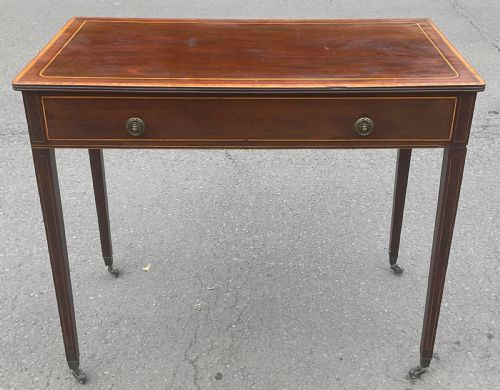

Hepplewhite Writing Table
These hepplewhite writing table pieces combine Georgian proportion with refined timberwork, offering a practical workspace shaped by eighteenth-century design.
Hepplewhite Writing Table
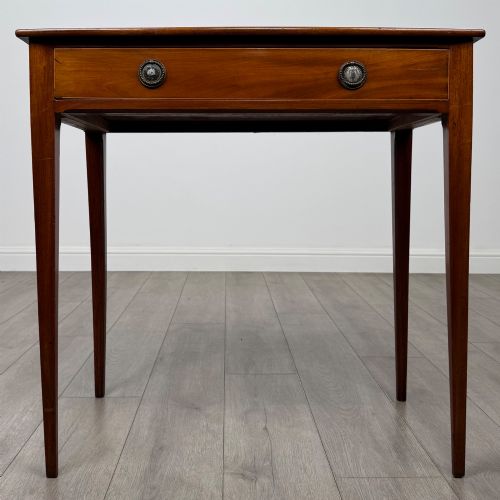
When searching for a hepplewhite writing table, a buyer explores pieces designed in the elegant eighteenth-century style associated with George Hepplewhite. The examples on this page span Georgian periods alongside later nineteenth-century interpretations and revivals.
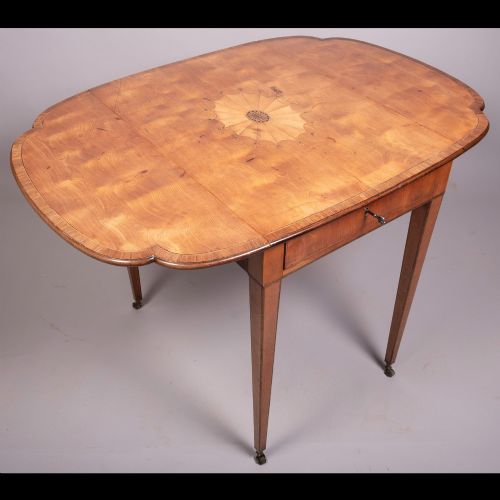
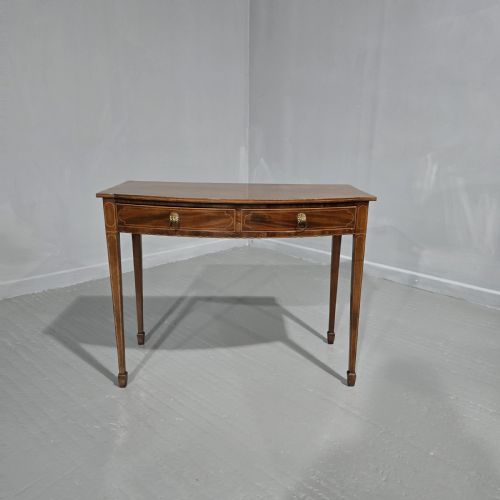
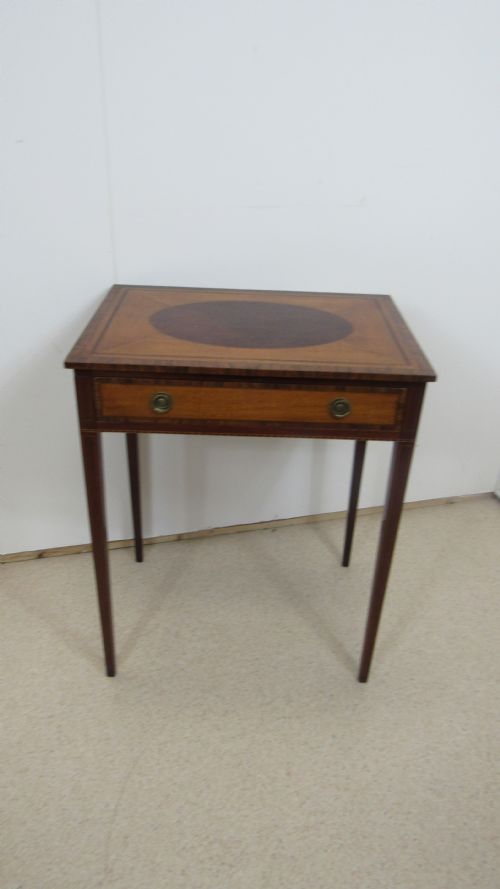
Forms extend beyond standard desks to encompass tambour estate desks, serpentine side tables, Pembroke tables, and dressing tables. Mahogany and satinwood predominate, frequently detailed with boxwood inlay and marquetry.
Victorian reproductions and revivals sit alongside pieces from the 18th century, demonstrating enduring demand for these lighter, more graceful proportions compared to heavier earlier furniture.
How they were made
Cabinetmakers constructed these tables primarily in mahogany and satinwood, utilising contrasting timbers like boxwood and tulipwood for delicate stringing and inlay. Brass hardware completed the fittings on drawers and writing compartments.
Surfaces often incorporated leather inserts for writing, while advanced pieces featured tambour shutters, folding flaps, and secret rising compartments that demanded precise joinery.
Several ladies worktables hide multiple secret rising compartments, designed to keep correspondence entirely private from visiting guests.
What varies in quality
The standard of a hepplewhite writing table rests on the crispness of its inlay and the choice of timber figure, such as well-matched mahogany or figured satinwood. Superior execution appears in the balanced proportions of serpentine fronts and tapered legs.
Complexity of function distinguishes finer examples, particularly those incorporating metamorphic mechanisms, tambour slides, or multiple secret compartments executed with smooth mechanical action.
The Hepplewhite Writing Table Glossary
- Tambour
- A flexible sliding shutter formed of narrow vertical strips of wood glued to canvas. It conceals pigeonholes and writing surfaces.
- Marquetry
- Decorative patterns created by fitting different woods and veneers into a glued matrix. It ornaments tabletops and drawer fronts.
- Serpentine
- A gently undulating line forming a convex centre flanked by concave curves. It defines the profile of drawers and tabletops.
- Metamorphic
- Furniture designed to transform its shape or function through hidden mechanisms. These pieces shift from tables into desks or dressing units.
Hepplewhite Writing Table: Frequently Asked Questions
Are all these tables from the eighteenth century?
The selection includes pieces from the Georgian eighteenth century alongside nineteenth-century Victorian interpretations and later revivals.
Construction details and secondary timbers help distinguish original eighteenth-century examples from later revival pieces.
What is the difference between a Pembroke table and a writing table?
A Pembroke table incorporates drop leaves supported by hinged brackets, offering an adaptable surface that expands when needed.
Writing tables focus primarily on a fixed writing surface and integrated drawer storage for correspondence.
How do I identify Hepplewhite style features?
Characteristic elements include tapered spade feet, delicate boxwood stringing, and curved serpentine or bowfront outlines.
The aesthetic values lightness and symmetry over the heavy mass of earlier furniture styles.
Did these tables include fitted compartments?
Many examples feature fitted interiors with small drawers, pigeonholes, and occasionally secret rising compartments for papers.
Estate desks and tambour models specifically incorporate complex internal arrangements for organisation.