



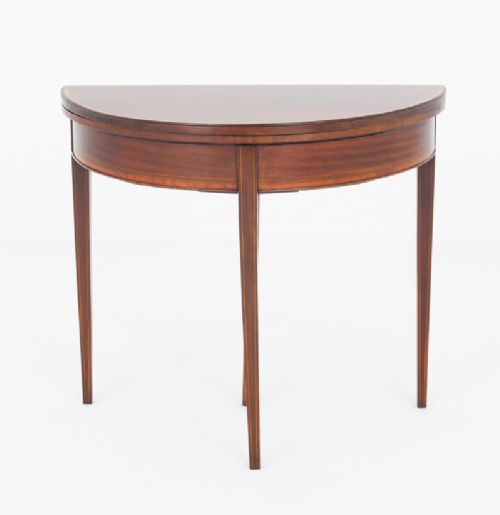


Hepplewhite Demi Lune Table
A hepplewhite demi lune table brings refined neoclassical curves and rich timbers to a hallway or drawing room.
What these tables are
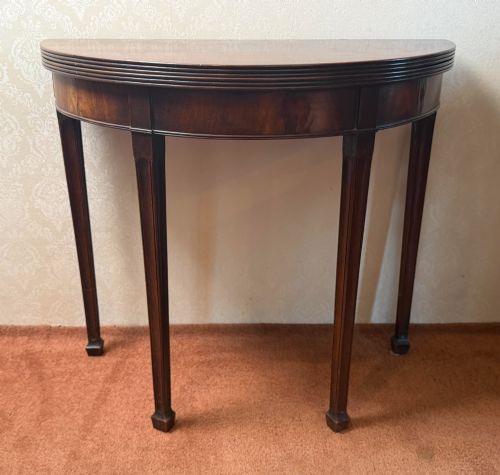
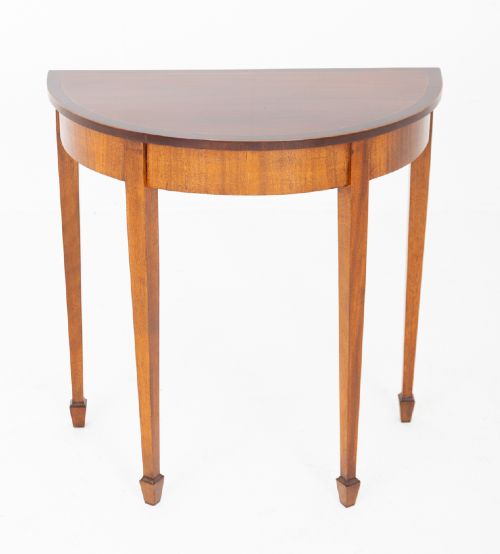
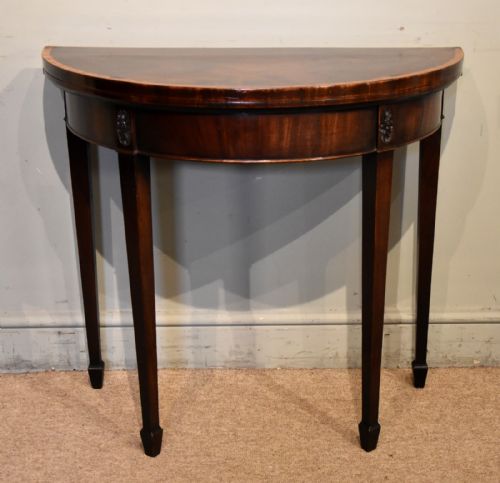
The hepplewhite demi lune table is a half-moon shaped furniture form that sits flat against a wall, frequently designed to double as a card table or tea table with a fold-over top. These pieces emerge predominantly from the Georgian and George III periods, extending into the Victorian era, as shown across 18th Century and 19th Century examples.
The aesthetic relies on the graceful crescent silhouette, paired with flat backs that allow the furniture to conserve space while delivering a formal presence.
How they were made
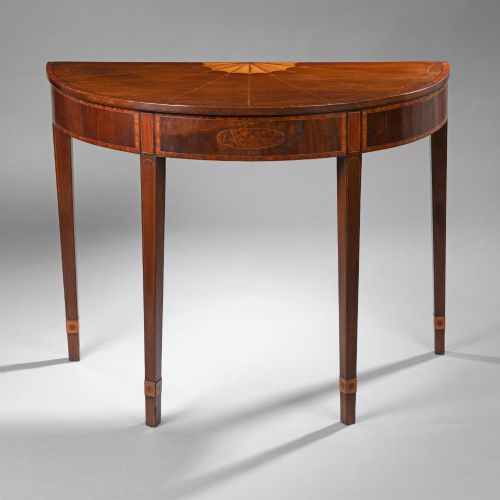
Cabinet makers utilised solid mahogany and wood veneer over secondary timbers, applying boxwood inlay and boxwood stringing to define the crescent edges. Satinwood and rosewood appear in select examples, providing lighter contrasting borders against darker primary woods.
Construction techniques involve precise wood veneer application for the curved tops and aprons, supported by straight or tapered legs that follow the architectural demands of the period.
Retail Price Guide 2026
Typical UK retail prices for hepplewhite demi lune table, calculated from the Sellingantiques database of over a million retail prices indexed since 2003. This retail price guide relies exclusively on Sellingantiques data; no external sources or auction records are used, so the figures do not describe the wider market.
A fold-over top hides a secret inner space designed for storing packs of playing cards out of sight.
What varies in quality
Quality rests in the precision of the boxwood inlay and the selection of the mahogany grain across the curved top. Finer examples display meticulous timber matching and crisp geometric stringing that accentuates the semi-circular outline.
The sophistication of the secondary veneers, such as satinwood and rosewood integration, distinguishes standard production from more ambitious cabinet work.
The Hepplewhite Demi Lune Table Glossary
- Demi-lune
- Half-moon shape. This architectural profile allows the table to stand flat against a wall while projecting a curved front into the room.
- Card table
- A folding table intended for gaming. The hinged top opens to reveal a baize-lined surface supported by a swing leg.
- Inlay
- Contrasting wood set into the surface. Boxwood lines the edges of the mahogany top to create crisp geometric borders.
- Veneer
- Thin slices of decorative wood applied to a base timber. This technique enables complex grain patterns across curved surfaces.
Frequently Asked Questions
How were demi lune tables used?
These tables functioned as side furniture or console pieces against walls in formal rooms.
Many versions converted into card tables or tea tables when entertaining guests.
What is a fold over top?
A fold over top consists of two matching wooden leaves hinged together along the back edge.
When closed, the table forms a narrow half-moon console, and when opened, it provides a full surface for cards or tea.
Which woods are most common?
Mahogany forms the primary structure for the majority of these tables, supplemented by boxwood inlay.
Satinwood and rosewood also appear in select George III examples to provide contrasting borders.
How do I date a table?
Dating relies on observing the structural materials, joinery methods, and decorative styles associated with Georgian and Victorian periods.
Evidence from the 18th Century and 19th Century helps establish the likely era of manufacture.