
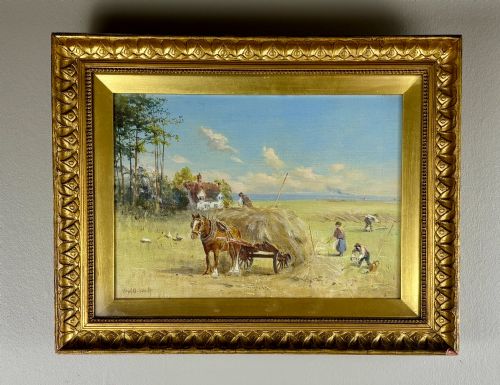
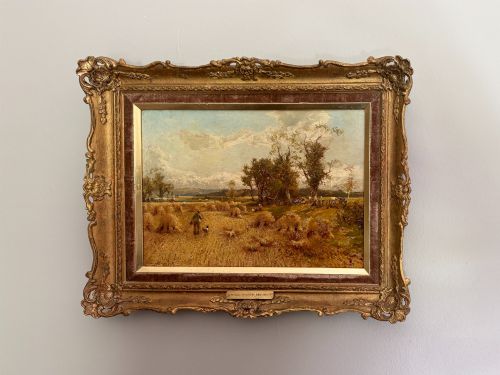
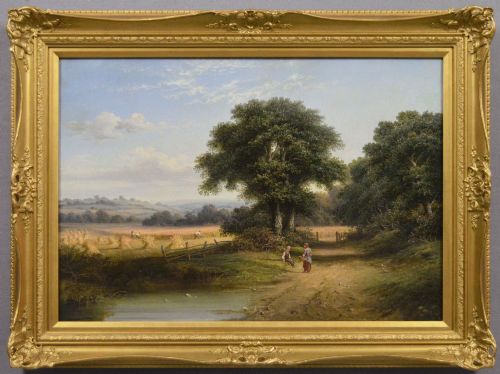


Harvest Landscape Oil Painting
These harvest landscape oil painting works capture agricultural toil and rural calm, offering buyers a window into nineteenth and twentieth century country life.
Harvest Landscape Oil Painting
A harvest landscape oil painting typically portrays figures gathering crops, haymaking, or working fields against pastoral backdrops. Buyers encounter compositions ranging from Victorian rural naturalism to British and Scottish impressionism.
The pieces on this page span the nineteenth and twentieth centuries, incorporating styles such as Edwardian pastoral and impressionist realism. Artists frequently record specific regional locales, from Sussex cornfields to Yorkshire valleys and Scottish highlands.
Subjects commonly include farmworkers with horses, hayricks, hop-kilns, and coastal agricultural scenes. These works document traditional farming methods before mechanisation altered the rural workforce.
Materials and Technique
Painters executed these works primarily using oil paint applied to stretched canvas or wooden panels. Pigments were manipulated to render the varied textures of wheat, hay, earth, and sky.
Frames frequently employ giltwood and gold leaf construction, complementing the warm tones of the rural scenes. Brushwork varies from tight Victorian academic detail to looser impressionistic strokes seen in later periods.
The inventory records regional landscapes from Sussex, Nottinghamshire, Yorkshire, and Scotland.
Judging Quality
Quality rests upon the artist's ability to handle atmospheric light, particularly the low sun of harvest time or approaching storms. Superior works demonstrate accomplished rendering of human figures and working horses in motion rather than stiff, generic placeholders.
Compositional balance and the preservation of the original paint surface determine the distinction between masterworks and lesser studio output. Original period framing also contributes to the integrity of the piece.
Walter Heath Williams·Henry John Boddington·James William Booth·Henry H Parker·Herbert Royle·Arthur Walker Redgate·Joseph Paulman·George Cole·William Greaves·Alfred Augustus Glendening Snr·John Clayton Adams·Charles H Passey
The Harvest Landscape Oil Painting Glossary
- Canvas
- A heavy woven fabric stretched across a wooden frame to serve as a support for oil painting. It provides the characteristic texture found on the majority of these pastoral works.
- Giltwood
- Wood carved and covered with a thin layer of gold leaf or metallic powder. This material frequently frames nineteenth-century paintings to enhance their visual weight.
- Rural Naturalism
- An artistic movement focusing on realistic depictions of agricultural labour and country life. Practitioners avoided romantic idealisation in favour of honest portrayals of farmworkers.
- Impressionism
- A style emphasising accurate depiction of light and unblended brushstrokes. British and Scottish variations applied these principles to native agricultural landscapes.
Harvest Landscape Oil Painting: Frequently Asked Questions
How do I date a harvest landscape oil painting?
Dating relies on stylistic clues, costume details of the figures, and framing materials. Victorian works often show tighter academic brushwork, while twentieth-century examples lean towards impressionistic techniques.
Pictorial evidence such as the style of agricultural machinery or horse-drawn implements also helps narrow the decade of creation.
Where should I hang these paintings?
These works suit dining rooms, libraries, or living spaces where traditional wooden furniture complements the gilt frames and earthy palettes. They require placement away from direct sunlight to protect the oil pigments.
Adequate wall space allows larger pastoral canvases to anchor a room without competing with surrounding decor.
What subjects appear in these scenes?
Common motifs include haymaking, wheat harvesting, hop-picking, and farmworkers resting with horses and dogs. Artists frequently set these scenes in named British regions.
Weather conditions also feature prominently, ranging from sunlit cornfields to threatening storm skies over rural valleys.
How do I care for an antique oil painting?
Maintenance involves keeping the canvas away from extreme temperature fluctuations and high humidity. Dusting should occur gently with a soft, dry brush.
Professional conservation is recommended for any cleaning or repair work to avoid damaging the original paint layers.