
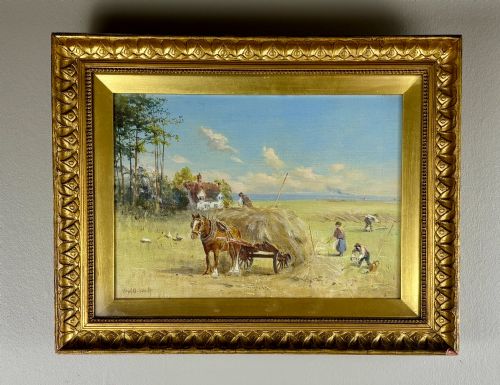



Antique Haymaking Landscape
These antique haymaking landscape works capture rural English agricultural life in oil and watercolour across the nineteenth and early twentieth centuries.
Antique Haymaking Landscape
An antique haymaking landscape captures the traditional rural labour of gathering the harvest, typically rendered in oil or watercolour across British pastoral settings.
The works on this page span the nineteenth century through the Edwardian period and into 1920, reflecting regional English scenes from Yorkshire to the Thames.
Buyers encounter both finished framed canvas oils and detailed paper watercolours showing farmworkers at work in fields during the summer months.
Materials and methods
Artists painted primarily with oil on canvas or applied watercolour pigments to paper, framed behind glass within wooden surrounds.
The technique relies on capturing natural light over open fields, balancing the depiction of human labourers with expansive rural backgrounds.
Materials recorded across these listings include canvas, paper, oil paint, watercolour, wood, and glass.
Judging quality and execution
Quality rests on the handling of atmospheric light and the dynamic placement of farmworkers within the wider rural setting.
Stronger examples demonstrate confident brushwork in oil or precise control of wash in watercolour, bringing depth and movement to the harvest scene.
Percy Lancaster·Henry Bailey·Herbert Royle·John Atkinson·James William Booth·Arthur Walker Redgate·Frederick J Knowles·William Greaves·George Graham·John Clayton Adams·George Anderson Short·Robert Thorne Waite·George Oyston·David Cox·David A Baxter
The Antique Haymaking Landscape Glossary
- Watercolour
- A painting method where fine pigment is suspended in water-based solution, typically applied to paper.
- Oil on canvas
- Pigment bound in an oil medium spread across a woven fabric stretched over a wooden frame.
- Victorian Rural Naturalism
- An artistic approach focusing on realistic portrayals of agricultural labourers and country life during the nineteenth century.
- Impressionism
- A style emphasising loose brushstrokes and accurate depiction of changing light in outdoor settings.
Antique Haymaking Landscape: Frequently Asked Questions
What periods do these paintings date from?
The works span from the 1870s through the Edwardian era up to 1920, capturing late Victorian and early twentieth-century artistic responses to the countryside.
This broad timeline shows how pastoral art evolved from nineteenth-century realism towards brighter impressionist interpretations of rural labour.
How should I care for a watercolour haymaking painting?
Watercolours require framing behind glass and protection from direct sunlight to prevent the paper from yellowing and the pigments from fading over time.
Keeping the piece in a stable environment away from damp conditions preserves both the paper support and the delicate painted surface.
What is the difference between the oil and watercolour works?
Oils are painted on canvas and offer rich textures with heavier pigment layers, whereas watercolours on paper present a lighter, more transparent finish.
Both mediums were used concurrently by artists to document the harvest, though oils tend to be housed in heavier wooden frames.
Where do these pastoral scenes typically take place?
The landscapes depict specific English regions, including Yorkshire river valleys, Essex fields, and riverside meadows near Abingdon on Thames.
Artists travelled into the countryside to record authentic rural tasks like hay cutting and harvest collection directly from nature.