


Hardwood Writing Desk
A hardwood writing desk brings enduring craft and dense timber to a room, offering a sturdy surface designed for correspondence and study.
Hardwood Writing Desk
A hardwood writing desk represents a functional workspace shaped through centuries of global design, taking forms from library tables to partners desks and bureau desks. These pieces originate across diverse regions, including Chinese export workshops, Anglo-Indian colonial cabinetmakers, and Japanese Meiji period studios.
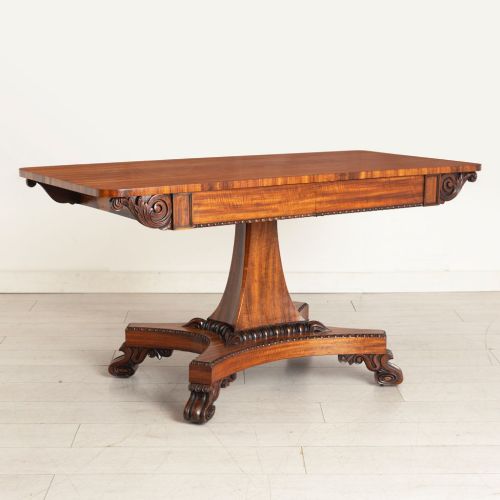
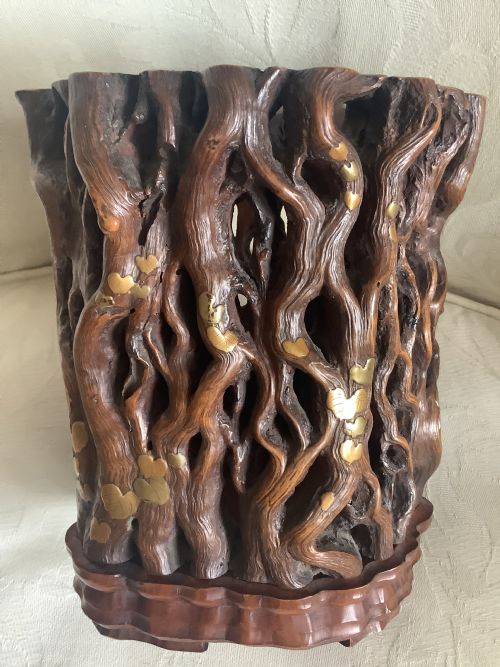
Buyers encountering this selection will find Victorian period examples alongside Regency library tables and travelling correspondence boxes. Forms range from heavy pedestal desks and carved centre tables down to compact brush pots and cylinder desks.
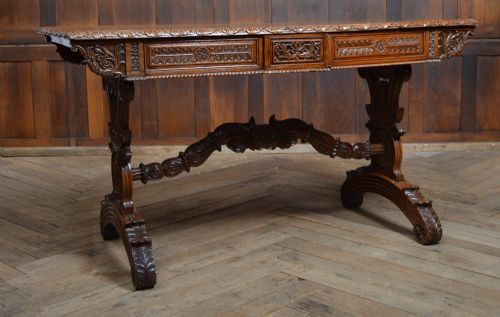
The variety spans traditional Chinese scholar pieces and intricate Anglo-Indian carved furniture, uniting heavy timber construction with practical drawers and writing surfaces.
Materials and Construction
Construction relies on dense tropical timbers such as padauk, teak, rosewood, and gonçalo alves, selected for their weight and stability. Cabinetmakers utilised brass hardware for handles, escutcheons, and campaign mounts on travelling boxes and correspondence desks.
Surface decoration involves deep hand carving, marquetry, and intricate parquetry work like Japanese yosegi patterns. Timber is finished to highlight natural grain patterns across large surfaces such as library tables and partners desks.
Materials recorded across the selection include padauk, teak, rosewood, gonçalo alves, and brass.
Assessing Quality
Quality rests in the selection of the timber, where dense exotic hardwoods and well-matched grain patterns separate standard items from exhibition pieces. The crispness and depth of hand carving across panels and legs indicate the skill of the original workshop.
Construction methods define endurance, particularly in the internal joinery of drawers and the stability of large library tables and partners desks. Original brass fittings and intact fitted interiors further elevate a piece within its period.
Liberty
The Hardwood Writing Desk Glossary
- Partners desk
- A large double-sided desk designed for two people to work opposite one another, featuring drawers and cupboards on both faces. These pieces were standard fixtures in nineteenth-century libraries and offices.
- Padauk
- A heavy, durable tropical hardwood with a rich reddish-brown colour that darkens with age. Cabinetmakers favoured it for its stability and resistance to wear.
- Yosegi
- A traditional Japanese wood mosaic technique using various natural wood shades to create geometric patterns without paint or stain. This method appears on decorative cylinder desks.
- Gonçalo alves
- An exotic dense timber displaying distinctive contrasting dark brown and lighter tiger-stripe markings. It was utilised for high-status Regency library tables.
Hardwood Writing Desk: Frequently Asked Questions
What is a partners desk?
A partners desk is a large double-sided workspace built with drawers and storage on both faces, allowing two people to work opposite each other.
These pieces were traditionally utilised in institutional libraries and private studies where multiple users required equal desk space.
How do I identify padauk wood?
Padauk is a dense tropical timber known for its deep reddish-brown tone and heavy weight. Over time, exposure to light causes the colour to deepen further.
It provides exceptional durability, which made it a preferred material for nineteenth-century campaign and pedestal desks.
Where were these desks made?
The pieces originate from diverse global traditions, including British colonial workshops in India, traditional Chinese export hubs, and Japanese Meiji period studios.
Each region applied local carving styles and native timbers to standard European furniture forms.