




English Regency Centre Table
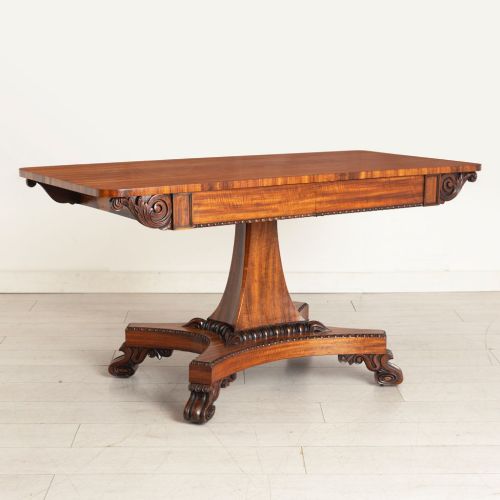
An English regency centre table stands freestanding in a room, designed to be admired from every angle.
English Regency Centre Table
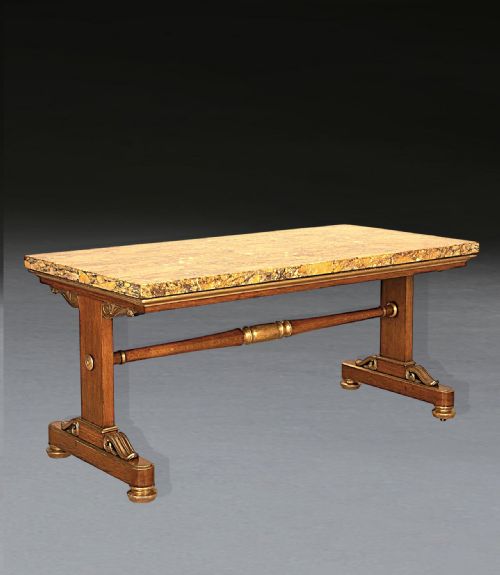
An English regency centre table is a freestanding piece designed to sit in the middle of a room rather than against a wall. These tables emerge from the Regency and William IV periods, alongside the broader nineteenth century, reflecting classical architectural influences.
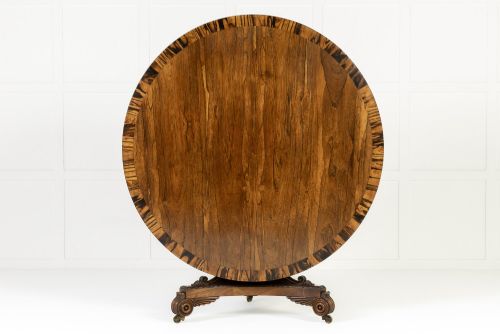
The form varies across the listings, encompassing dedicated library tables, breakfast tables with tilt tops, and circular drum tables. Mahogany and rosewood dominate the selection, accompanied by exotic timbers such as pollard oak, macassar ebony, and gonçalo alves.
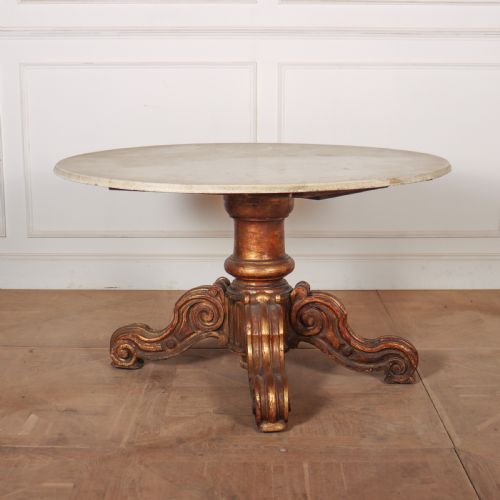
Makers utilised contrasting veneers and sophisticated pedestal bases, often supported by brass castors or giltwood mounts. Examples range from compact occasional pieces to large dining tables intended for country house interiors.
Evaluating Quality and Craftsmanship
The distinction between standard production and superior work lies in timber selection and secondary wood usage. Finer tables employ solid exotic hardwoods and dense tropical species rather than simple veneered deal or pine carcases.
Carved details, such as giltwood mounts and brass inlay, demonstrate the hand of the specialist artisan rather than routine workshop output. Structural stability in pedestal mounts and smooth operation of tilt-top mechanisms further separate workshop grades.
Gillows of Lancaster and London
The English Regency Centre Table Glossary
- Centre table
- A freestanding table finished on all sides, intended to be placed in the middle of a room rather than against a wall.
- Tilt top
- A hinged tabletop mechanism that allows the surface to be folded vertically for storage or movement.
- Pollard oak
- Oak timber taken from trees that have been pollarded, producing dense, highly figured clusters of growth rings.
- Gonçalo Alves
- A dense tropical hardwood imported from South America, prized for its dramatic dark figuring and warm colour.
- Siena marble
- A yellow Italian marble with dark grey or purple veins, frequently used for luxury tabletop inserts during the nineteenth century.
English Regency Centre Table: Frequently Asked Questions
Where should a centre table go?
These tables are designed to sit in the middle of a room, functioning as a visual anchor rather than resting against a wall. Their finished backs and all-around detailing allow them to be viewed from any angle.
In period interiors, they frequently occupied the centre of a library, drawing room, or entrance hall to display books and decorative objects.
How do I care for rosewood and mahogany?
Polished hardwood surfaces respond best to natural beeswax applied sparingly and buffed with a soft cloth. Avoid placing these tables in direct sunlight or near heat sources to prevent timber shrinkage and veneer splitting.
Routine dusting with a dry lint-free cloth preserves the historic sheen without building up chemical residues.
How do I tell Regency from William IV?
Regency furniture typically exhibits refined classical proportions influenced by Greek and Roman designs, often featuring delicate brass inlay and slender supports. William IV pieces tend to be heavier and more robust, displaying bolder carved scrolls and thicker pedestal bases.
Both styles overlap significantly in nineteenth-century country house interiors, sharing many of the same timber choices and workshop traditions.