


Handwoven Wool Tapestry Carpet
A handwoven wool tapestry carpet brings rich texture, pattern, and history directly onto a floor or wall.
Handwoven Wool Tapestry Carpet
When searching for a handwoven wool tapestry carpet, buyers encounter flatweaves, pile rugs, and embroidered textiles originating from diverse regions including Central Asia, the Caucasus, Persia, and Eastern Europe. These items serve primarily as decorative floor coverings or wall hangings, carrying distinct regional motifs passed down through generations.
The selections available here lean heavily towards nineteenth-century and early twentieth-century examples, ranging from Bessarabian kilims and Pirot or Sharkoy pieces to Turkmen tribal bagfaces and French Aubusson weaves. Each piece reflects the specific utilitarian and aesthetic traditions of the culture that produced it.
Tribal and folk art pieces dominate the selection, bringing bold graphic designs, repeat medallions, and banded patterns into modern interiors. Buyers find everything from large room-sized carpets down to small nomad storage bagfaces and eating cloths.
Materials and Construction Methods
The foundational material across these textiles is wool, frequently paired with cotton, linen, canvas, or camel hair for structural stability and texture. Natural dyes provide the underlying palette, yielding soft, faded reds, warm neutrals, and deep earth tones that mellow gracefully over time.
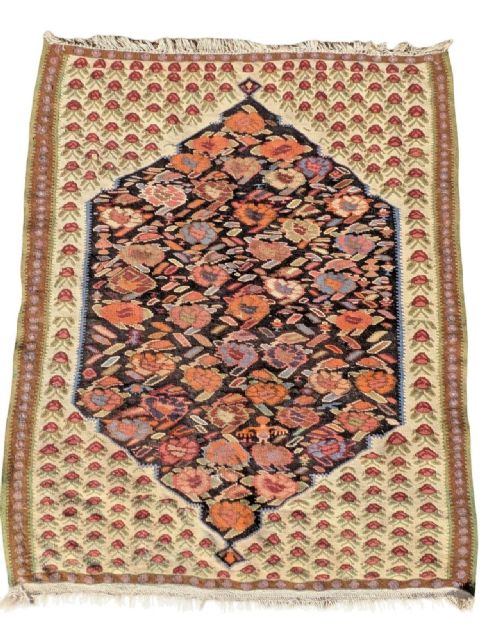
Techniques vary from slit-tapestry flatweaving used in kilims to intricate needlework and knotted pile construction. Artisans interlace weft threads tightly over warps, sometimes building a textile in multiple narrow strips or sections before joining them together into a unified whole.
The inventory spans the nineteenth century through the 1940s, highlighting traditions from Persian, Turkmen, Uzbek, Bessarabian, and French workshops.
Factors Defining Quality
Quality in these textiles rests upon the fineness of the weave, the precision of the graphic execution, and the integrity of the materials. Tighter knotting or weaving densities allow for sharper geometric or floral detail and better long-term durability under foot traffic.
The harmony and depth of the colour palette also distinguish finer examples, particularly where natural dyes have created subtle tonal shifts and patination. Additionally, scarce structural formats, such as multi-strip constructions or unusual regional designs, elevate the standing of a piece.
The Handwoven Wool Tapestry Carpet Glossary
- Kilim
- An untufted, flatwoven carpet or rug produced by tightly interweaving warp and weft strands. This technique creates a lightweight textile without a pile.
- Warp
- The stationary vertical or lengthwise threads stretched on a loom that form the structural foundation of the textile. Weft threads are woven across them.
- Weft
- The horizontal threads passed back and forth over and under the warp threads to build the design and colour of the fabric. In tapestry weaving, discontinuous wefts create distinct colour blocks.
- Chuval
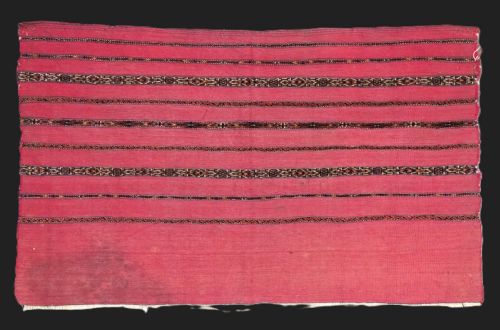
- A large storage bag produced by Turkmen tribes for household organisation inside a yurt. Surviving faces are frequently framed and displayed as small rugs.
- Sofreh
- A woven or embroidered cloth traditionally used for spreading meals on the ground or preparing dough. These utilitarian textiles often feature striking minimalist or tribal geometries.
- Natural Dyes
- Colourants derived from plants, insects, and minerals rather than synthetic chemical compounds. They interact with wool fibres to produce complex, organic hues that age with distinct character.
Handwoven Wool Tapestry Carpet: Frequently Asked Questions
What is a kilim carpet?
A kilim is a flatwoven textile made without a pile, created by tightly interlocking the horizontal weft threads over vertical warp threads. This method produces a thin, durable fabric with identical patterns visible on both sides.
Historically utilised for floor coverings, wall hangings, and storage sacks, kilims are prized today for their bold geometric graphics and versatility in interior design.
How do I care for a antique wool rug?
Antique wool rugs require gentle maintenance, beginning with regular, careful vacuuming without a rotating power brush. Keeping them out of direct, harsh sunlight prevents the natural dyes from fading prematurely over the years.
Professional cleaning tailored for antique textiles should be employed when deep cleaning becomes necessary. Rotating the rug periodically also ensures even wear across the surface from foot traffic.
Where were Bessarabian kilims made?
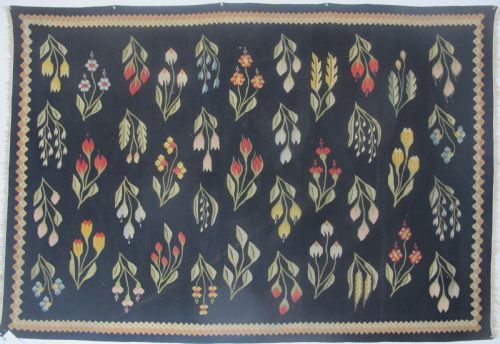
Bessarabian kilims originate from the historical region of Bessarabia, situated between the Prut and Dniester rivers in Eastern Europe. These pieces often feature distinctive European floral patterns influenced by French design traditions.
Local weavers combined these floral motifs with traditional dark grounds, resulting in decorative carpets that bridge rural folk art and formal Western aesthetics.
What distinguishes tribal rugs from city rugs?
Tribal rugs are woven by nomadic or village groups for personal use or local trade, featuring memory-based geometric designs and symbolic motifs. They typically employ locally sourced wool and natural dyes with an expressive, slightly irregular character.
City rugs, by contrast, are produced in organised workshops under the direction of master designers, yielding highly symmetrical, intricate floral curves and standardised compositions.