




Turkish Flatweave Carpet
These pieces of turkish flatweave carpet bring geometric pattern and woven texture into a room, offering authentic regional designs from the nineteenth and twentieth centuries.
Turkish Flatweave Carpet
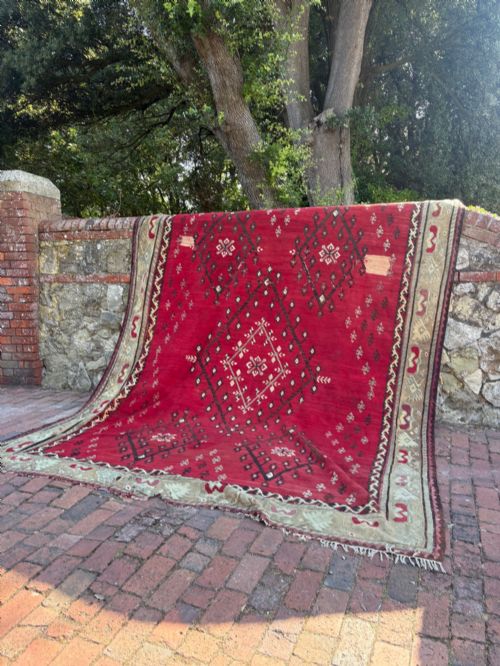
A turkish flatweave carpet is a floor covering produced without a pile, relying instead on interlocking weft threads to form flat patterns. These textiles originate from specific weaving traditions across Anatolia and the Balkans, including regions such as Konya, Malatya, and Sarkoy. Examples range from compact runner formats to large room-sized carpets.
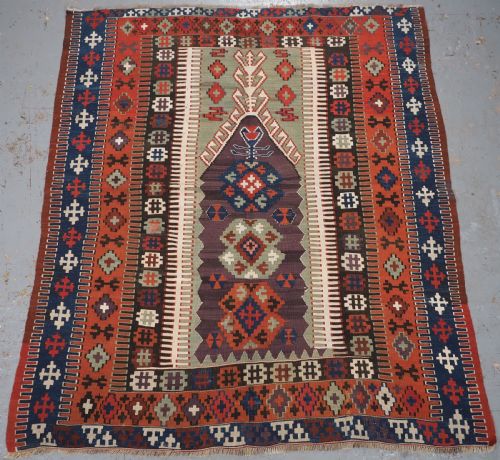
Makers shaped these textiles into distinct regional forms, such as prayer kilims with specific mihrab designs or multi-part carpets woven in separate sections and joined together. The aesthetic draws on tribal and traditional motifs, featuring repeat medallions, bold geometric bands, and all-over patterns. Surviving pieces span from the mid-nineteenth century through the 1930s.
Materials and construction
The primary materials recorded are wool and cotton, utilised to build a sturdy foundation and surface structure without pile. Wool provides the flexible, resilient body for the patterned weft threads, while cotton often appears in the structural warp and weft matrix of specific regional types.
The technique involves slit-tapestry weaving or related flatweave methods, where coloured weft yarns wrap around warp threads and reverse direction at pattern boundaries. This creates characteristic vertical slits or interlocking joins between colour fields, yielding a reversible or near-reversible textile.
Listings feature materials strictly limited to wool and cotton, spanning production dates from the 1860s through the 1930s.
Factors of quality
Quality rests on the integrity of the weave, the clarity of the regional design, and the depth of the palette. Tighter, more precise weft work creates a stable fabric that holds geometric lines cleanly across large formats.
Condition and scale influence the standing of an example, with large room sizes and multi-part constructions requiring careful preservation. The character of the dye palette, whether soft pastels or bold tones, dictates the visual impact of the piece.
The Turkish Flatweave Carpet Glossary
- Kilim
- A flatweave carpet or rug produced without a pile through interlocking weft techniques. These textiles serve as floor coverings or wall hangings.
- Warp
- The stationary vertical threads stretched on the loom that form the structural skeleton of the carpet. Weft threads are woven horizontally through them.
- Weft
- The horizontal threads passed through the warp to create the visible pattern and colour fields. In flatweaves, these threads build the entire fabric structure.
- Prayer kilim
- A rug featuring a niche or arch design known as a mihrab, traditionally oriented toward Mecca during daily prayers.
- Anatolian
- Pertaining to the central region of Turkey, a historic heartland for diverse tribal and traditional carpet weaving.
Turkish Flatweave Carpet: Frequently Asked Questions
How do I clean a flatweave carpet?
Regular gentle vacuuming without a beater bar removes surface dust and grit from the flat structure. Professional cleaning tailored to antique textiles preserves the wool fibres and natural dyes.
Avoid excessive moisture and harsh chemical treatments, which weaken the historical cotton and wool foundations. Prompt attention to spills prevents staining without stressing the weave.
Can I use these rugs in high traffic areas?
These flatweave carpets suit moderate traffic rooms like studies, bedrooms, and low-impact living spaces. The lack of pile means they lie flat under furniture and doors.
Placing a quality rug underlay beneath the textile prevents slipping and cushions the flat structure against floor friction. This reduces direct wear on the historic wool threads.
What does woven in two parts mean?
Weavers on traditional looms often produced large carpets in two narrow strips that were subsequently joined down the centre. This technique accommodated standard loom widths while allowing the creation of room-sized floor coverings.
Examining the reverse reveals the stitch line where the two complementary flatweaves were united. This traditional method is common in large nineteenth and early twentieth century formats.
How do I date a Turkish flatweave?
Dating relies on stylistic markers, regional weaving characteristics, and structural analysis of the wool and cotton materials. Pieces from the mid-nineteenth century often display distinct regional palettes and relaxed tribal geometries.
Later twentieth-century examples shift towards softer pastels or bolder decorative designs while maintaining traditional techniques. Comparing repeat medallions and border structures helps place an item within its era.