
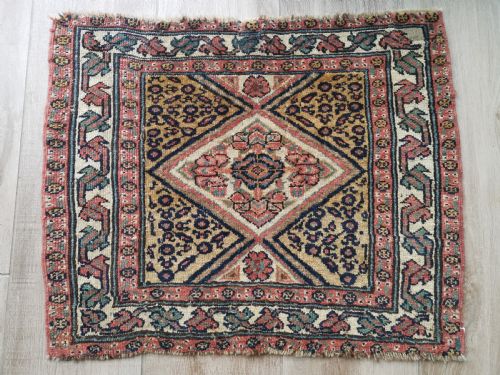
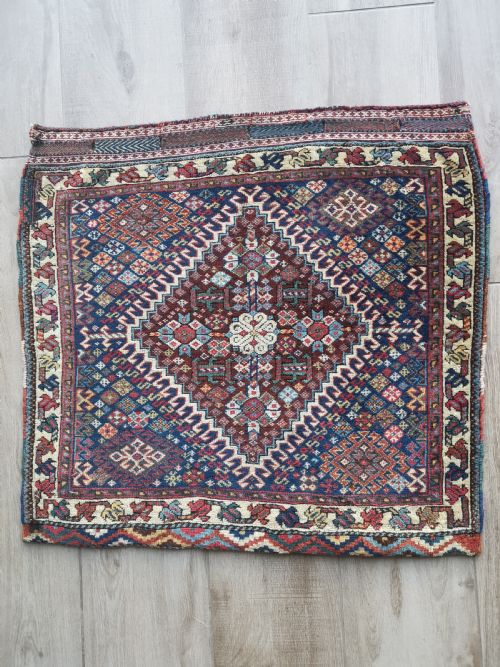


Hand Knotted Saddlebag
These hand knotted saddlebag pieces are tribal weavings carrying deep nomadic roots, offering rich geometric colour and genuine history for your floor or wall.
Hand Knotted Saddlebag
The pieces on this page are predominantly bagfaces and half-saddlebags produced by weavers from specific tribal confederations and groups such as the Qashqai, Afshar, Luri, Jaf Kurd, and Khamseh.
Most surviving examples exist as single bag faces or halved sections rather than complete double pouches because the utilitarian items were separated during decades of nomadic life and subsequent trade.
How They Were Made
The materials recorded in these listings rely primarily on hand-spun wool and cotton foundations, dyed with natural colorants to achieve durable, deep hues.
Weavers knotted the pile tightly by hand onto sturdy warps and wefts, resulting in dense structures designed to withstand the rigours of animal transport across rugged terrain.
Current listings span from the late nineteenth century to 1930, utilising wool and cotton with natural dyes across Persian tribal styles.
What Varies in Quality
Quality in these tribal weavings rests upon the lustre and handling of the wool, alongside the precision and complexity of the geometric or medallion designs. Lustrous, luminous wool yields a softer handle and greater visual depth.
The integrity of the remaining border elements and the fineness of the knotting distinguish the more accomplished weaving traditions from simpler utilitarian pieces.
The Hand Knotted Saddlebag Glossary
- Bagface
- The decorative front panel of a traditional transport pouch. It is the portion most frequently preserved as an independent textile.
- Medallion
- A central ornamental motif set within the field of the weaving. It anchors the symmetrical patterns typical of tribal designs.
- Warp
- The stationary lengthwise threads stretched on a loom. Foundation wool or cotton wraps around these structural elements.
- Weft
- The transverse threads passed across the warps to lock knots in place. They form the rigid grid of the textile.
- Pile
- The upright tufts of yarn forming the soft surface of the rug. Hand-spun wool creates the textured nap.
Hand Knotted Saddlebag: Frequently Asked Questions
What is a saddlebag face?
A saddlebag face is the decorative front portion of a woven pouch used by nomadic groups for transport on animals. Over time, these panels were separated from their backing fabrics and preserved as individual decorative textiles.
They display the distinct tribal patterns and colour palettes characteristic of the weaving group that produced them.
How do I hang a bag face?
Bag faces can be mounted on walls using a specialist textile display method or a fabric sleeve sewn along the reverse. This protects the wool foundation from undue strain.
Ensure the hanging method distributes the weight evenly across the entire upper edge of the piece.
Which tribes made these bags?
The listings show pieces originating from Persian tribal confederations and groups such as the Qashqai, Afshar, Luri, Jaf Kurd, and Khamseh. Each group employed specific motifs and colour combinations.
Geographic regions like Fars, Luristan, and Kerman defined the local weaving characteristics.
Are these pieces genuine antiques?
The pieces date from the nineteenth century and the early decades of the twentieth century. They reflect traditional nomadic production methods before commercial dyes and synthetic materials dominated.
Natural dyes and hand-spun wool confirm their historical production period.