
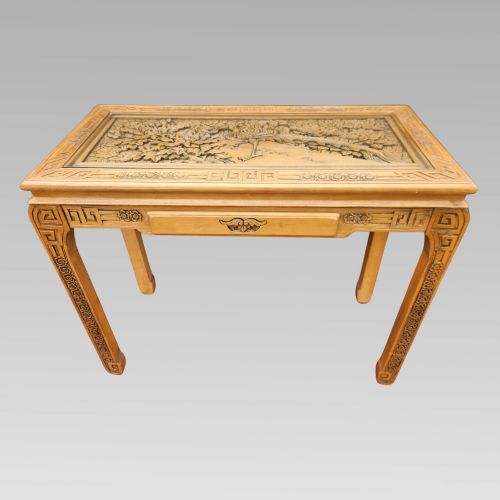


Hand Carved Oak Desk
These hand carved oak desk pieces bring solid construction and deep timber grain to a room, offering practical workspace rooted in historic craft.
Hand Carved Oak Desk
A hand carved oak desk brings together robust British timbers and deliberate sculptural detail, spanning styles from Victorian and Gothic Revival to Arts and Crafts and the distinct work of Robert Mouseman Thompson. When searching for a hand carved oak desk, buyers encounter robust writing surfaces, kneehole configurations, and bureau forms shaped across the nineteenth and twentieth centuries.
The pieces listed here range from substantial partner desks incorporating seventeenth-century religious panels to smaller bureau desk drawers with original receipts. Construction spans the 18th century through to the 1940s, showing how cabinet makers utilised oak alongside secondary woods to create enduring working furniture.
How they were made
Makers shaped these items using solid oak timbers, applying hand carving techniques to enrich friezes, panels, and structural surrounds. Ironmongery, brass handles, and glass elements appear where functional hardware complements the dense grain of the timber.
Cabinet makers joined boards using traditional joints to ensure stability across large partner desks and smaller bureau forms. The surface ornamentation relies entirely on chisel and gouge work, cutting directly into the seasoned oak rather than applying surface veneers.
Listings feature oak alongside alternative materials including brass, glass, camphorwood, padauk, and teak across various international styles.
What varies in quality
The distinction between ordinary and superior examples lies in the depth and precision of the carved ornamentation, particularly where relief panels or figural motifs meet the structural framework. Crisp edges on carved friezes and well-proportioned kneehole layouts denote a higher standard of workshop output.
Integrity of the timber and the preservation of original internal drawers or receipts also dictate the standing of a piece. Desks retaining their authentic brass fittings and uncompromised oak surfaces hold greater architectural coherence.
Thornton Smith Co·Robert Mouseman Thompson
The Hand Carved Oak Desk Glossary
- Bureau
- A slope-fronted desk enclosing fitted interior compartments and drawers. It provides a concealed writing surface when closed.
- Kneehole desk
- A pedestal desk featuring a central recess for the user's legs, flanked by banks of small drawers. This form became standard for domestic studies in the nineteenth century.
- Partner desk
- A large double-sided writing table designed for two people to work opposite one another. These pieces feature drawers and cupboards accessible from both sides.
- Frieze
- A decorative horizontal band situated immediately beneath the top surface of a desk. Carvers frequently adorn this area with foliate or geometric motifs.
Hand Carved Oak Desk: Frequently Asked Questions
What is a partner desk?
A partner desk is a large double-sided writing table designed so that two people can sit opposite each other and work simultaneously. These desks typically feature matching sets of drawers and cupboards on both sides.
They were originally produced for professional offices, boardrooms, and large country houses where partners or colleagues needed shared access to workspace and storage.
How do I care for antique oak?
Antique oak benefits from simple dusting with a dry, soft cloth and occasional treatment with traditional beeswax to nourish the dry timber. Avoid placing these desks near direct heat sources or in strong sunlight, which can dry out the wood and cause splitting.
Maintaining a stable room temperature helps preserve both the structural joinery and the hand-carved surface details.
Are these desks practical for daily use?
These desks offer sturdy writing surfaces and functional drawer storage suited to modern daily paperwork or laptop use. The solid oak construction provides durability that easily withstands everyday environments.
Buyers should check internal drawer dimensions and kneehole clearance to ensure the desk matches their specific seating and storage requirements.
How do I identify Arts and Crafts desks?
Arts and Crafts desks emphasise visible hand-carved details, exposed joinery, and honest use of solid oak without excessive ornamentation. The design prioritises structural simplicity and traditional craftsmanship over factory-produced regularity.
Look for hand-chiselled motifs, distinct regional variations, and sturdy proportions characteristic of the movement around nineteen hundred.