





Gustavian Style Sofa
A gustavian style sofa brings restrained Nordic elegance into a room, offering clean Neoclassical lines and time-worn painted surfaces.
Gustavian Style Sofa
A gustavian style sofa draws on Scandinavian interpretations of continental Neoclassical design, balancing formal symmetry with lighter country proportions. These pieces range from authentic eighteenth-century examples to later nineteenth-century interpretations and twentieth-century revivals.
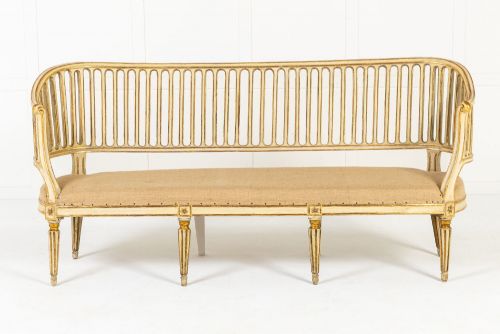
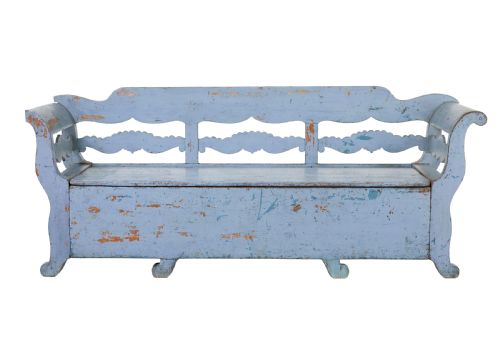
The versions most commonly met on this page include painted wood settees and settle benches originating from Sweden, often featuring the pale, muted tones characteristic of the Scandinavian country aesthetic. Alongside traditional sofas, the selection encompasses related seating forms such as benches and settees from the eighteenth and nineteenth centuries.
How they were made
Construction relies primarily on timber frames shaped into architectural profiles, utilising pine and other native woods as a base for decorative schemes. Artisans applied multiple layers of paint to the woodwork, achieving the characteristic matte or distressed surfaces seen on period seating.
Upholstery and cane work complete the seating areas, with textiles and natural weaving methods adding texture to the painted wooden frames. Occasional giltwood accents appear on grander interpretations, reflecting French Provincial and Swedish Empire influences.
The inventory includes console tables and benches alongside traditional settees, representing Scandinavian country, Neoclassical, and Swedish Empire styles.
What varies in quality
The distinction between ordinary and exceptional pieces lies in the integrity of the original painted surface and the crispness of the carved detail. Retaining early or original paint layers elevates a piece, whereas heavy modern repainting obscures the historical character of the wood.
Proportion and structural balance also separate standard items from finer examples, with well-executed Neoclassical lines demonstrating superior craftsmanship. The subtlety of the hand-carved fluting and rosette motifs indicates the skill level of the original maker.
The Gustavian Style Sofa Glossary
- Gustavian
- The Swedish Neoclassical style developed during the reign of Gustav III, known for its light palette and restrained classical ornamentation. It adapts heavier European court styles for northern interiors.
- Neoclassical
- An artistic movement drawing inspiration from the classical art and architecture of ancient Greece and Rome. It emphasises symmetry, straight lines, and understated decorative motifs.
- Giltwood
- Wood that has been treated with a thin layer of gold leaf or gold paint. This technique highlights carved details on more formal frames.
- Settle
- A wooden bench with high back and arms, often incorporating storage beneath the seat. It served as a practical and draught-excluding form of seating in traditional homes.
Gustavian Style Sofa: Frequently Asked Questions
How do I identify a genuine period piece?
Examine the construction methods, tool marks, and the ageing of the painted surfaces to determine the age of the wood. Period items often display natural wear and layers of historic paint that are difficult to replicate accurately.
Compare the proportions and carving styles against documented examples from the eighteenth and nineteenth centuries. Consulting specialist dealers helps build an eye for authentic regional details.
Where should I place a painted sofa?
Position the piece against a neutral wall to allow the pale painted finish and classical silhouette to stand out within the room. These settees work well in hallways, living spaces, or bedrooms as statement seating.
Keep wooden frames away from direct heat sources and strong sunlight to protect the fragile paint and upholstery from fading or drying out. Stable indoor environments preserve both the structure and the surface finish.
What is the difference between a settee and a sofa?
Historically, settees often featured upholstered seats with wooden frames, whereas early sofas evolved with more integrated upholstery and padded backs. Both terms describe long seating furniture designed for multiple occupants.
In Scandinavian country pieces, the distinction often blurs between benches, settees, and sofas depending on regional vernacular terminology. The construction and backrest style provide clearer clues to function than the historic label.
How do I care for antique painted wood?
Dust the surface regularly with a soft, dry cloth to prevent dirt accumulation on the delicate painted finish. Avoid using modern chemical polishes or water, which can damage historic paint layers.
Maintain consistent room humidity to prevent the underlying timber from expanding or contracting. This simple precaution stops the painted surface from cracking and flaking over time.