



Grey Paper Marine Artwork
Grey paper marine artwork brings together coastal views and shipping scenes worked in watercolour and pigment upon tinted sheets.
Grey Paper Marine Artwork
Grey paper marine artwork comprises paintings and watercolours executed on tinted paper supports, focusing on harbours, coastal settlements, and shipping. The selection relies heavily on Victorian, Edwardian, and mid-century British works depicting scenes from Yorkshire ports to the Thames.
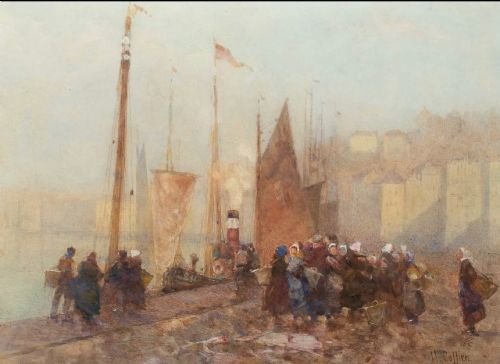
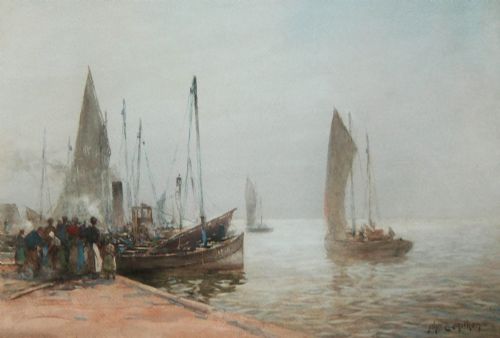
Buyers encounter watercolours and gouache paintings framed behind glass, often signed by regional British artists working from the nineteenth century into the mid-twentieth century. These pieces capture maritime activity, from fishing cobles to tall-masted ships, rendered directly onto the toned sheet.
The format highlights the tonal qualities of the paper itself, which artists utilise to represent moody skies or reflective water without laying down white pigment everywhere. Most examples date from the late Victorian period through the nineteen-fifties, reflecting strong regional traditions in British marine painting.
How they were made
Artists apply watercolour paint and bodycolour directly onto grey or tinted paper, using the background tone to unify the composition. Lithographic ink and pencil sketches also appear within the medium, providing sharp lines beneath translucent washes of pigment.
Watercolour pigment mixes with water to create varying opacity, allowing the grey paper to show through as clouds, fog, or open sea. Framed beneath glass within wooden surrounds, these works protect the delicate paper surface from atmospheric moisture and handling.
Grey Paper Marine Artwork Retail Price Guide 2026
Typical asking prices for grey paper marine artwork among the pieces listed under this phrase on Sellingantiques today, from the lower quarter to the upper quarter. They describe what is for sale here now, not the wider market.
Listings span periods from the nineteenth century through the nineteen-fifties, focusing primarily on British watercolour paintings on paper.
What varies in quality
Quality rests upon the artist's handling of light against the tinted paper, where confident brushwork defines the movement of water and shipping rigging. Stronger examples demonstrate precise control of watercolour washes that preserve the paper tone effectively in sky and sea.
Compositional balance and atmospheric depth distinguish accomplished maritime paintings from simpler topographical records. Pieces signed by established practitioners of British impressionism or regional marine schools show greater facility in capturing coastal weather and harbour activity.
James E Aitken·Hector Caffier·Thomas Bush Hardy·Edward Seago·Frank H Mason
The Grey Paper Marine Artwork Glossary
- Watercolour
- A painting method where water-soluble pigments are suspended in a water-based solution. Artists apply these transparent washes onto paper supports to build up tone and colour.
- Gouache
- An opaque water-based paint that includes white pigment to create solid areas of colour. It is frequently combined with transparent watercolour on tinted paper.
- Coble
- A traditional type of open fishing boat with a flat bottom and high bow, commonly used along the northeast coast of England. These craft frequently appear in Yorkshire marine watercolours.
- Lithographic ink
- A greasy ink used in printing processes and sometimes applied directly in works on paper. It creates dense, dark lines distinct from standard watercolour pigment.
Grey Paper Marine Artwork: Frequently Asked Questions
What is grey paper marine artwork?
Grey paper marine artwork consists of paintings and watercolours created on tinted paper supports featuring coastal views, harbours, and shipping. These pieces capture maritime subjects through the combined use of watercolour pigment and the visible paper tone.
Most examples date from the Victorian era to the mid-twentieth century, created by British artists working around ports and coastal towns. The tinted background serves as a mid-tone for skies and water, reducing the need to paint every element from scratch.
How should I hang watercolour on paper?
Watercolours require framing behind glass to protect the paper surface from dust, humidity, and direct sunlight. UV-filtering glass helps prevent the pigments and tinted paper from fading over time.
Keep these artworks away from damp walls and direct heat sources such as radiators. Proper mounting with acid-free materials ensures the paper does not buckle or discolour within the frame.
How do I identify the period of a marine watercolour?
Dating relies on the artist's active working dates, the style of the vessel depicted, and framing materials. Victorian and Edwardian works often feature detailed rigging and specific regional harbour identifications.
Mid-century pieces shift toward looser brushwork and simplified coastal forms, reflecting British modernist tendencies. Signatures, monograms, and inscriptions on the reverse or mount provide additional chronological markers.
Why use grey paper instead of white?
Grey paper provides an immediate atmospheric tone that mimics overcast skies and turbulent coastal water. Artists leave portions of the paper bare to represent natural light or mist.
This technique speeds up the painting process and unifies the palette around neutral tones. Highlights are added with white bodycolour or gouache to create contrast against the dark support.