






Green Woodland Landscape Art
Green woodland landscape art captures shaded canopies and leafy glades through the eyes of painters working in oil and watercolour across several centuries.
Green Woodland Landscape Art
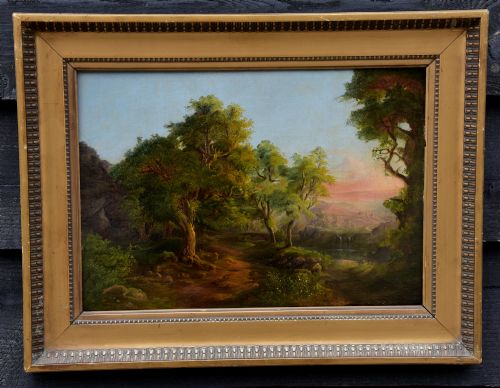
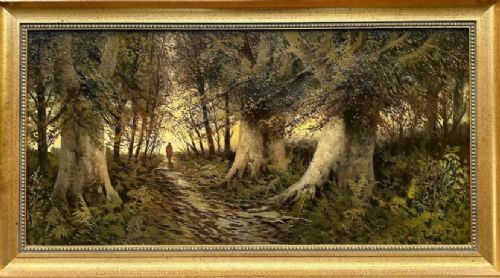
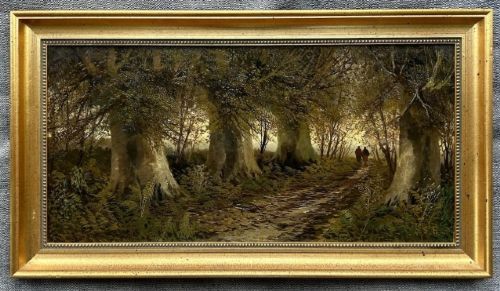
Green woodland landscape art encompasses painted scenes of trees, forests, and quiet country paths executed on canvas, board, and paper. These works capture the shifting light through branches, forest floors, and pastoral retreats spanning from earlier centuries through the mid twentieth century.
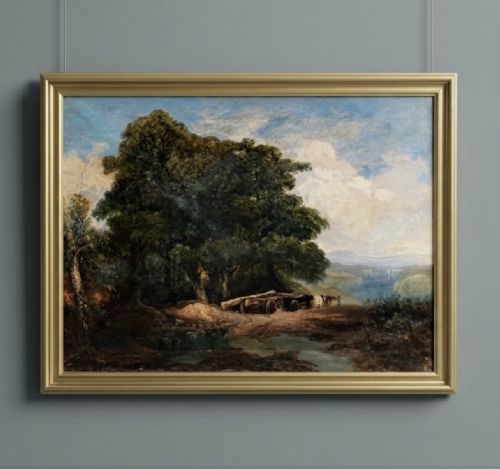
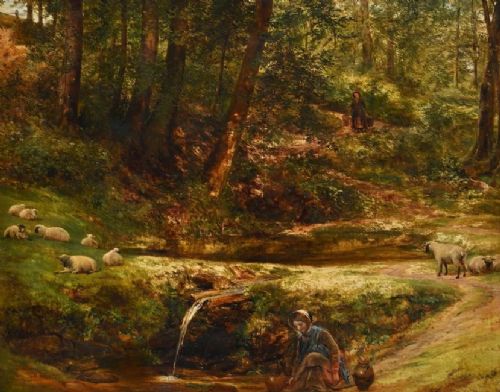
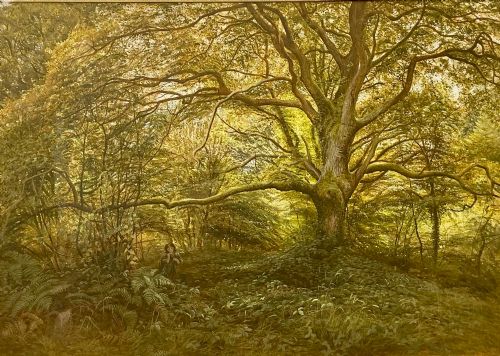
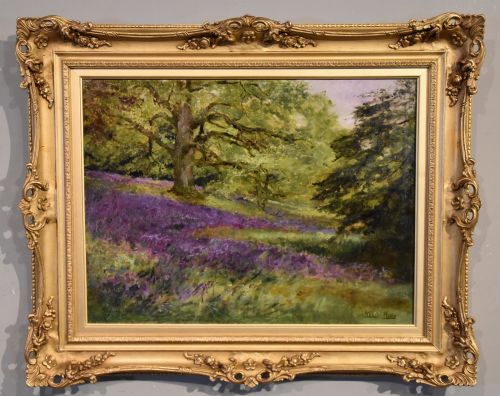
Buyers browsing this selection encounter nineteenth century oil paintings alongside watercolours from the Edwardian era and later decades. Common motifs include cattle grazing beneath timber, figures gathering firewood, and bluebell woods rendered in distinct regional styles.
The assortment ranges from large romantic canvases by named British and European artists to intimate watercolours and period wall tapestries. Each piece reflects the prevailing artistic interpretation of woodland scenery from its respective decade.
How they were made
Artists painted these woodland scenes primarily with oil paint on canvas or board, and with watercolour pigments on paper. Canvas supports often received a preparatory ground before the application of oil layers, whilst watercolours relied on the white of the paper to lend luminosity to light filtering through foliage.
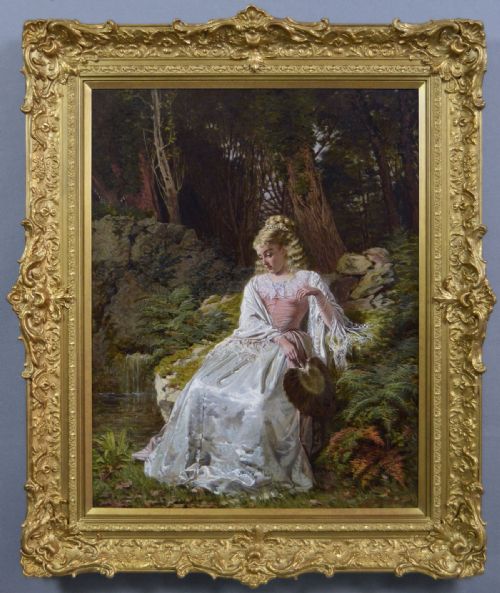
Makers utilised traditional brushwork techniques, ranging from the tight realism of the Victorian period to the looser handling associated with British Impressionism and the Barbizon School. Framing typically involved moulded wood, frequently finished with gilt to complement the earthy greens and browns of the forest palette.
Deer, cattle, and bathers frequently share these green woods with figures gathering firewood and picking primroses.
What varies in quality
Quality in these landscape paintings rests upon the artist's command of atmospheric depth and the natural rendering of light through foliage. Finer examples display subtle tonal transitions in the canopy and a confident handling of shadows on the forest floor, whereas lesser works rely on formulaic repetition.
The handling of secondary elements such as cattle, figures, or architectural details distinguishes superior works from standard studio output. Pigment preservation and the stability of the original canvas or paper support further differentiate the works.
Richard Sebastian Bond·William H Myers·Thomas W Lascelles·Richard Redgrave·Paul Desire Trouillebert·Henry Yeen King·Thomas Bromley Blacklock·William Hoggatt·Thomas Edward Roberts·James Mallard Bromley·Henri Joseph Harpignies·John Wright Oakes·James Proudfoot·Rowland Henry Hill·Edmund George Warren·Abraham Hulk Jnr·Alfred W Parsons·Harold Swanwick·William Lucas·Thomas Hollingsworth·Ernest Higgins Rigg·Edward H Holder·George F Wetherbee
The Green Woodland Landscape Art Glossary
- Barbizon School
- A nineteenth century French art movement dedicated to naturalistic landscape painting, working directly from nature in the forests surrounding Fontainebleau. This approach influenced subsequent landscape artists across Europe.
- Collotype
- A planographic printing process using gelatin, capable of producing high quality photographic reproductions with continuous tonal gradations. These prints appeared in various fine art contexts during the early twentieth century.
- Verdure tapestry
- A European textile wall hanging featuring a stylized landscape design dominated by foliage, trees, and occasionally animals. These heavy wall art pieces often originated in Flemish workshops during earlier centuries.
- Gilt
- A thin layer of gold leaf applied to wood frames to provide a decorative metallic surface. This finish enhances the visual presentation of traditional oil paintings and watercolours.
Green Woodland Landscape Art: Frequently Asked Questions
What periods do these paintings cover?
The listings span from seventeenth century Dutch school works and verdure tapestries through nineteenth century Victorian realism to mid twentieth century oil paintings.
Most pieces concentrate on the Victorian, Edwardian, and early twentieth century periods, reflecting changing artistic approaches to the natural world.
How do I care for antique watercolours?
Antique watercolours on paper require careful placement away from direct sunlight to prevent the fading of delicate pigments and green washes.
Glazing with UV protective glass helps preserve the paper support and maintains the integrity of the original watercolour medium.
What is a verdure tapestry?
A verdure tapestry is a woven wall hanging dominated by woodland foliage, trees, and pastoral landscape elements.
These large textiles were traditionally produced in European workshops, such as those in Audenarde, to insulate rooms and provide decorative wall art.
How do I distinguish oil on canvas from watercolour?
Oil paintings feature a textured paint layer on stretched canvas or wooden board, often showing visible brushstrokes and a rich gloss.
Watercolours are executed on paper beneath protective glass, presenting a flat, translucent surface where the texture of the paper remains visible through the pigment.