33,624  PAGES BROWSED TODAY PAGES TODAY 158  ANTIQUES UPLOADED TODAY NEW ARRIVALS
ID #SA1226341
FOR SALE
£7,000
Email
Save
Richard Redgrave the Sylvan Spring
Darnley Fine Art
for sale €8,190     $8,890
£7,000

Darnley Fine Art

Sellingantiques Verified Since Jul 2026
View Dealers Stock Page
Id #SA1226341
PDF SHARE
SAVE

Richard Redgrave the Sylvan Spring

19th century
For Sale by Darnley Fine Art
Description

Oil on canvas, signed and dated '1855'; inscribed verso

Image size: 32 ½ x 26 ¼ inches (82.5 x 67 cm)

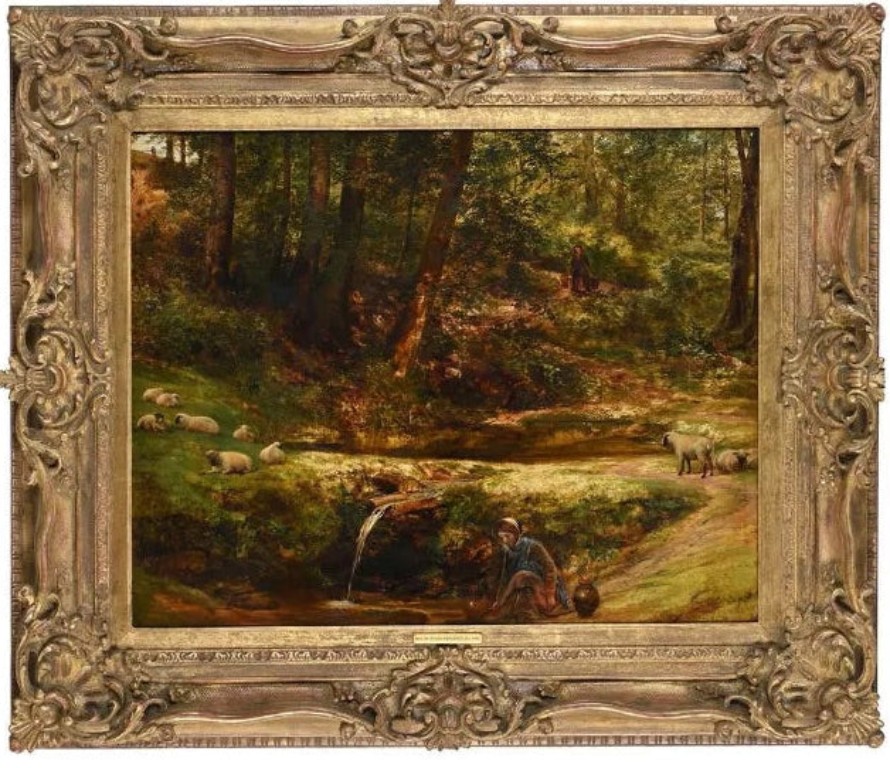
Ornate gilt frame

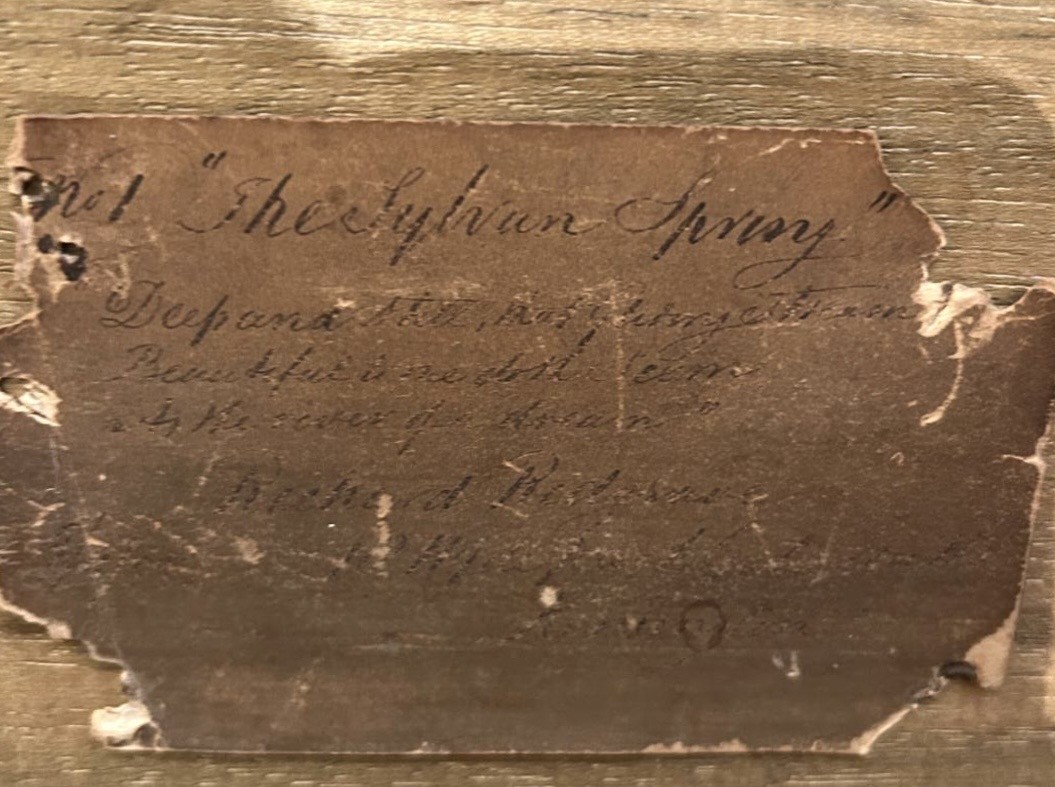
Inscription verso:

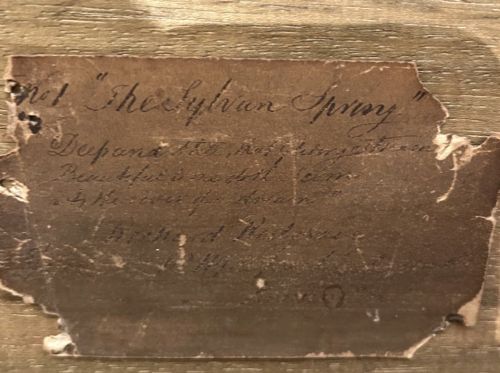
The Sylvan Spring

Deep and still, that gliding stream

Beautiful to thee must seem
As the river of a dream

Richard Redgrave

10 Hyde Park Gate South Kensington

Provenance:

Sotheby's, British & Irish Art, 2014

Sotheby's, 1981

Exhibited:

Royal Academy, London, 1855, no. 88

Literature:

Athenaeum, 1855, no. 1439, p. 623
Art Journal, 1855, p. 171

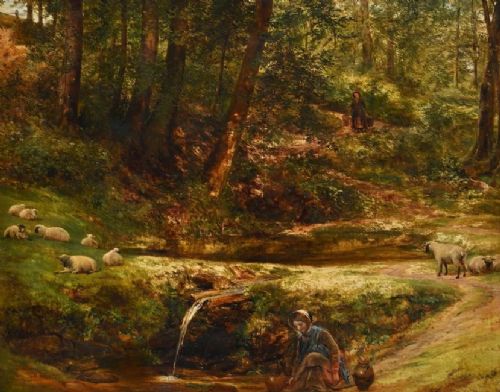
The subject matter of this work is taken from the 1842 poem Maidenhood, by the internationally renowned American poet Henry Wadsworth Longfellow. Longfellow wrote in the Romantic style that was incredibly popular in England at the time, and so his works were applauded amongst British literary and artistic circles. He was a contemporary of Redgrave, who was undoubtedly inspired by this poem and incorporated its symbolism into this particular artwork.
Longfellow’s poem centres around a young woman about to cross over a babbling brook, symbolising her transition from childhood into adulthood, and urges her to take the qualities associated with maidenhood - innocence, kindness, purity, modesty - into her new life as a mature woman. The poem draws heavily on imagery of the sun, dawn and the stream to represent innocence and transition. It is these thematic notions that Redgrave has used as inspiration for his work. Whilst not directly copying certain symbols from the poem, such as the lily flower and snow, Redgrave’s choice of subject clearly still connotes feminine innocence.

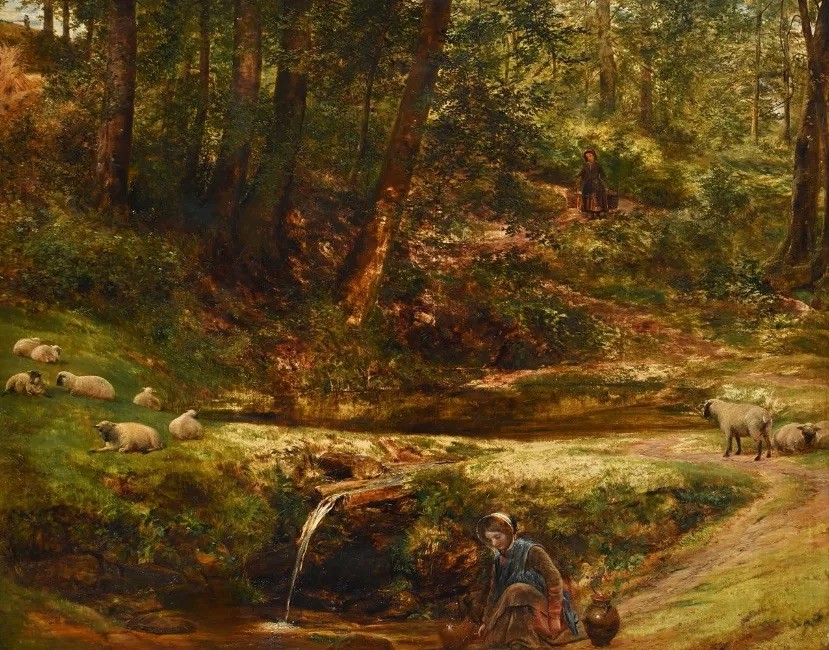
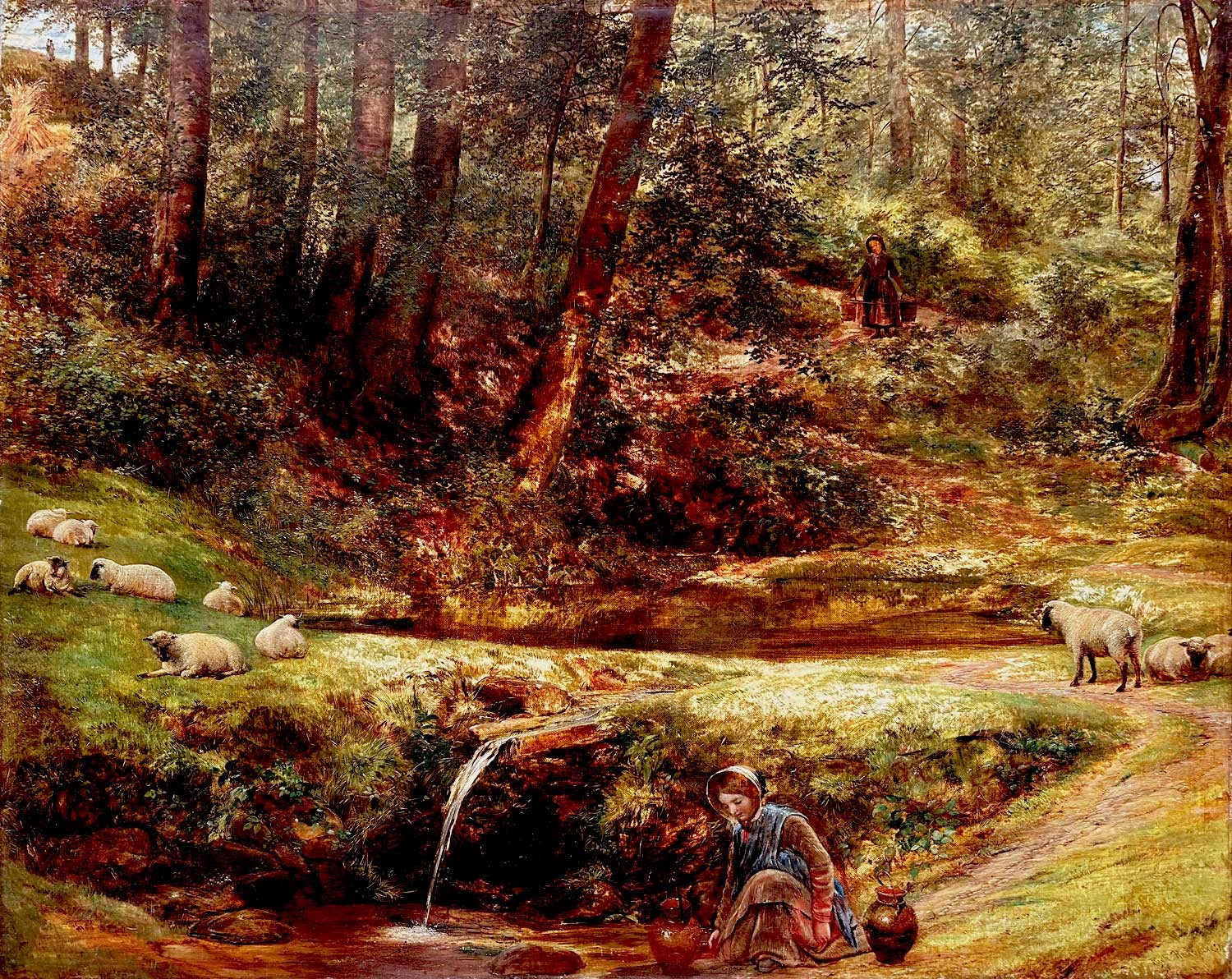
The scene takes place on a sunny day, likely in Spring or Summer, with the sun’s rays flickering down through the branches of the forest. Redgrave has put remarkable effort into representing how the filtered light interacts with the forest floor, creating a dappled effect that contrasts areas of light and shade. The trees are verdant and the grass is green, serving to connote natural vitality that complements the ideas of youthfulness and innocence.

The lady in the foreground is a youthful and lithe figure, with the bonnet on her head a symbol of the modesty and propriety of Victorian social etiquette. This lady is likely Redgrave’s representation of the Maiden archetype in Longfellow’s poem. The sense of innocence is further accentuated by the appearance of sheep in the work, an old Biblical motif for innocence and piety. The sheep and the lady, when seen together, hint at the use of a shepherdess motif that furthers the painting’s themes of innocence - shepherdesses were seen as representations of a traditional uncomplicated existence, free from the burdens of early modern society and the ills associated with the Industrial Revolution.

Besides the symbolic beauty of the work, Redgrave’s attention to detail affirms why he is one of the most influential 19th century British artists. As previously mentioned, the quality and accuracy of the light and its behaviour over the forest floor and the spring is outstanding. The physicality of the sheep and their anatomy is rendered beautifully, with visible texture to their woolly pelts. The forest appears as a sheet of green foliage, with Redgrave painstakingly detailing each leaf in their variety of green shades.

One of the most understated features of the work, however, has to be the spring cascading into the small pool near to the lady - the water falls in a beautiful arc, and is marked by lines of white that demonstrate light playing over its surface and its ever-changing quality.

Physical Dimensions
Height
67cm (26.38")
Width
82.5cm (32.48")
Declaration

Darnley Fine Art has dated this Victorian Landscape Oil Painting to the 1850s.

Reference Numbers
Sellingantiques Reference
SA1226341
Description
Oil on canvas, signed and dated '1855'; inscribed verso

Image size: 32 ½ x 26 ¼ inches (82.5 x 67 cm)

Ornate gilt frame

Inscription verso:

The Sylvan Spring

Deep and still, that gliding stream

Beautiful to thee must seem

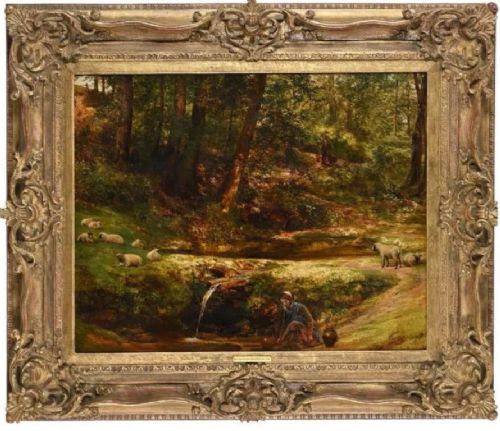
fig 1. A Victorian oil painting depicting a woodland stream, grazing sheep on grassy banks, and a seated figure near a natural spring.
fig 1. Richard Redgrave the Sylvan Spring

As the river of a dream

Richard Redgrave

10 Hyde Park Gate South Kensington

Provenance:

Sotheby's, British & Irish Art, 2014

Sotheby's, 1981

Exhibited:

Royal Academy, London, 1855, no. 88

Literature:

Athenaeum, 1855, no. 1439, p. 623

fig 2. A Victorian oil painting depicting a woodland stream, grazing sheep on grassy banks, and a seated figure near a natural spring.
fig 2. Richard Redgrave the Sylvan Spring

Art Journal, 1855, p. 171

The subject matter of this work is taken from the 1842 poem Maidenhood, by the internationally renowned American poet Henry Wadsworth Longfellow.
Darnley Fine Art

Longfellow wrote in the Romantic style that was incredibly popular in England at the time, and so his works were applauded amongst British literary and artistic circles. He was a contemporary of Redgrave, who was undoubtedly inspired by this poem and incorporated its symbolism into this particular artwork.

fig 3. A Victorian oil painting depicting a woodland stream, grazing sheep on grassy banks, and a seated figure near a natural spring.
fig 3. Richard Redgrave the Sylvan Spring

Longfellow’s poem centres around a young woman about to cross over a babbling brook, symbolising her transition from childhood into adulthood, and urges her to take the qualities associated with maidenhood - innocence, kindness, purity, modesty - into her new life as a mature woman. The poem draws heavily on imagery of the sun, dawn and the stream to represent innocence and transition. It is these thematic notions that Redgrave has used as inspiration for his work. Whilst not directly copying certain symbols from the poem, such as the lily flower and snow, Redgrave’s choice of subject clearly still connotes feminine innocence.

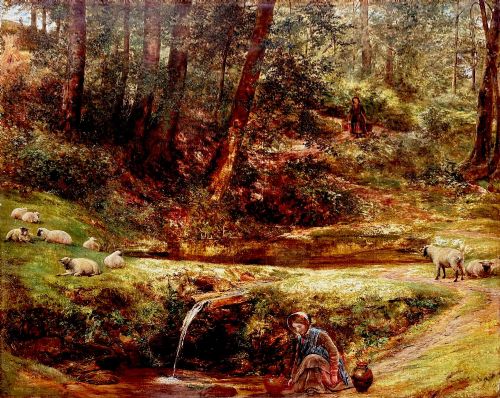
The scene takes place on a sunny day, likely in Spring or Summer, with the sun’s rays flickering down through the branches of the forest. Redgrave has put remarkable effort into representing how the filtered light interacts with the forest floor, creating a dappled effect that contrasts areas of light and shade. The trees are verdant and the grass is green, serving to connote natural vitality that complements the ideas of youthfulness and innocence.

The lady in the foreground is a youthful and lithe figure, with the bonnet on her head a symbol of the modesty and propriety of Victorian social etiquette. This lady is likely Redgrave’s representation of the Maiden archetype in Longfellow’s poem. The sense of innocence is further accentuated by the appearance of sheep in the work, an old Biblical motif for innocence and piety. The sheep and the lady, when seen together, hint at the use of a shepherdess motif that furthers the painting’s themes of innocence - shepherdesses were seen as representations of a traditional uncomplicated existence, free from the burdens of early modern society and the ills associated with the Industrial Revolution.

Besides the symbolic beauty of the work, Redgrave’s attention to detail affirms why he is one of the most influential 19th century British artists. As previously mentioned, the quality and accuracy of the light and its behaviour over the forest floor and the spring is outstanding. The physicality of the sheep and their anatomy is rendered beautifully, with visible texture to their woolly pelts. The forest appears as a sheet of green foliage, with Redgrave painstakingly detailing each leaf in their variety of green shades.

One of the most understated features of the work, however, has to be the spring cascading into the small pool near to the lady - the water falls in a beautiful arc, and is marked by lines of white that demonstrate light playing over its surface and its ever-changing quality.

Height
67cm (26.38")
Width
82.5cm (32.48")
Date of Manufacture

Darnley Fine Art has dated this Victorian Landscape Oil Painting to the 1850s.

Reference Numbers
Sellingantiques Ref
SA1226341
Darnley Fine Art
Sellingantiques verified Since Jul 2026
Dealer Profile

You can view the stock and full dealer information on the Darnley Fine Art Profile Page
PDF SHARE
SAVE
A Victorian oil painting depicting a woodland stream, grazing sheep on grassy banks, and a seated figure near a natural spring.
1 / 4
Archive I A Victorian oil painting depicting a woodland stream, grazing sheep on grassy banks, and a seated figure near a natural spring.

Richard Redgrave The Sylvan Spring

Archive II A Victorian oil painting depicting a woodland stream, grazing sheep on grassy banks, and a seated figure near a natural spring. View II
Archive III A Victorian oil painting depicting a woodland stream, grazing sheep on grassy banks, and a seated figure near a natural spring. View III
Archive IV A Victorian oil painting depicting a woodland stream, grazing sheep on grassy banks, and a seated figure near a natural spring. View IV
FURTHER BROWSING

Visitors also looked at these ⇣

Enlarged Archival View
Telephone 0207 379 0499
Location
2-4 Cecil Court
London
WC2N 4HE
United Kingdom

Opening Times
Monday to Saturday: 10:30 - 5:30
(excluding Bank Holidays)
Dealer Profile Page sellingantiques.co.uk/dfa
Verified Since Jul 2026
Items For Sale 76
Darnley Fine Art
Verified Since Jul 2026
View Dealer Info
Location: 2-4 Cecil Court, London, WC2N 4HE, United Kingdom, , Opening Times, Monday to Saturday: 10:30 - 5:30, (excluding Bank Holidays)
Verified
Jul 2026
For Sale
76
A Victorian oil painting depicting a woodland stream, grazing sheep on grassy banks, and a seated figure near a natural spring.
Richard Redgrave The Sylvan Spring
Ref: SA1226341
A Victorian oil painting depicting a woodland stream, grazing sheep on grassy banks, and a seated figure near a natural spring.
Detail View 1
Detail View 2
Detail View 3
Archival Detail
Every single antique dealer on our platform is individually approved by our internal team. We verify their professional trade history, ethical standards, and photographic quality to ensure a secure, high-standard buying environment. Upon joining, every dealer agrees to a strict 9-point code of conduct. While issues can occasionally arise, our dealers typically resolve them swiftly and directly with the buyer. In fact, since our founding in 2002, Sellingantiques has only had to step in to help resolve an issue on roughly five occasions—a true testament to the quality of our dealers and their dedication to your happiness.
Our dealers are highly experienced in packing and shipping fragile, high-value antiques. Because you are in direct contact with the dealer, you will be able to easily go through all available shipping and insurance options together to ensure your item arrives safely.
Antiques are the ultimate green purchase. By choosing historical pieces over newly manufactured goods, you completely eliminate the carbon footprint of modern mass production while preserving exceptional, timeless craftsmanship.

Victorian landscape art is defined by naturalism, detailed depictions of vegetation, and atmospheric lighting, often reflecting rural British countryside settings and pastoral themes.

Artists during this era typically utilised oil pigments bound with drying oils such as linseed, applied directly onto woven linen or cotton canvas stretched over timber frames.

Authentic period paintings display natural age craquelure across the varnish, subtle discolouration of historic glazes, and physical evidence of hand-stretched canvas on antique wooden stretchers.

Positioning a period oil painting above a mantelpiece or modern sideboard creates a focal point, pairing historical fine art with contemporary architectural lines.

Store the painting away from direct sunlight, dampness, and heat sources, dust gently using a soft dry brush, and consult a professional conservator for surface restoration.
items
Add keywords to the filter
Price
£100
£250000
Era
Movements
Material
Origin
Stock Location
Freshness
Online Payments
Categories