



Green Tree River Artwork
Green tree river artwork brings together pastoral landscapes and quiet waters painted across the nineteenth and twentieth centuries.
Green Tree River Artwork
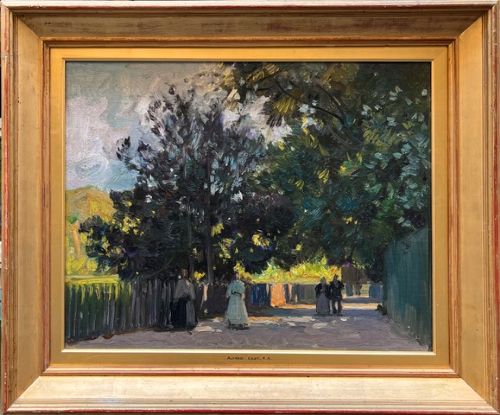
Green tree river artwork encompasses oil paintings and watercolour paintings depicting rural waterways, shaded banks and mature trees. These pieces span from the late nineteenth century into the mid twentieth century, capturing diverse European landscapes from the Thames Valley to the Seine and Provence. Buyers searching for green tree river artwork will find framed pastoral scenes created by artists working within realism, impressionism and the Barbizon tradition.
The selections on this page highlight both British and continental European views, ranging from English abbeys and river paths to French canal scenes and Mediterranean riverbanks. Most works date from the Victorian era up to nineteen fifty, utilising traditional canvases, wooden boards and heavy paper supports. Each piece offers a distinct atmospheric take on water, foliage and light.
Materials and construction
These works rely primarily on oil paint applied to canvas or wood, alongside watercolour pigment on paper. Artists built up their compositions using layered brushwork to capture the texture of foliage, the movement of water and the play of light across riverbanks.
Many of these paintings retain their original or period gilt wood frames, which complement the traditional techniques of the artists. The combination of oil on canvas and careful framing defines the physical presence of these historical landscapes.
Listings feature works from eighteen seventy to nineteen fifty, using oil paint, canvas, watercolour pigment, paper and wood.
Distinguishing quality
Quality in these pastoral landscapes rests upon the artist's handling of light, atmosphere and perspective rather than the subject matter alone. Finer pieces demonstrate confident brushwork that brings movement to trees and water, creating a genuine sense of space and natural depth.
The preservation of the pigment, the stability of the canvas or board, and the harmony of the framing further elevate the standing of a piece. Stronger works capture a specific mood or time of day with clarity, while lesser examples rely on more formulaic composition.
Alfred Young Nutt·Sir Alfred East·William Bradley·Alois Arnegger·Antoine Bouvard
The Green Tree River Artwork Glossary
- Oil on Canvas
- A traditional painting medium where oil paints are applied to a stretched woven fabric support. This method allows for rich colour blending and textured brushwork.
- Watercolour
- A painting method where pigment is suspended in a water-soluble vehicle, typically applied to paper. It yields translucent washes of colour that capture delicate light.
- Barbizon School
- A nineteenth-century French art movement dedicated to realism in landscape painting. Artists painted outdoors to capture natural light and everyday rural scenery.
Green Tree River Artwork: Frequently Asked Questions
What periods do these river paintings come from?
The works span from the late nineteenth century through to the middle of the twentieth century, including Victorian pieces and post-impressionist examples.
This broad timeframe covers various regional styles across Britain and France, reflecting changing artistic approaches to landscape painting.
How should I display a vintage oil painting?
Display your painting away from direct sunlight and sudden temperature changes to protect the canvas and paint layers.
Ensure the piece is securely hung using appropriate hardware suited to the weight of the wooden frame.
What is the difference between oil and watercolour?
Oil paint uses a slow-drying oil binder that allows for thick application and rich colour depth on canvas or wood boards.
Watercolour uses water-soluble pigments on paper, producing lighter, translucent effects that require protective glass framing.
Are these artworks original period pieces?
The selections shown date from specific historical periods such as the Victorian era and the early twentieth century.
Each listing reflects the materials and techniques characteristic of its stated era and geographic origin.