
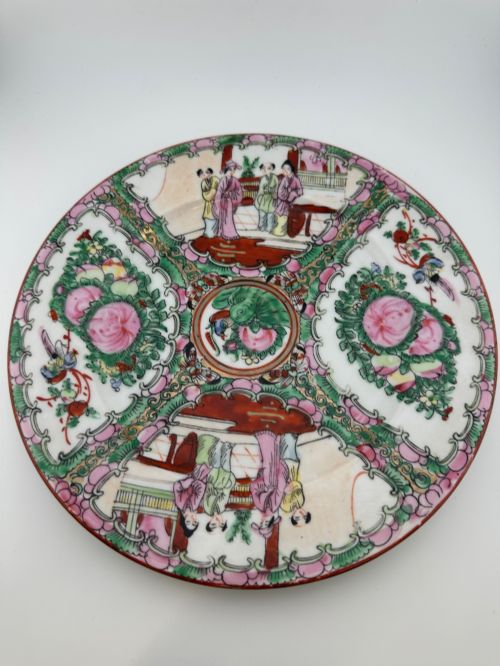


Green Japanese Enamel Charger
These green japanese enamel charger pieces bring intricate metalwork and traditional motifs straight into a room, offering rich colour and historic depth.
Green Japanese Enamel Charger
A green japanese enamel charger functions primarily as a decorative dish or large tray meant for display rather than dining. These items emerge chiefly from the Meiji period and late Edo period, capturing a golden age of metalcraft.
Meiji era examples dominate the selection, showing the technical heights reached by Japanese workshops during the late nineteenth century. Earlier pieces from the seventeenth century provide a foundation in porcelain alongside the metalwork.
How they were made
Artisans built these chargers using copper and brass as a base, shaping metal bodies to receive delicate surface decoration. Fine brass wire was bent into intricate compartments to form the outlines of birds, flowers, and mythical creatures.
Coloured enamel paste filled these wire cells before the pieces underwent high temperature firing in a kiln. Artisans then polished the hardened surfaces down until the metal grids and vitreous pastes sat flush together in a smooth plane.
Several chargers feature grumpy-looking owls and scampering shrimp alongside majestic dragons, proving that Meiji artisans kept a wonderful sense of humour.
What varies in quality
The fineness of the wirework dictates much of the visual success, with thinner lines allowing for greater detail in subjects like feathers and foliage. Mastery over the enamel colours creates depth and subtle shading across the surface of the charger.
Signed works and those employing specialised techniques like Totai Shippo demonstrate a higher degree of workshop skill. The complexity of the subject matter, from simple mon motifs to elaborate single dragons and samurai figures, separates standard pieces from exceptional ones.
The Green Japanese Enamel Charger Glossary
- Cloisonne Enamel
- A metalwork technique where fine wire is soldered to a base to create cells filled with enamel paste. These cells are fired and polished to a smooth finish.
- Totai Shippo
- A variation of cloisonne where the enamel is applied over a ceramic or porcelain core rather than solid metal. This method creates distinctive textural effects such as simulated tree bark.
- Meiji Period
- The era of Japanese history spanning from 1868 to 1912, noted for a massive output of decorative arts for international export. Work from this time displays exceptional technical precision.
- Ho-o Bird
- A mythical Chinese phoenix adopted into Japanese art as a symbol of virtue and grace. It appears frequently on chargers with elaborate tail feathers.
- Mon
- A Japanese heraldic badge or crest used to identify families and clans. These stylized circular emblems often appear woven into the background patterns of metalwork.
Green Japanese Enamel Charger: Frequently Asked Questions
How were chargers displayed in the past?
These large plates were typically placed on wooden stands or mounted on walls to showcase their detailed artistry. They served as primary decorative focal points in formal rooms.
Today, owners often place them on sturdy tabletop stands or display cabinets where the light catches the polished enamel surface.
What is the difference between a charger and a plate?
Chargers are significantly larger than standard dining plates, generally measuring over thirty centimetres across. Their main purpose is decorative display rather than serving food.
Smaller plates appear alongside chargers in traditional Japanese metalwork, but the larger formats allow for much more complex pictorial scenes.
How do I identify a Meiji period piece?
Meiji period metalwork often exhibits highly refined cloisonne wirework and vibrant colour palettes developed during the late nineteenth century. Many of these items bear signatures from master workshops.
Earlier Edo period pieces tend to show different stylistic conventions and heavier construction methods compared to the export-driven output of the Meiji era.
What maintenance do enamel chargers require?
These metal and glass objects need only gentle dusting with a soft, dry cloth to keep their surfaces clear. Avoid using liquid cleaners or abrasive cloths which can scratch the polished enamel.
Keeping them out of direct sunlight helps protect the colours from fading over long periods of time.