
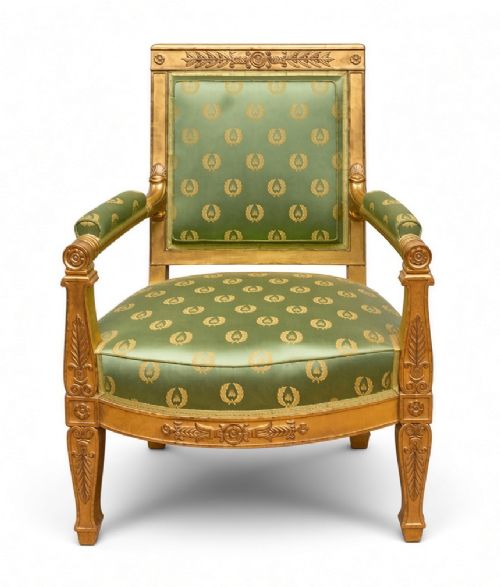
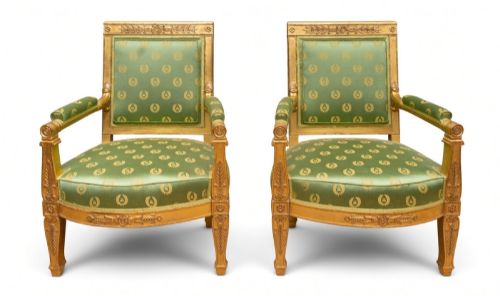
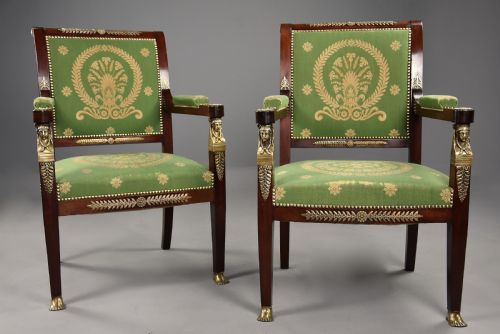


Green Empire Armchairs
Green empire armchairs are stately seating options rooted in classical design, offering buyers imposing silhouettes, rich upholstery, and enduring architectural presence.
Green Empire Armchairs
Green empire armchairs encompass substantial seating choices spanning from the early nineteenth century through various later revivals, including Regency, French Restauration, and Napoleon III styles. When searching for green empire armchairs, buyers encounter diverse forms ranging from individual fauteuils originating in historic palaces to larger parlour suites and sets of dining chairs.
How they were made
Cabinetmakers constructed these frames using dense hardwoods like mahogany, walnut, and birch, frequently enhancing the timber with giltwood accents or parcel-gilt details. Structural integrity relies on traditional joinery methods suited to supporting wide armrests and raked backrests.
Textiles played a central role in finishing these chairs, utilising luxurious materials such as silk, velvet, leather, and textured fabric for the upholstery. Decorative elements often incorporate brass mounts and carved motifs that reflect classical antiquity.
Folding campaign chairs proved essential for stylish seating on the move during the nineteenth century.
What varies in quality
The standard of a piece depends heavily on the precision of the timber carving and the originality of the giltwood or bronze mounts. Superior examples demonstrate crisp architectural detailing and harmonious proportions that reflect high workshop standards.
Material selection also dictates overall grade, distinguishing robust primary hardwoods from lighter secondary timbers used in revival pieces. The execution of upholstery foundations and textile quality further separates standard commercial seating from exceptional cabinet work.
Jacob Desmalter·George Smith
The Green Empire Armchairs Glossary
- Fauteuil
- An open-arm armchair with upholstered back and armrests, typically featuring an exposed wooden frame. This French form forms a staple of classical seating arrangements.
- Giltwood
- Timber treated with gold leaf or gold paint to create a brilliant metallic surface finish. This technique highlights carved details on prominent decorative frames.
- Restauration
- A stylistic period bridging the fall of the French Empire and the July Monarchy, characterised by simplified classical lines. Pieces from this era retain stately dignity without heavy ornamentation.
- Parcel-gilt
- A decoration method where only specific portions of a wooden object receive gilding, contrasting with the natural or dark-finished timber. This approach accentuates particular mouldings and carved motifs.
- Karl Johan
- A Scandinavian neoclassical style spanning the early nineteenth century, blending French Empire influences with regional restraint. Furniture from this design vocabulary favours clean geometries and pale woods like birch.
Green Empire Armchairs: Frequently Asked Questions
What defines green empire armchairs?
These seating options draw inspiration from classical antiquity, featuring strong architectural lines, exposed wood frames in mahogany, walnut, or giltwood, and characteristic green upholstery. They encompass genuine nineteenth-century pieces alongside later revival interpretations.
Buyers find forms ranging from grand library armchairs to matched sets of dining chairs, all sharing a distinct formal presence suitable for prominent rooms.
How do I identify a revival piece?
Revival items, such as those from the later nineteenth or early twentieth centuries, often exhibit subtle differences in timber treatment, machine assistance in carving, and standardised joinery techniques compared to their earlier counterparts.
Examining the secondary woods, wear patterns, and specific stylistic quirks helps differentiate an original Regency or Empire piece from a later homage.
Where should I place these chairs?
Their striking silhouettes make these armchairs ideal focal points in studies, libraries, or formal drawing rooms where classical proportions complement existing decor. Single fauteuils work well as reading chairs or accent seating against panelled walls.
Larger suites and matching sets can anchor a formal dining space or provide coordinated seating in a spacious lounge environment.
How do I care for the upholstery?
Maintaining textile elements like silk, velvet, or leather requires gentle vacuuming with a soft brush attachment and immediate attention to any accidental spills using appropriate cleaner for the specific fabric. Avoiding direct sunlight prevents fading on delicate green dyes.
Periodic professional inspection of the internal webbing and padding ensures the structural health of the seat remains intact over decades of use.