
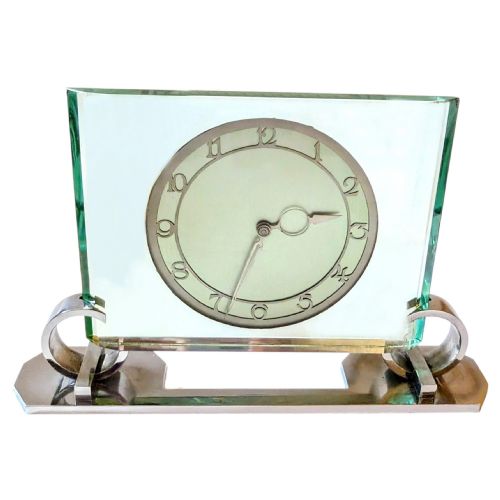


Green Art Deco Clock
A green art deco clock brings the sharp geometries and striking tones of the nineteen-thirties into a room.
Green Art Deco Clock
A green art deco clock takes several distinct forms, most commonly appearing as a mantel clock designed to sit squarely on a shelf or sideboard. These pieces frequently date from the nineteen-thirties, aligning with the height of the modernist movement in Britain and France.
Beyond standard mantel pieces, buyers encounter desk clocks, clock garniture sets paired with side ornaments, and occasional wall-hanging designs. Materials range from solid green onyx and marble to vibrant mirror glass and translucent opaline uranium glass.
Makers such as Smiths and GEC dominate the English examples, often incorporating chrome bezels and numerals into the design. The overall aesthetic relies on clean architectural lines and rich green colour palettes.
Materials and construction methods
Makers built these pieces using substantial slabs of natural green onyx and polished marble, cut and squared to frame the dial. Chrome-plated brass and standard brass components provided contrasting metallic accents for bezels, hands, and feet.
Glass technology played a major role, utilising heavy moulded green glass, uranium glass, and mirrored panels assembled around mechanical movements. Enamel and copper details occasionally supplemented the glass and metal chassis.
Movements were predominantly eight-day mechanical systems or early electric mechanisms, requiring precise housing within the stone or glass bodies.
Listings feature nineteen-thirties pieces constructed from green glass, chrome, brass, marble, and green onyx.
Evaluating craftsmanship and condition
Quality rests heavily on the purity and finish of the materials, separating solid carved onyx or thick mirror glass from simpler compositions. The weight and integration of the chrome fittings determine the visual balance of the piece.
The sophistication of the dial design and the reputation of the maker, such as Mappin & Webb or Garrards, elevate certain examples above standard domestic production. Original matching garnitures or sculpted elements by known artists further distinguish superior pieces.
Smiths Clockmakers·Mappin & Webb·GEC·Garrards
The Green Art Deco Clock Glossary
- Garniture set
- A matching centre clock accompanied by side ornaments or vases intended to be displayed together on a mantelpiece.
- Onyx
- A banded variety of chalcedony used extensively for solid stone clock bodies during the period.
- Opaline glass
- An opaque or translucent glass often utilised in vibrant green shades for clock faces and surrounds.
- Bezel
- The metal ring that holds the glass protecting the clock face in place.
Green Art Deco Clock: Frequently Asked Questions
How do I wind an eight day clock?
An eight-day movement requires winding via the dial holes using a matching key every week to maintain tension on the mainspring.
Care should be taken not to overwind the mechanism, stopping as soon as resistance is felt.
Where should I place a heavy onyx clock?
Heavy stone and marble pieces require a sturdy, level surface such as a solid wood mantelpiece or sideboard to support their substantial weight safely.
Direct sunlight should be avoided to protect the polished stone and interior metal finishes over time.
Are these clocks electric or mechanical?
Most examples from this period utilise traditional mechanical eight-day spring-driven movements that tick audibly in a room.
Some later or alternative pieces incorporate early electric movements requiring compatible wiring or specialist attention.
How do I clean green glass clock bodies?
Glass and mirrored surfaces benefit from gentle wiping with a soft, dry microfibre cloth to remove dust without damaging the edges.
Harsh chemical cleaners must be kept away from chrome bezels and painted dial markings to preserve the original finish.