
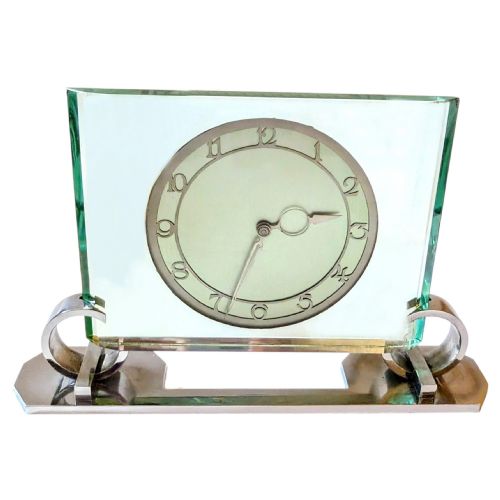


Vintage Green Desk Clock
A vintage green desk clock brings rich colour and striking period design to a room, offering both practical timekeeping and distinct character.
Vintage Green Desk Clock
A vintage green desk clock encompasses functional timepieces produced across several decades, most frequently appearing in striking Art Deco designs from nineteen thirty alongside earlier nineteenth century examples. These objects range from compact bedside alarms to substantial mantel pieces and sculptural garnitures designed for prominent display.
The materials span deep green onyx and marble alongside vibrant opaline uranium glass, complemented by metallic accents in brass, chrome, copper, and gilt bronze. French and English makers dominate the selection, bringing diverse regional aesthetics from architectural Victorian forms to streamlined modernist geometries.
Buyers encounter a variety of functional configurations, including eight-day movements, wind-up mechanisms, and combined lamp or sculpture units. The enduring appeal lies in the rich interplay between green mineral bodies and polished metal hardware, making each piece a distinct decorative focal point.
How they were made
Natural stones such as green onyx and marble were meticulously cut, carved, and polished to form heavy, stable clock housings and architectural cases. Artisans paired these mineral bodies with cast and plated metals, utilising chrome, brass, and ormolu for bezels, feet, and decorative mounts.
Glass production played a significant role through moulded opaline and uranium glass components, shaped into luminous coloured panels and dials. Metalworking techniques involved striking copper, enamelling, and intricate gilt bronze casting to build mechanical clock housings alongside associated sculptural elements.
Materials documented across the pieces include brass, chrome, copper, glass, green onyx, green marble, and gilt bronze.
What varies in quality
The distinction between standard production and exceptional work rests on the precision of the stone polishing and the weight of the marble or onyx blocks used in the case. Superior examples feature heavier, unblemished mineral slabs paired with finely finished metalwork rather than thin plating.
Maker attribution elevates the standing of a piece significantly, with recognised firms delivering superior dial typography, more refined glass casting, and robust mechanical movements. The integration of artistic elements, such as detailed patinated metal sculptures or complex crystal regulator panels, distinguishes the finest examples from simpler utility pieces.
Smiths Clockmakers·Mappin & Webb·GEC·Garrards·Pinchon, Fils, Paris·Marti
The Vintage Green Desk Clock Glossary
- Onyx
- A banded variety of chalcedony prized for its smooth texture and rich translucent layers, frequently utilised for heavy clock cases. It provides a cool, polished surface that holds a deep green lustre.
- Opaline glass
- An opaque or translucent glass often tinted in soft or vibrant tones, used to create luminous clock faces and bodies. This material gained popularity for its smooth finish and ability to catch ambient light.
- Garniture
- A set consisting of a central clock flanked by matching decorative objects such as vases or sculptural figures. These matched groupings were designed to create a symmetrical display on a mantelpiece.
- Crystal regulator
- A mantel clock housed within glass panels that expose the mechanical movement and pendulum to view from multiple angles. This sophisticated French style highlights the precision of the internal gears.
- Ormolu
- A metallic technique involving the application of finely ground high-carat gold to a bronze base, creating a rich golden finish. It appears on nineteenth-century clock mounts and decorative trims.
Vintage Green Desk Clock: Frequently Asked Questions
How do I wind an eight-day clock?
Insert the appropriate key into the winding arbour on the dial and turn it gently clockwise until you feel firm resistance. Avoid over-winding, as this can strain the internal spring mechanism.
Ensure you support the clock body with one hand while winding to prevent shifting the heavy marble or glass case on your desk or mantel.
Where should I place a heavy marble clock?
Select a sturdy, level surface such as a wooden mantelpiece, heavy desk, or sideboard capable of supporting substantial weight. Avoid areas subject to direct sunlight or excessive moisture to protect the stone and metal finishes.
Ensure the placement allows easy access for winding and viewing the dial without risking accidental knocks to the glass panels or sculptural elements.
How do I identify an Art Deco clock?
Look for geometric forms, stylised numerals, and streamlined silhouettes that reject Victorian ornamentation in favour of modern industrial aesthetics. Materials often combine green glass or onyx with polished chrome and contrasting metal accents.
Many of these pieces date from around nineteen thirty, reflecting the sleek, functional design priorities of the interwar period.
What is a garniture set?
A garniture set pairs a central mantel clock with two matching decorative pieces, such as matching vases or sculptural figures, designed to sit together. This arrangement created a balanced, formal display across a fireplace mantel or large piece of furniture.
Pieces like German Shepherd dog sculptures or cast metal figures frequently accompanied the clock in these cohesive suites.