





Grand Tour Pietra Dura
Grand tour pietra dura pieces are hard-stone inlaid souvenirs bought by travellers abroad, prized for their detailed mineral mosaic work.
Grand Tour Pietra Dura
When you search for grand tour pietra dura, you encounter items created as mementoes of European travels during the nineteenth century. These objects range from small desk accessories to large centre tables.
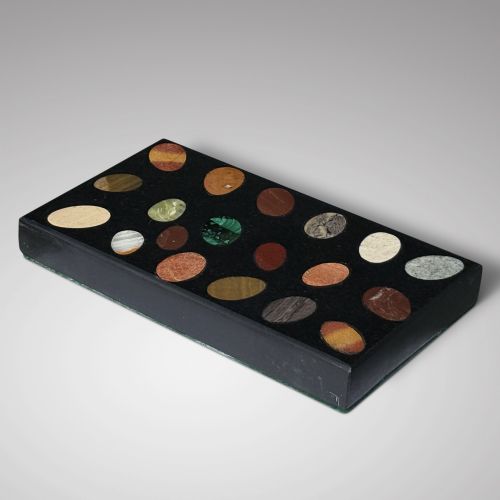
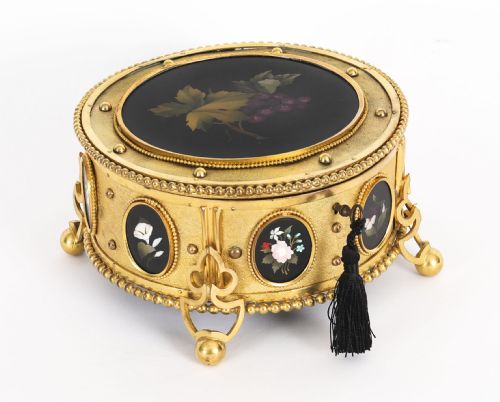
The pieces on this page most commonly take the form of paperweights, decorative obelisks, and jewellery caskets. Many originate from Italy or Derbyshire, utilising local stones and marbles.
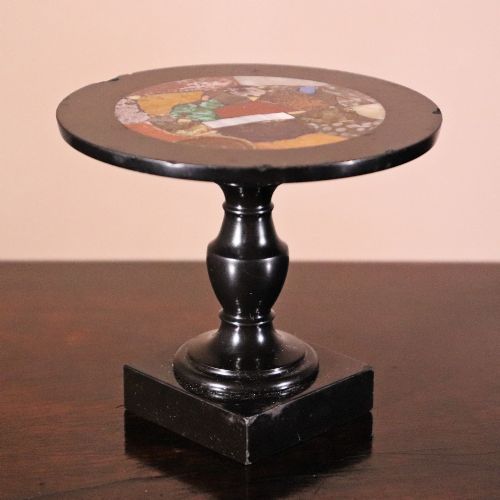
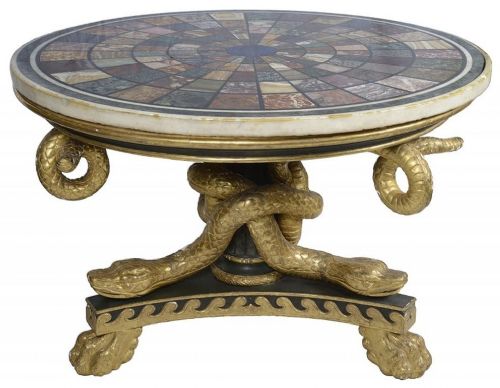
You will also find occasional larger furnishings such as side and centre tables featuring inlaid specimen marble panels. Smaller items frequently employ black marble or ebonised wood as a contrasting base for the colourful stone inlay.
How they were made
Craftsmen shaped thin slices of coloured mineral stones, such as malachite and various marbles, to fit precisely into hand-cut recesses within a solid stone base. This technique required immense precision to ensure tight joints between the individual segments.
Support elements often incorporated brass, ormolu, and ebonised wood, mounted to frame or elevate the stone plaques. Certain items also combined pietra dura work with micro-mosaic panels set into the marble surface.
Travellers returning from Italy packed heavy stone tables and tiny mosaic matchboxes alike, trusting luggage porters to manage the geological weight.
What varies in quality
The standard of a grand tour pietra dura piece rests upon the tightness of the stone-to-stone joints and the complexity of the mosaic imagery. Superior examples display intricate pictorial details, such as birds or floral arrangements, rendered in diverse specimen stones.
Quality also depends on the selection and variety of the marbles employed, alongside the execution of any subsidiary metal mounts in brass or ormolu. Simpler geometric inlay on standard black marble sits at the accessible end of the range, while elaborate pictorial plaques command greater attention.
The Grand Tour Pietra Dura Glossary
- Pietra dura
- An Italian term for hard-stone inlay using sliced and fitted coloured stones to create decorative pictures or patterns. It translates literally as hard stone.
- Specimen marble
- Marbles and mineral stones gathered from various geological locations for decorative inlay work. These stones provide a wide palette of natural colours.
- Ashford black marble
- A dark limestone from Derbyshire used as a base for inlay work. It takes a high polish and contrasts sharply with bright specimen stones.
- Obelisk
- A tall, four-sided, narrow tapering monument that ends in a pyramid-like shape at the top. These decorative objects were popular grand tour souvenirs.
- Scagliola
- A composite substance made from selenite, glue, and pigments, mixed to imitate marble and other hard stones. Craftsmen used it as an alternative to carved stone panels.
Grand Tour Pietra Dura: Frequently Asked Questions
What is grand tour pietra dura?
Grand tour pietra dura refers to hard-stone inlay objects brought back by travellers from nineteenth-century European journeys. These items celebrate classical destinations through detailed mineral mosaics.
They encompass portable paperweights, plaques, and caskets, alongside larger tables featuring elaborate stone panels.
Where were these pieces made?
Production centred primarily in Italy, where workshops produced souvenirs for foreign visitors, and in Derbyshire, England, utilising local black marble.
Italian pieces frequently feature pictorial flora and fauna, while Derbyshire items often showcase geometric specimen stone layouts.
How do I display a paperweight?
Paperweights work well on desks, sideboards, or coffee tables where adequate light allows the polished stone grain to show. Flat surfaces near a window highlight the precise mosaic work.
Keep them away from direct heat sources and abrasive materials to protect the smooth marble surface.
What materials are used?
Pieces incorporate a variety of hard stones, including malachite, various marbles, and limestone set into dark marble or ebonised wood bases. Subsidiary mounts frequently use brass or ormolu.
The combination of these mineral components creates the colourful imagery typical of the style.
How do I date a piece?
Dating relies on stylistic clues, material types, and structural assembly typical of the nineteenth century. Most catalogued items date from the Victorian era and the Regency period.
Comparative analysis with documented souvenir pieces helps narrow down the decade of production.