





Grand Tour Inlaid Table
A grand tour inlaid table brings the classical sights of Italy directly into a Victorian interior through meticulous stonework and marquetry.
Grand Tour Inlaid Table
A grand tour inlaid table represents the tangible souvenirs brought back by travellers touring Europe during the nineteenth century. These pieces encompass centre tables, side tables, and occasional tables originating primarily from Italian workshops and the Sorrento region. Buyers seeking this phrase typically encounter circular or low tables featuring elaborate stone or wood surfaces.
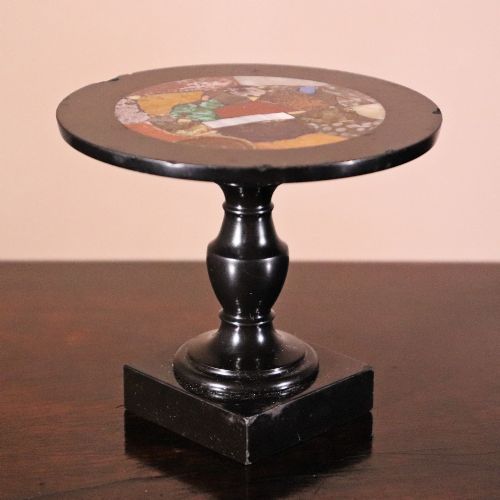
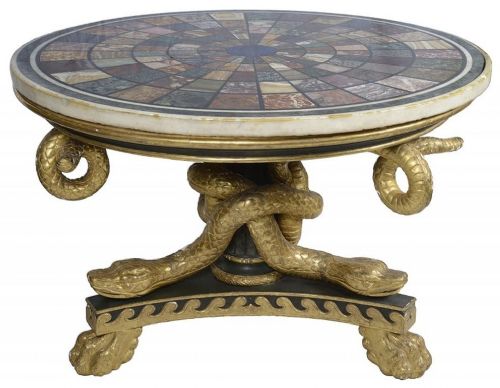
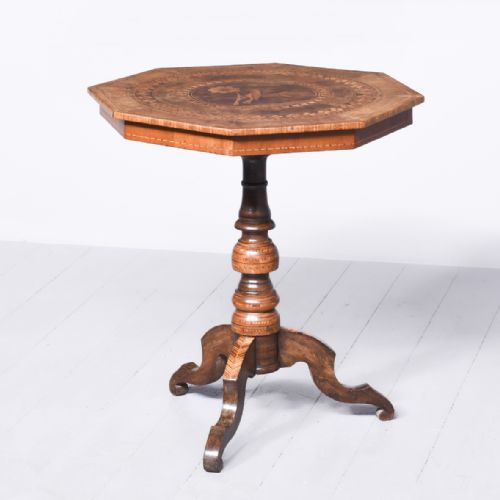
The materials visible across these pieces include walnut, fruitwood, and ebonised wood paired with extensive specimen marble and olive wood. Styles range from Victorian Italian and Grand Regency to specific Sorrento ware designs from the eighteen seventies and nineteen twenties. Centre tables and lamp tables dominate the selection, often resting on carved or turned supports.
Materials and Technique
The construction of these tables relies on combining solid timber structures with precise surface decoration. Craftsmen utilised walnut, olive wood, and fruitwood to build the frames and occasional table bases, occasionally incorporating ebonised wood for contrast.
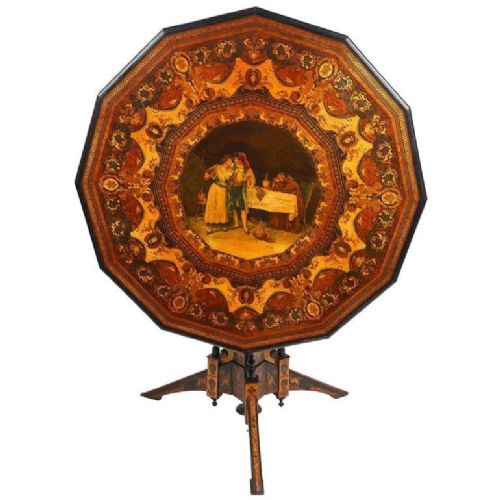
Table tops utilise specimen marble, pietra dura, and scagliola to create pictorial or geometric designs. Artisans inlaid tiny slices of various marbles and coloured stones into a main marble or slate slab, while woodworkers applied complex marquetry veneers in floral and architectural motifs.
Listings feature nineteen-century pieces alongside examples from the Regency, Victorian, and Edwardian periods, constructed in walnut, marble, and olive wood.
Quality Variations
The standard of a grand tour inlaid table depends heavily on the precision of the stone cutting and the complexity of the wood marquetry. Superior examples display tightly fitted mineral specimens with minimal visible cement, whereas simpler items show wider grout lines between individual stone segments.
Almerico Gargiulo
The Grand Tour Inlaid Table Glossary
- Specimen Marble
- A tabletop composed of many different types of marble and hardstones arranged in geometric or pictorial patterns. Each individual piece of stone is shaped and fitted by hand.
- Pietra Dura
- An artistic technique using cut and fitted highly-polished coloured stones to create images. It translates from the Italian as hard stone.
- Sorrento Ware
- Wooden decorative items and furniture produced in the Italian town of Sorrento, characteristically decorated with intricate micro-marquetry and banding. This style gained immense popularity during the Victorian era.
- Scagliola
- A composite substance made from selenite, glue, and pigments, used to imitate inlay in marble and other hard stones. Craftsmen apply it to replicate costly stone work with exact precision.
- Marquetry
- The art and craft of applying pieces of veneer to a structure to form decorative patterns and pictures. Makers utilise various coloured woods to achieve tonal gradation without paint.
Grand Tour Inlaid Table: Frequently Asked Questions
Where were these tables made?
Most of these pieces originated in Italian workshops, particularly in Florence and the coastal town of Sorrento. Artisans produced them to cater to affluent British travellers undertaking the traditional grand tour across Europe.
Workshop production focused heavily on local materials, combining native olive wood and walnut with imported marbles gathered from historical sites across the continent.
How do I care for a marble top?
Polished stone surfaces require gentle cleaning with a damp cloth and mild neutral soap to preserve the original gloss. Avoid acidic liquids and harsh commercial cleaners that etch or dull marble and scagliola.
Use coasters and felt pads beneath decorative objects to prevent scratching the delicate stone or inlaid wooden veneers during daily use.
What is the difference between pietra dura and specimen marble?
Pietra dura involves precisely cut hardstones assembled specifically to form pictorial representations like birds, flowers, or architectural views. The individual stones fit together flush to create a seamless artistic panel.
Specimen marble arrangements often focus on geometric tiles, starbursts, or systematic displays of numerous geological samples gathered from different regions.
How do I distinguish nineteenth century pieces?
Nineteenth century examples generally exhibit hand-cut stone specimens and traditional joinery methods suited to walnut or ebonised wood frames. Examination of the underside often reveals the structural methods of the period.
Signatures or stamps from specific Sorrento workshops occasionally appear on the woodwork, providing direct evidence of the origin and production era.