



Gothic Revival Drawers
Gothic revival drawers bring medieval form and heavy timber into nineteenth-century rooms, offering storage rooted in architectural design.
Gothic Revival Drawers
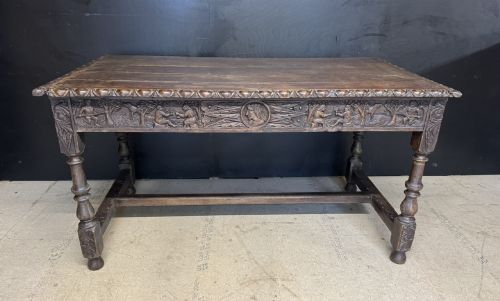
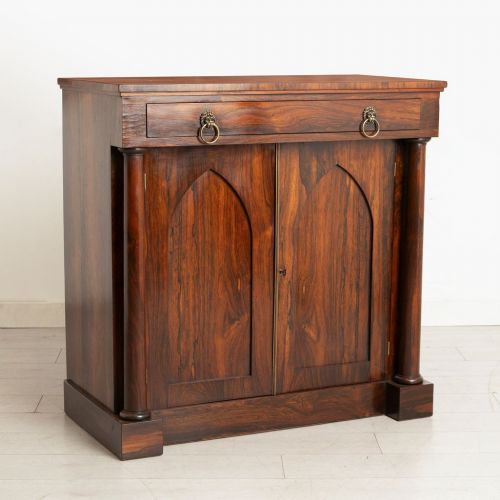
These pieces encompass chest of drawers, desks, and cupboards shaped by nineteenth-century tastes for medieval architecture, linenfold panels, and carved grotesque details.
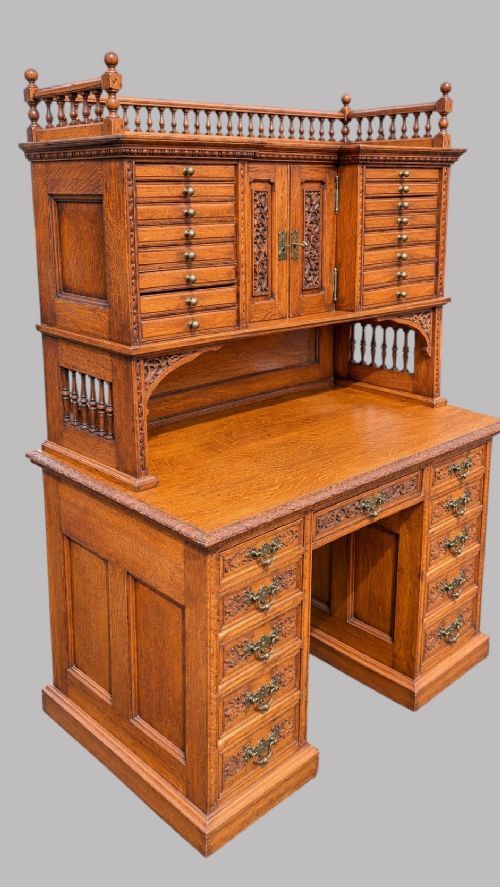
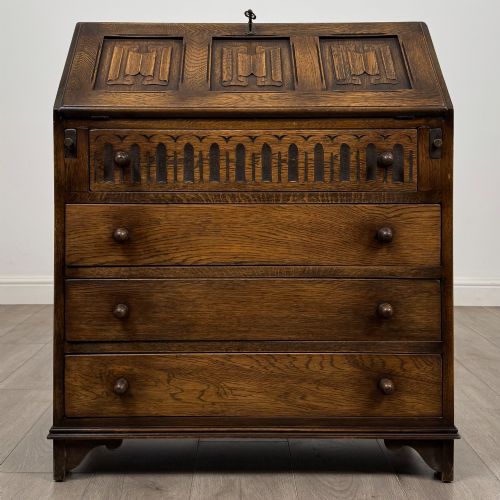
The oak kneehole desk, the carved linenfold bureau, and the bedside chest of drawers form the core of what appears in this selection.
Victorian and Edwardian periods dominate the origins, alongside pieces drawing on Tudor and Renaissance revival influences.
Materials and construction
Solid oak and mahogany provide the structural foundation for the heavy carving, linenfold panels, and architectural mouldings seen across these items.
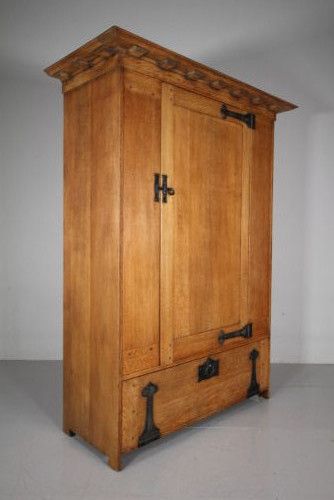
Brass fittings and wrought iron hardware fasten doors and drawers, while glass panels appear in bookcases and glazed upper sections.
Makers utilised multi-wood construction in specific transitional designs, pairing darker timbers with carved relief motifs.
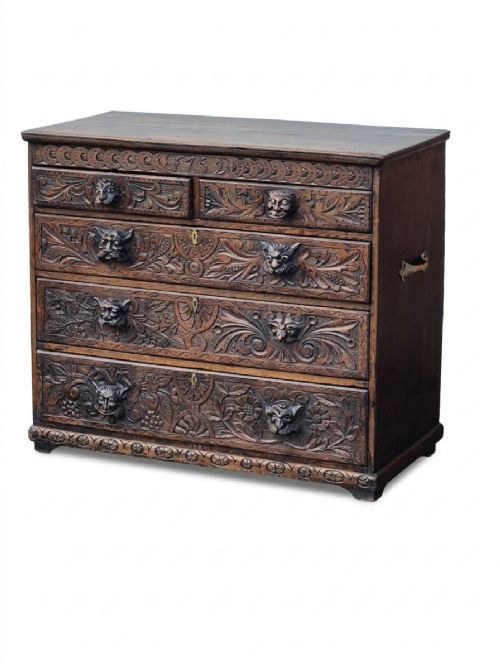
Several pieces stare back with carved Green Man foliage masks hiding in the woodwork.
Judging quality
Depth and crispness of the carved ornamentation separate standard production from superior cabinet work, particularly in figures like the Green Man and linenfold panels.
The choice of dense, well-figured oak or rosewood influences the overall weight and presence of the furniture, alongside the integrity of the original brass and iron mounts.
Heals St. Ives·Phillips Bristol
The Gothic Revival Drawers Glossary
- Linenfold
- A style of wood carving that imitates folded parchment or linen, frequently seen on panels of bureaus and cupboards. This technique adds texture to flat wooden surfaces.
- Green Man
- A sculptural motif depicting a human face carved with leaves, branches, or vines sprouting from the mouth. It appears frequently on nineteenth-century carved oak furniture.
- Kneehole desk
- A compact writing table featuring a central recess for the legs, flanked by pedestals containing banks of drawers. These pieces often incorporate heavy panel detailing.
- Chiffonier
- A low sideboard or cabinet featuring drawers and shelves, developed during the Regency and Victorian periods for dining rooms and drawing rooms.
Gothic Revival Drawers: Frequently Asked Questions
How do I date gothic revival drawers?
Dating relies on timber selection, construction methods, and stylistic cues such as hardware and secondary woods. Pieces from the nineteenth century often show hand-cut dovetails and deep relief carving.
Changes in fastener types and the evolution of revival styles from Regency through to Edwardian periods help narrow the decade of manufacture.
What rooms suit a carved oak desk?
These substantial pieces anchor studies, libraries, or living rooms with strong architectural character. Their dark timbers pair well with neutral walls and leather seating.
Peculiar proportions make them functional as writing surfaces while providing enclosed storage for papers and small items.
Are linenfold panels authentic to the middle ages?
Linenfold panels originated in the late fifteenth century, but the examples found on these chests and bureaus were typically carved during the nineteenth-century revival periods.
Cabinetmakers of the Victorian and Edwardian eras emulated earlier Tudor techniques to satisfy contemporary demands for historicism.
How do I care for antique oak furniture?
Maintain solid oak surfaces by dusting with a dry cloth and applying natural beeswax periodically to nourish the grain. Avoid placing pieces near direct heat sources or strong sunlight.
Stable indoor humidity prevents timber from splitting and keeps nineteenth-century brass fittings secure.