


Gothic Revival Bookshelf
A gothic revival bookshelf brings architectural drama to a room, offering sturdy timber framing and pointed arches for your volumes.

Gothic Revival Bookshelf
A gothic revival bookshelf combines medieval architectural motifs with Victorian domestic utility, creating striking housing for a library. When you search for a gothic revival bookshelf, you encounter pieces designed to evoke cathedrals and castles through pointed arches, tracery, and heavy cornices.
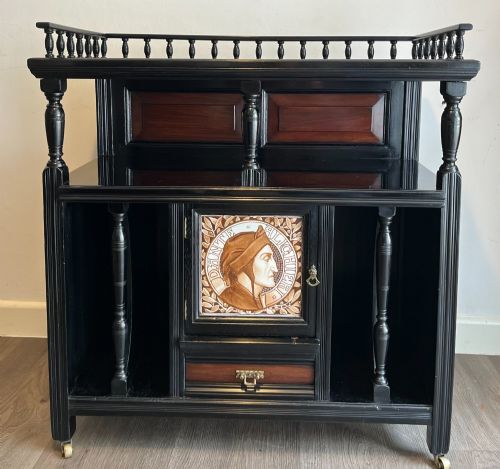
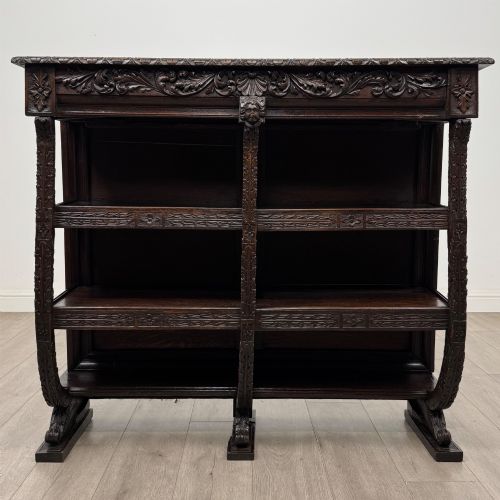
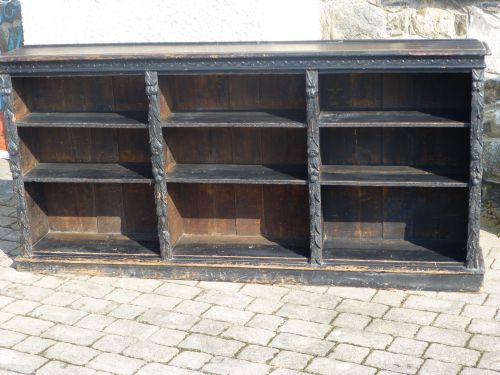
Most examples appearing here belong to the nineteenth century and the Victorian era, spanning open dwarf bookcases, wall shelves, and substantial double bookcases. Solid oak and ebonised wood predominate, often embellished with carved details such as green man masks.
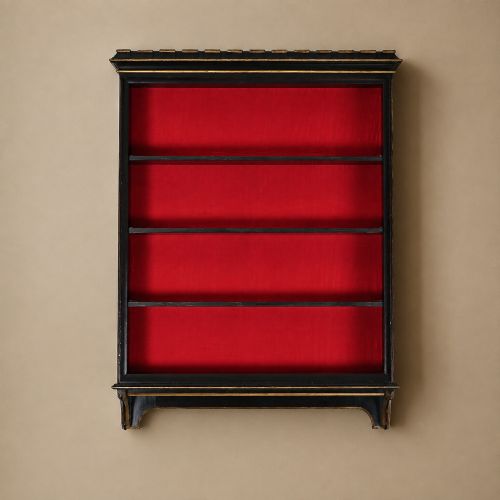
The forms range from compact wall-mounted display shelves to freestanding cupboards with adjustable shelving and glass panels. Makers of the period drew heavily upon historical precedent, producing furniture that suited both modest studies and grand Victorian libraries.
How they were made
Carpenters constructed these bookcases primarily in solid oak, walnut, mahogany, and ebonised timber, selecting woods capable of supporting heavy rows of volumes. Structural integrity relied on traditional joinery, housing adjustable shelves on wooden ratchets or brass pins.
Carving formed a central part of the construction process, with craftsmen hand-chiselling linenfold panels, quatrefoils, and grotesque masks directly into the timber. Surfaces received polish or ebonisation to deepen the grain, sometimes paired with brass hinges and ceramic fittings.
Peering from the woodwork, carved green man masks watch over your daily reading with leafy expressions.
What varies in quality
The depth and crispness of the hand-carving distinguish standard production from exceptional work, particularly on elements like green man faces and tracery panels. Superior pieces exhibit thoughtful proportions where architectural pediments and uprights integrate harmoniously with the storage space.
Material selection dictates longevity, with dense solid oak and well-finished ebonised wood outlasting softer secondary timbers like beech. The presence of original adjustable shelving mechanisms and high-grade brass hardware further elevates the standing of a piece.
George Edmund Street·John Moyr Smith·Pugin
The Gothic Revival Bookshelf Glossary
- Gothic Revival
- An architectural and decorative style drawing inspiration from medieval design, characterised by pointed arches, buttresses, and ecclesiastical motifs. This movement revived twelfth to sixteenth-century forms for nineteenth-century domestic interiors.
- Ebonised Wood
- Timber treated with chemical stains or dark paint to imitate expensive ebony wood. Victorian cabinet makers frequently utilised this technique to achieve stark, dramatic contrasts.
- Green Man
- A sculptural motif depicting a human face disgorging foliage, symbolising rebirth. It appears frequently as a carved detail on nineteenth-century furniture.
- Tracery
- Openwork stonework patterning translated into woodwork, forming decorative intersecting ribs in windows and panel openings. It defines the skeletal framing of gothic furniture.
- Dwarf Bookcase
- A low bookcase standing beneath waist height, designed to keep books within easy reach while leaving wall space above clear for pictures.
Gothic Revival Bookshelf: Frequently Asked Questions
How do I date a gothic revival bookshelf?
Examine the secondary woods, construction joints, and stylistic cues within the carving. Pieces carrying specific nineteenth-century dates or Victorian hallmarks often align with the height of the revival movement.
Look closely at the hardware, such as brass fittings and shelf adjustment mechanisms, which shifted in manufacture style across the decades from the eighteen-seventies onward.
Are these bookcases suitable for heavy books?
Solid oak and mahogany construction provides the structural rigidity necessary to support rows of dense volumes without sagging over time. Adjustable shelving systems allow you to configure shelf heights for folios and smaller octavos alike.
Check the thickness of the timber shelves and the condition of the internal supports before loading them with a heavy library collection.
How do I care for ebonised wood?
Maintain ebonised surfaces by dusting with a soft, dry cloth to prevent abrasion to the dark finish. Avoid placing the wood in direct sunlight or near heat sources, which can cause the dark stain to fade or the timber to split.
Apply a microcrystalline wax sparingly if the surface requires nourishment, avoiding silicone-based polishes that build up a hazy film.
Where should I place a wall shelf?
Wall-mounted versions require secure fixing into solid masonry or direct wall studs to bear the weight of books and display items safely. Hang them at a height where the carved pediments and decorative brackets can be viewed comfortably from eye level.
Pair a wall shelf above a low dwarf bookcase to create a cohesive vertical library display within a study or sitting room.