
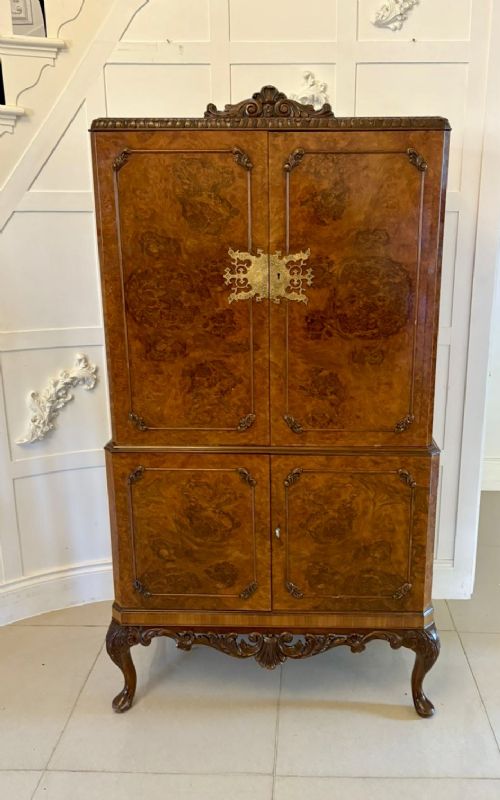

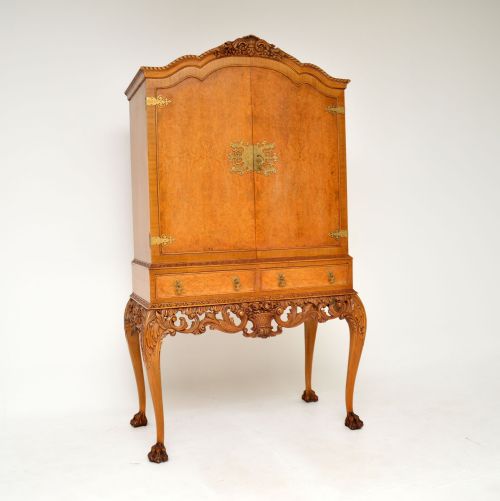
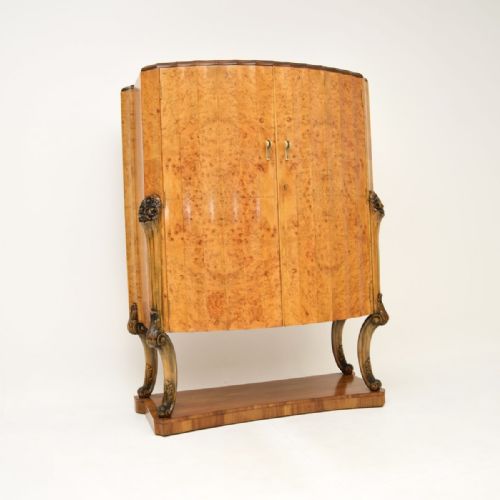


Golden Walnut Bar Cabinet
A golden walnut bar cabinet brings period elegance and serious presence to a room, offering a dedicated home for glassware and spirits.
Golden Walnut Bar Cabinet
A golden walnut bar cabinet serves as a sophisticated drinks or cocktail cabinet, designed to house bottles and barware in style. These pieces emerge from periods such as the Edwardian era, the 1920s, and the 1930s, reflecting shifts in social entertaining.
The most common examples on this page adopt the Art Deco style or draw on earlier forms like the Queen Anne Revival and Georgian Revival. Alongside dedicated cocktail and drinks cabinets, buyers will also encounter related forms such as bookcases and sideboards adapted for similar display purposes.
The aesthetic centres on the natural warmth of the timber, frequently utilising burr walnut veneer to create striking figured patterns across the exterior doors and drop-front surfaces.
Materials and construction
Cabinet makers relied heavily on walnut and burr walnut veneer applied over solid wood carcases, allowing them to showcase the swirling, decorative grain patterns characteristic of the timber. This technique required expert matching of veneer leaves to achieve symmetrical visual effects across the front of the cabinet.
Metal and glass components complete the construction, with brass hardware providing structural contrast and decorative accents. Interior fittings frequently incorporate glass shelving and mirrored backs to enhance the display of glassware, while period details include elements like Bakelite handles.
Listings for this phrase feature pieces primarily from the Edwardian period through to the 1930s, constructed in walnut, burr walnut veneer, and brass.
Distinguishing quality in walnut cabinets
The visual impact of the cabinet depends largely on the choice and handling of the burr walnut veneer, where superior examples display rich, highly figured grain patterns carefully balanced across the doors. The skill of the maker dictates how cleanly these veneers meet at the seams and edges.
Attribution to notable workshops elevates a piece, as demonstrated by cabinet work associated with makers like Epstein. Furthermore, the integration of internal lighting, mirrored surfaces, and purpose-built pull-out mixing slides separates standard storage from exceptional cocktail furniture.
Epstein·Harry and Lou Epstein
The Golden Walnut Bar Cabinet Glossary
- Burr walnut veneer
- A thin slice of wood taken from a walnut tree growth or burr, prized for its swirling, knotted grain pattern. It is applied to a stable timber base to create decorative furniture surfaces.
- Art Deco
- A design style popular in the 1920s and 1930s, characterised by sleek geometric shapes, stylised motifs, and modern glamour. It heavily influences the lines of many vintage cocktail cabinets.
- Queen Anne Revival
- A style of furniture popular in the early twentieth century that reinterprets eighteenth-century English forms, often featuring cabriole legs and pad feet. Pieces in this style bring a traditional silhouette to walnut drinks furniture.
- Bakelite
- An early form of synthetic plastic developed in the early twentieth century, frequently utilised for cabinet handles, knobs, and interior decorative elements in Art Deco pieces.
- Drop-front
- A hinged panel that opens downward to create a horizontal surface for mixing drinks or serving beverages. This feature is central to the design of many period cocktail cabinets.
Golden Walnut Bar Cabinet: Frequently Asked Questions
How do I identify an Art Deco cabinet?
Art Deco cabinets typically feature clean geometric lines, bold proportions, and symmetrical burr walnut veneer patterns. They often dispense with traditional ornamentation in favour of streamlined silhouettes and contrasting materials like brass or Bakelite.
Pieces from this movement frequently date to the 1930s and emphasise modern luxury.
How do I care for walnut furniture?
Walnut furniture benefits from being kept out of direct sunlight to prevent the timber and veneer from fading or drying out. Regular dusting with a soft, dry cloth maintains the finish without the need for heavy chemical polishes.
Maintaining a stable room temperature and humidity level protects the underlying veneer from lifting.
What is the difference between a drinks cabinet and a bookcase?
While both share tall wooden cabinetry forms, a drinks cabinet is internally configured for bottle storage, glassware display, and often includes a pull-out mixing surface. Bookcases feature open shelving designed strictly for holding books.
Some revival pieces blur these lines by adapting bookcase frames into multipurpose walnut cabinets.