
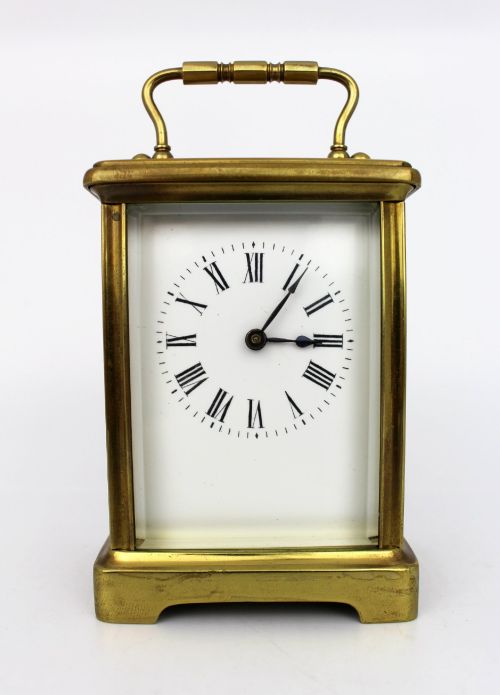


Gold Tone Desk Clock
A gold tone desk clock brings functional elegance to any writing surface, offering heavy brass frames, delicate glass panels, and reliable movements.
Gold Tone Desk Clock
A gold tone desk clock represents a practical timepiece designed for portable use or desktop placement, combining polished metal housings with visible dials. When exploring a gold tone desk clock, you encounter variations spanning the Victorian era through the mid-twentieth century, including carriage clocks and novelty shapes.
The selections on this page draw heavily from French workshops of the nineteenth century alongside later British retail pieces. Miniature formats and travel versions with original cases appear frequently, showing how these objects were built for movement as well as stationary display.
Materials and construction
Gilt brass and gilt metal form the primary structural housings for these timepieces, often heavily engraved or cast with architectural motifs. Glass panels enclose the movements, allowing a clear view of the escapement and gear trains from multiple angles.
Movements rely on precision brass and steel components, frequently featuring Swiss or French engineering with eight-day capabilities. Leather often appears in fitted travel cases designed to protect the metal casing during journeys.
Gold Tone Desk Clock Retail Price Guide 2026
Typical asking prices for gold tone desk clock among the pieces listed under this phrase on Sellingantiques today, from the lower quarter to the upper quarter. They describe what is for sale here now, not the wider market.
The listings demonstrate a strong representation of nineteenth-century French carriage clocks alongside Edwardian and mid-century Swiss timepieces.
Judging quality and craftsmanship
Quality reveals itself in the crispness of the gilt brass engraving and the depth of the hand-chiselled decoration on the case. Superior examples feature fully engraved gorge or corniche frames where every surface receives decorative attention.
The presence of original cases and specialised complications such as alarm mechanisms or repeater functions elevate a piece significantly. Finer movements demonstrate superior finishing on the internal plates and reliable striking trains.
Antoine Redier·Henry Jacot·Penlington and Batty
The Gold Tone Desk Clock Glossary
- Carriage clock
- A portable spring-driven timepiece designed for travel, typically featuring a rectangular brass case with glass panels and a swinging handle on top. They originated in France during the nineteenth century.
- Gorge case
- A specific style of carriage clock housing characterised by a stepped, tiered top and base moulding. This design is commonly found on higher-quality nineteenth-century French pieces.
- Repeater
- A mechanical complication that strikes the hours and quarters on demand when a button or lever is pressed. This feature required advanced watchmaking skill.
- Escapement
- The internal mechanism that controls the release of power to regulate the movement of the clock. Swiss and French movements utilise various configurations to maintain accuracy.
Gold Tone Desk Clock: Frequently Asked Questions
How do I wind a carriage clock?
Most mechanical desk clocks use a dedicated winding key inserted into arbours on the back plate. Turn the key gently until you feel resistance, taking care not to overwind the mainspring.
Different arbours control the timekeeping train and any subsidiary striking or alarm functions. Ensure you support the clock securely while operating the key.
What is a repeater mechanism?
A repeater mechanism allows the clock to sound the time audibly upon pressing a button on the case. This was particularly useful during the night before electric lighting was common.
Advanced models strike both hours and quarters using tiny internal gongs. This added complexity distinguishes finer pieces from standard time-only versions.
Why do some clocks have glass panels?
Bevelled glass panels protect the delicate internal movement from dust while allowing light to illuminate the escapement. This design let owners admire the moving balance wheel and gears during operation.
In carriage clocks, four glass windows surround the movement to provide a complete view. The top panel often displays the escapement directly.
How can I tell the age of a clock?
Dating relies on stylistic details of the brass case, the shape of the handle, and the engraving technique. Victorian and Edwardian pieces often exhibit distinct casting patterns and case signatures.
Maker marks stamped on the movement back plate provide definitive clues to origin and period. Comparing the escapement type also helps narrow down the manufacturing decade.