
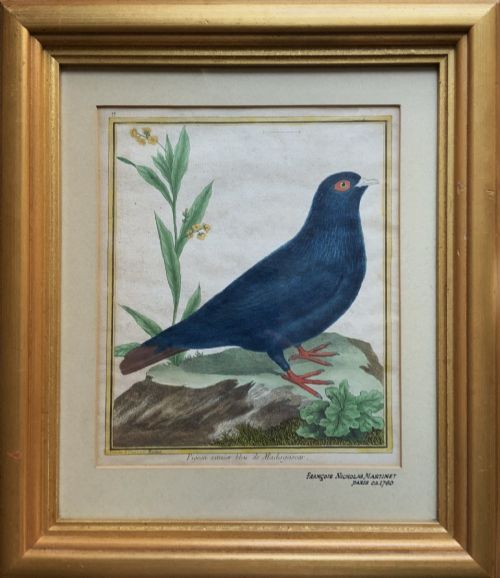


Gold Framed Bird Illustrations
Gold framed bird illustrations combine natural history observation with decorative wall art, offering collectors detailed avian subjects mounted in gilt wood.
Gold Framed Bird Illustrations
These gold framed bird illustrations encompass framed prints, wall art, and watercolour paintings depicting avian subjects across the Georgian, Regency, and Victorian periods. Buyers examining this category encounter works ranging from hand-coloured pigeon engravings to botanical and ornithological watercolours.
The assortment on this page draws heavily from nineteenth-century natural history and British naturalism, alongside eighteenth-century works. Examples feature specific species such as parrots, finches, tragopans, and macaws rendered through engraving, lithography, and watercolour.
Many of these pieces arrive as sets or pairs, particularly the bird engravings by William Swainson and George Edwards. Single sheets and large prints also appear, framed behind glass in gilt and gold leaf wooden mouldings.
Materials and technique
Makers utilised paper as the primary support for these watercolours, engravings, and lithographs, applying hand-colouring to delineate plumage and botanical details. Printmaking techniques combined etching and engraving or lithographic transfer before artists added pigment by hand.
Framing relied upon wood finished with gold leaf, gilt, or gilded wood to enclose the paper works behind glass. These gilt frames provide the characteristic metallic border that defines the visual presentation of the artworks.
Mother Faux’s Macaw peers out from Farnley Hall across the centuries.
Assessing quality
Quality rests upon the precision of the initial print line or brushwork and the vibrancy of the hand-applied colour. Works by recorded ornithological artists display superior anatomical accuracy in the depiction of feathers and posture compared to anonymous output.
The condition of the paper support and the originality of the gilt wood framing dictate the standing of an individual piece. Period frames that retain their original gold leaf finish enhance the overall integrity of the object.
François-Nicolas Martinet·William Andrews Nesfield·Harry Bright·George Edwards·William Swainson·Edward Lear
The Gold Framed Bird Illustrations Glossary
- Lithograph
- A print produced by drawing on limestone or a metal plate with a greasy medium so that ink adheres only to the drawn areas. This method allowed for the reproduction of detailed ornithological illustrations in colour.
- Engraving
- A printmaking process where an artist cuts lines directly into a metal plate using a burin. The resulting incisions hold the ink for transfer onto paper under pressure.
- Watercolour
- A painting method where fine pigment is suspended in a water-based solution on paper. These works capture transient tones in natural history subjects.
- Gilt wood
- Timber treated with gold leaf or metallic powder to create a reflective surface. Frames utilise this finish to complement the artwork within.
Gold Framed Bird Illustrations: Frequently Asked Questions
How old are these bird illustrations?
The pieces span from the mid-eighteenth century through the Georgian and Regency eras into the Victorian period and the early twentieth century. Dates depend on the specific print run or the execution of the watercolour.
Specific makers and publication dates are frequently recorded on the mount or within the engraving text, helping to establish the precise decade of origin.
Are these hand coloured prints?
Several examples feature hand-colouring applied over engraved or lithographic base lines by print workshop artists. This technique ensured accurate hues for feathers and botanical surroundings.
Watercolour paintings in the selection are entirely hand-drawn and painted directly onto paper by artists working in the natural history tradition.
What framing materials were used?
Frames are constructed from wood finished with gold leaf, gilt, or gilded wood. The glazing consists of glass protecting the paper surface from environmental damage.
Many frames retain their period characteristics, matching the nineteenth-century or eighteenth-century origin of the artwork they enclose.
How should I hang them at home?
These framed works suit studies, hallways, and living spaces where natural history collections can be displayed at eye level. Pairs and sets benefit from symmetrical arrangements on the wall.
Keep framed watercolours and prints away from direct sunlight to prevent fading of the paper support and the hand-applied pigments.